
When facing criminal charges in Texas, the evidence presented by the prosecution can feel insurmountable. However, what law enforcement uncovers—or fails to uncover—is often only part of the story. A private investigator can be a crucial asset for your defense, but the pressing question is always: what is the cost to hire a private investigator?
For most criminal defense investigations in the Houston area, you can expect to pay an hourly rate between $50 and $200. Nearly every qualified investigator will also require an upfront retainer before they begin the critical work of building your defense.
Understanding the Financial Side of an Investigation
Facing criminal allegations means making strategic decisions that will impact the rest of your life. This includes how you invest in your defense. Hiring a private investigator is not merely an expense; it is a tactical move to uncover exculpatory evidence, challenge the prosecution’s narrative, and locate witnesses that law enforcement may have overlooked. Understanding the financial commitment is the first step toward empowering your legal team.
The cost structure for a private investigator is not always straightforward. Similar to the cost of a criminal defense lawyer, an investigator’s fees are influenced by several key factors. You will typically encounter one of three payment models, each designed for different types of investigative work essential for a robust criminal defense.
Common Pricing Models
To prepare for this critical investment in your freedom, it is vital to understand the financial landscape. Here is a look at the most common ways private investigators bill for their specialized services.
To provide a clear picture, here is a quick breakdown of the fee structures you will most likely encounter when building your defense team in the Greater Houston area:
Private Investigator Fee Structures at a Glance
| Fee Structure | Typical Rate (U.S.) | Best For |
|---|---|---|
| Hourly Rates | $50 – $200 / hour | Surveillance, locating witnesses, and other unpredictable tasks. |
| Flat Fees | Varies by task | Simple, predictable jobs like background checks or serving papers. |
| Upfront Retainer | $1,000 – $10,000+ | Nearly all cases; acts as a down payment for future hourly work. |
This table illustrates how different investigative needs require different billing methods. The key is to align the fee structure with the specific requirements of your criminal defense strategy to ensure every dollar is spent effectively.
How Each Model Works in Practice
- Hourly Rates: This is the standard model for most criminal defense investigations. It applies to tasks with unpredictable timelines and complexities, such as conducting surveillance on a key individual, tracking down a reluctant alibi witness, or re-interviewing individuals involved in your case. In major metropolitan areas like Houston, expect rates between $50 and $200 per hour, with the national average around $105 per hour.
- Flat Fees: Some tasks are well-defined with a clear beginning and end. For these predictable services—like running a comprehensive background check on a state’s witness or serving legal documents—an investigator may quote a single flat fee.
- Upfront Retainer: This is standard operating procedure in the legal and investigative fields. A retainer is a lump-sum payment made upfront, against which the investigator bills their hourly rates and associated expenses. For a simple case, a retainer might be $1,000, but for complex felony investigations requiring extensive fieldwork, it could easily exceed $10,000. You can find more detail on these 2025 pricing benchmarks on AmericanPrivateInvestigator.com.
A properly funded investigation is one of the most proactive and powerful steps you can take to build a formidable defense. The evidence a skilled PI uncovers can introduce reasonable doubt, corroborate your alibi, or expose critical flaws in the prosecution’s case, fundamentally altering the trajectory of your legal battle.
Planning for this investment is an essential part of mounting a serious legal defense. Before retaining an investigator, it is imperative to have a transparent discussion about all potential costs.
Navigating Investigator Fee Models
When you are ready to add a private investigator to your defense team, the first step is to deconstruct their fee structure.
Think of it like commissioning a specialized service: you select specific actions tailored to your case’s needs, not a generic package.
Whether you need a quick background check on a witness or a multi-day surveillance operation, investigators typically use three billing methods:
- Hourly Rates
- Flat Fees
- Upfront Retainers
Understanding which model best suits your legal strategy helps you budget effectively and avoid unforeseen expenses that could hinder your defense.
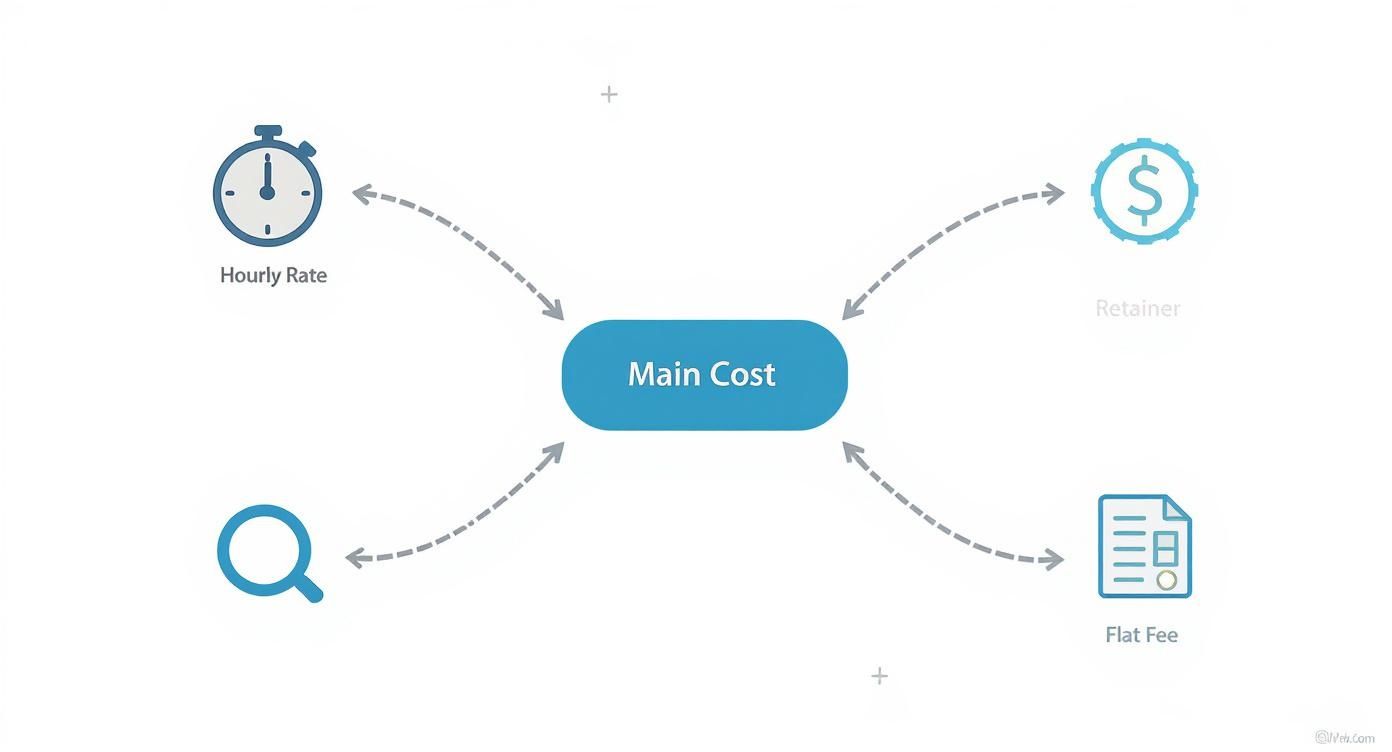
The infographic above illustrates how each payment model aligns with specific investigative needs. Next, we will delve into each one in greater detail.
Hourly Billing: The Pay-As-You-Go Option
Hourly billing is essential when the scope of work is fluid and unpredictable—such as tracking a subject’s movements across Harris County or meticulously analyzing complex case files. Rates typically range from $50 to $200 per hour, influenced by:
- The investigator’s level of experience, particularly in criminal cases
- Your geographic location (e.g., Houston vs. a rural area)
This model provides necessary flexibility. However, establishing clear guidelines for time-tracking and communication upfront is crucial to prevent budget overruns.
Flat Fees For Predictable Tasks
When a task is straightforward and its scope is clearly defined—serving subpoenas, retrieving public records from the courthouse, or conducting a standard background check—a flat fee is often the best approach.
- You agree on a single, all-inclusive price for a specific task.
- There are no surprise hourly overages.
- It is ideal for discrete, one-off assignments that are unlikely to expand in complexity.
Flat fees provide absolute cost certainty from the outset, allowing for precise budget allocation within your overall defense fund.
The Upfront Retainer: A Universal Requirement
The vast majority of reputable investigators require a retainer before commencing any work. This should be viewed as a deposit on future services, often ranging from $1,000 to $5,000 for initial case work.
- The retainer funds are placed in a trust account and are billed against as the investigator accrues hours and expenses.
- It formally secures the investigator’s availability for your case.
- You may be required to replenish the retainer if the investigation extends beyond the initial scope.
For a deeper understanding of when retaining a private investigator is a critical move for your case, review this guide.
What Factors Drive Up Investigation Costs
The final invoice from a private investigator is rarely just a simple calculation of hours worked. Several critical variables can significantly increase an initial estimate, and understanding these cost drivers is essential for anyone facing criminal charges. Knowing what you are paying for allows you to budget strategically and recognize the immense value behind the investment.
An investigator’s background, for example, is a primary factor. A seasoned PI with a background in law enforcement or specialized expertise in digital forensics will command a higher rate than a generalist. You are not just paying for their time; you are investing in their deep knowledge, their network of contacts, and their ability to navigate the complex legal landscape of Texas criminal procedure without making errors that could jeopardize your case.
The Complexity of Your Case
The single most significant factor influencing the cost to hire a private investigator is the nature of your criminal case. Not all investigations are created equal, and the required resources can differ dramatically.
- Simple vs. Complex Tasks: A basic task, like locating a cooperative witness with a known last address, is relatively inexpensive. In contrast, a complex financial crimes investigation that requires forensic accounting, data analysis, and uncovering shell corporations is far more intensive—and consequently, more costly.
- Surveillance Needs: Surveillance is one of the most labor-intensive services an investigator provides. A case requiring multiple investigators to conduct 24/7 monitoring—a common need in high-stakes drug or conspiracy cases—will dramatically increase costs, especially if it spans several days or weeks. To see how this compares to official police methods, you can learn more about how police gather evidence through surveillance.
Simply put, the more intricate and challenging the investigation, the more time, skill, and resources it will demand. All of these factors will be reflected in the final cost.
Geography and Logistical Demands
Where the investigation occurs is critically important. An inquiry limited to a single neighborhood in Houston is one matter; a case that requires travel across Texas or even state lines introduces new layers of complexity and expense. Travel time, mileage, accommodations, and other logistical costs are all billed directly to the client.
The variability in costs can make budgeting for investigative services challenging, especially when cases involve cross-jurisdictional elements, which can increase costs by 25–50% due to added travel, licensing, and compliance requirements.
Furthermore, many investigations require specialized equipment. This can range from high-powered lenses for discreet surveillance to sophisticated software for recovering deleted data from electronic devices. The cost of deploying this advanced technology is often passed on to the client, adding another layer to the overall expense. Recognizing these factors is crucial for anticipating the true financial scope of strengthening your defense.
Uncovering Hidden Fees and Additional Charges
The hourly rate or flat fee quoted by a private investigator is only the starting point. To truly understand the cost to hire a private investigator, you must look beyond the initial number and account for the ancillary expenses that arise during the course of an investigation.
These are not “hidden” fees in a deceptive sense. A professional PI is not trying to mislead you. They are the necessary operational costs required to conduct a thorough and effective investigation. However, if you fail to discuss them in advance, the final invoice can be a significant shock, potentially straining your financial resources at the most critical time.

What Are These Extra Charges, Anyway?
Just as a builder bills for materials in addition to labor, a PI must pass on the costs of the tools and resources used to gather evidence for your criminal case. In a sprawling metropolitan area like Greater Houston, these expenses can accumulate quickly.
Let’s examine some of the most common line items you might find on your bill.
Common Additional Investigation Expenses
Below is a table outlining the typical ancillary costs that can appear on a private investigator’s invoice. These are the necessary expenses that support the fieldwork and administrative tasks crucial to building your case.
| Expense Category | Description | Typical Cost Range |
|---|---|---|
| Mileage & Travel | Covers fuel and vehicle wear for travel to surveillance sites, courthouses, or witness interviews. Often billed at the federal mileage rate. | $0.60 – $0.75 per mile |
| Database Access | Fees for using proprietary, professional-grade databases to find people, run background checks, or uncover assets. These aren’t free Google searches. | $50 – $300+ per search |
| Court & Public Records | Costs for retrieving official documents like police reports, court filings, or property deeds from government agencies. | $25 – $100 per document |
| Surveillance Gear | Rental or usage fees for specialized equipment like GPS trackers, covert cameras, or high-powered lenses needed for a specific job. | $75 – $500+ per day/case |
| Report Preparation | The time it takes to compile all findings, organize evidence, and write a professional, court-ready report. Billed at the investigator’s hourly rate. | 1-5+ hours of billable time |
| Court Testimony | If your PI needs to testify, their time for preparation, travel, and waiting at the courthouse is billed hourly. | Standard hourly rate |
Remember, these are estimates. The key is to discuss these potential costs with your investigator before they begin working on your case.
The single most effective way to prevent budget surprises is to demand complete transparency from day one. Any reputable investigator will provide a detailed fee schedule and be willing to explain every potential charge. Their willingness to do so is a strong indicator of their professionalism.
Ultimately, every potential charge should be explicitly detailed in your service agreement or retainer contract. Before you sign anything, review it meticulously. The principles are similar to legal contracts, so it can be beneficial to review guides on reading and understanding a legal retainer agreement to familiarize yourself with the language. Taking this step now ensures every dollar is accounted for later.
Why a Higher Price Can Mean a Stronger Defense
When your liberty is at stake, the urge to find the most affordable option is understandable. But viewing the cost to hire a private investigator as a simple budget line item can be a catastrophic error in judgment. In the high-stakes arena of criminal defense, you unequivocally get what you pay for. Choosing a low-cost investigator is a gamble you cannot afford to take when facing serious charges.
A higher price point is not about an inflated invoice; it can be a direct reflection of extensive experience, superior resources, and a critical understanding of the rules of evidence. A seasoned investigator who has spent years navigating Texas courtrooms and criminal procedure brings a level of strategic insight that a novice cannot match. They know precisely how to gather evidence in a manner that is legally defensible and, most importantly, admissible in court.
The Value of Experience and Admissibility
A bargain-priced investigator might cut corners, perhaps by inadvertently violating privacy laws or mishandling the chain of custody for a piece of evidence. The consequence? The one piece of information that could have proven your innocence is deemed inadmissible by the judge, rendering it completely useless to your defense.
Experienced PIs charge more because they have a demonstrated history of delivering results that withstand legal scrutiny. Their objective is not just to find information—it is to find facts that your attorney can leverage to build a powerful defense strategy. That distinction is paramount and can be the difference between a dismissal and a conviction.
An investigator’s true value is measured by their ability to uncover legally admissible evidence. Their proficiency in navigating complex legal protocols ensures that every fact they discover can be used to strengthen your case and dismantle the prosecution’s narrative.
Investing in Resources and Results
A higher fee also grants access to superior resources. This includes sophisticated surveillance equipment, subscriptions to exclusive professional databases inaccessible to the public, and a network of contacts cultivated over decades in the field. These tools empower a top-tier investigator to unearth details that would otherwise remain hidden, whether it’s locating a key witness who has gone off the grid or analyzing digital forensics.
The private investigation industry is expanding rapidly for a reason. The global market is projected to reach USD 21.1 billion in 2025, a testament to the immense value these professionals provide in legal, corporate, and personal matters. You can read more about these industry growth insights on AmraandElma.com.
This growth underscores a critical point: quality investigative work is in high demand because it is effective. You must think of this cost not as an expense, but as a strategic investment in the best possible outcome for your case.
How Your Attorney Maximizes Your Investigative Budget
Hiring a private investigator independently can be a perilous undertaking. You are navigating a field of potential expenses and legal liabilities, hoping that you are investing your resources wisely. However, there is a far more strategic approach.
Integrating an investigator into your defense strategy through an experienced criminal defense attorney is the single most effective way to control the cost to hire a private investigator and maximize their impact. This crucial step transforms a PI from a mere contractor into a protected, strategic extension of your legal team.
Your attorney serves as the director of the investigation. They are the ones who focus the PI’s efforts exclusively on tasks that are legally relevant and have a high probability of strengthening your defense. This prevents the investigation from veering into costly dead ends or gathering evidence that a judge will later exclude. An attorney ensures the PI is not just active—they are surgically precise and productive.
The Shield of Attorney-Client Privilege
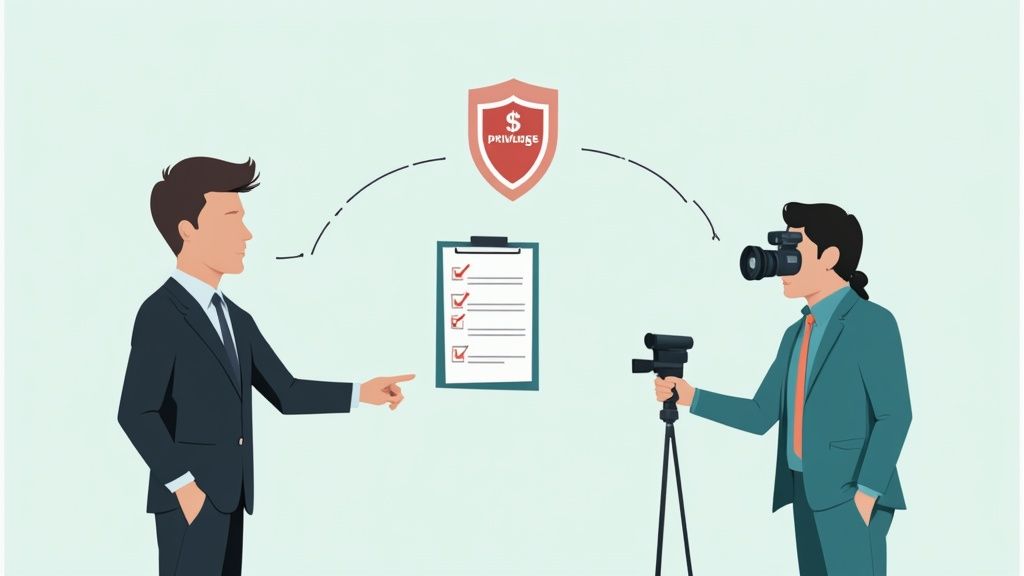
Beyond financial efficiency, routing the investigation through your lawyer provides an indispensable layer of legal protection. When an attorney directs the investigator, their communications, findings, and reports become shielded by the attorney-client privilege and the work-product doctrine.
This legal safeguard is a game-changer. It means the prosecution cannot simply subpoena the investigator’s notes, reports, or testimony to learn about your defense strategy. This vital protection can be completely forfeited if you hire the PI directly, leaving your entire defense vulnerable to discovery by the opposition.
When an investigator operates under the direction of your attorney, their work product becomes a confidential component of your legal defense. This ensures that all information uncovered, whether favorable or unfavorable, remains protected from the prosecution.
Targeted and Cost-Effective Strategies
A skilled attorney does not simply hire a PI and hope for the best; they manage them with a clear legal objective. By applying smart resource allocation optimization tactics, your legal team develops a precise investigative plan, detailing exactly what evidence is needed and why.
This collaborative approach makes the investigation incredibly targeted and efficient. Instead of a broad, open-ended inquiry that quickly depletes your retainer, the PI is assigned specific, mission-critical tasks:
- Locate the missing alibi witness who can place you elsewhere during the alleged crime.
- Identify and document inconsistencies between the police report and physical evidence.
- Conduct surveillance to challenge the credibility of a key prosecution witness.
This focused methodology eliminates wasted hours and maximizes the strategic impact of every dollar you invest. It transforms an investigative expense into a powerful tool for building a formidable, legally sound defense.
Questions We Often Hear About PI Costs
When considering adding a private investigator to your defense team, questions are inevitable. This is a significant decision with your freedom hanging in the balance, so achieving clarity on the financial commitment is not just important—it’s essential.
Here are some of the most common questions individuals facing criminal charges ask about the cost to hire a private investigator. Addressing these points from the outset will empower you to move forward with confidence.
Do I Have to Pay a Private Investigator Upfront?
Yes, it is standard practice for nearly every professional investigator to require an upfront payment known as a retainer. This functions as a down payment for their services, securing their time and providing the necessary funds to begin work on your case immediately.
The investigator will bill their hourly rate and any incurred expenses against this initial retainer. For a relatively straightforward criminal matter, a retainer might begin in the $1,000 to $5,000 range. However, for complex felony charges that require extensive investigation, this amount can be substantially higher. Before any work begins, a signed agreement should clearly outline the retainer amount, the billing process, and the terms for replenishing funds if necessary.
Can a Private Investigator Guarantee a Specific Result?
Absolutely not. If an investigator ever guarantees a specific outcome, you should immediately cease communication and seek a different professional. A reputable PI’s role is not to manufacture a desired result; it is to conduct a thorough, ethical, and impartial investigation to uncover the facts, regardless of what they are.
Their value lies in the integrity of their process and the quality of the evidence they gather, not in promising a particular conclusion. An ethical investigator’s findings are always based in objective reality, which is the only foundation for a credible defense.
Evidence is only valuable if it is obtained legally and can withstand scrutiny in court. This is why hiring a seasoned professional, often through an attorney, is a critical strategic decision.
Is Evidence from a Private Investigator Admissible in Court?
Evidence is only useful if it is legally admissible in a Texas court of law, which is a compelling reason to invest in an experienced PI. They possess a deep understanding of the rules of evidence, criminal procedure, and privacy laws. They know precisely how to gather information without compromising its integrity or violating legal statutes, which is essential to ensure your attorney can effectively use it in court.
When an investigator is retained through your lawyer, an additional layer of professional oversight is established. This attorney-investigator partnership ensures that the PI’s methods are legally sound and that every piece of evidence they find becomes a solid, admissible asset for your defense.
Navigating the complexities of a criminal case requires a strong, strategic defense. The team at David Smith Law Firm, PLLC is dedicated to fighting for your rights and exploring every avenue to achieve the best possible outcome. If you are facing criminal charges and need expert legal guidance, learn more about building your defense at https://www.davidsmith.law.
Discover more from David Smith Law Firm, PLLC
Subscribe to get the latest posts sent to your email.