
When facing a DWI charge in Texas, the first number that often comes to mind is the criminal fine. These are steep, starting at a maximum of $2,000 for a first offense and escalating to a staggering $10,000 for a third offense. However, as a criminal defense attorney in the Greater Houston area, I’ve seen firsthand that these court-ordered fines are merely the tip of the iceberg—the beginning of a potential financial nightmare.
The statutory fine represents only a fraction of what a DWI conviction will truly cost you. The financial fallout extends far beyond the courtroom, and immediate action is paramount to protect your future.
Understanding the Escalating Financial Penalties of a Texas DWI
A DWI charge in Texas is not a one-time financial penalty. It initiates a long and expensive journey that goes well beyond what a judge orders you to pay. Consider the initial fine as the sticker price on a car; the real cost emerges from hidden fees, mandatory surcharges, and long-term expenses that can drain your finances for years to come.
The real financial damage lurks beneath the surface, composed of numerous costs most people never anticipate. A single conviction can trigger a domino effect of expenses that accumulate with alarming speed, making urgent legal counsel essential.
The Immediate and Long-Term Costs
From the moment of arrest, the financial clock starts ticking. These are not just one-off payments; many become recurring bills that create a long-term drain on your resources.
The immediate costs begin instantly:
- Bail and Towing Fees: Your first financial hurdle is securing bail to get out of jail. Simultaneously, your vehicle is likely impounded, and you’ll have to pay fees to retrieve it.
- Court Costs and Legal Fees: The judicial process itself carries administrative court costs. More importantly, retaining an experienced DWI attorney is a critical investment in defending your freedom and your financial future.
- Mandatory Surcharges: Even after your court case concludes, the Texas Department of Public Safety (DPS) will impose annual surcharges on your driver’s license for several years. This alone can add thousands to the total cost.
The infographic below clearly illustrates how the maximum criminal fines increase with each subsequent offense.
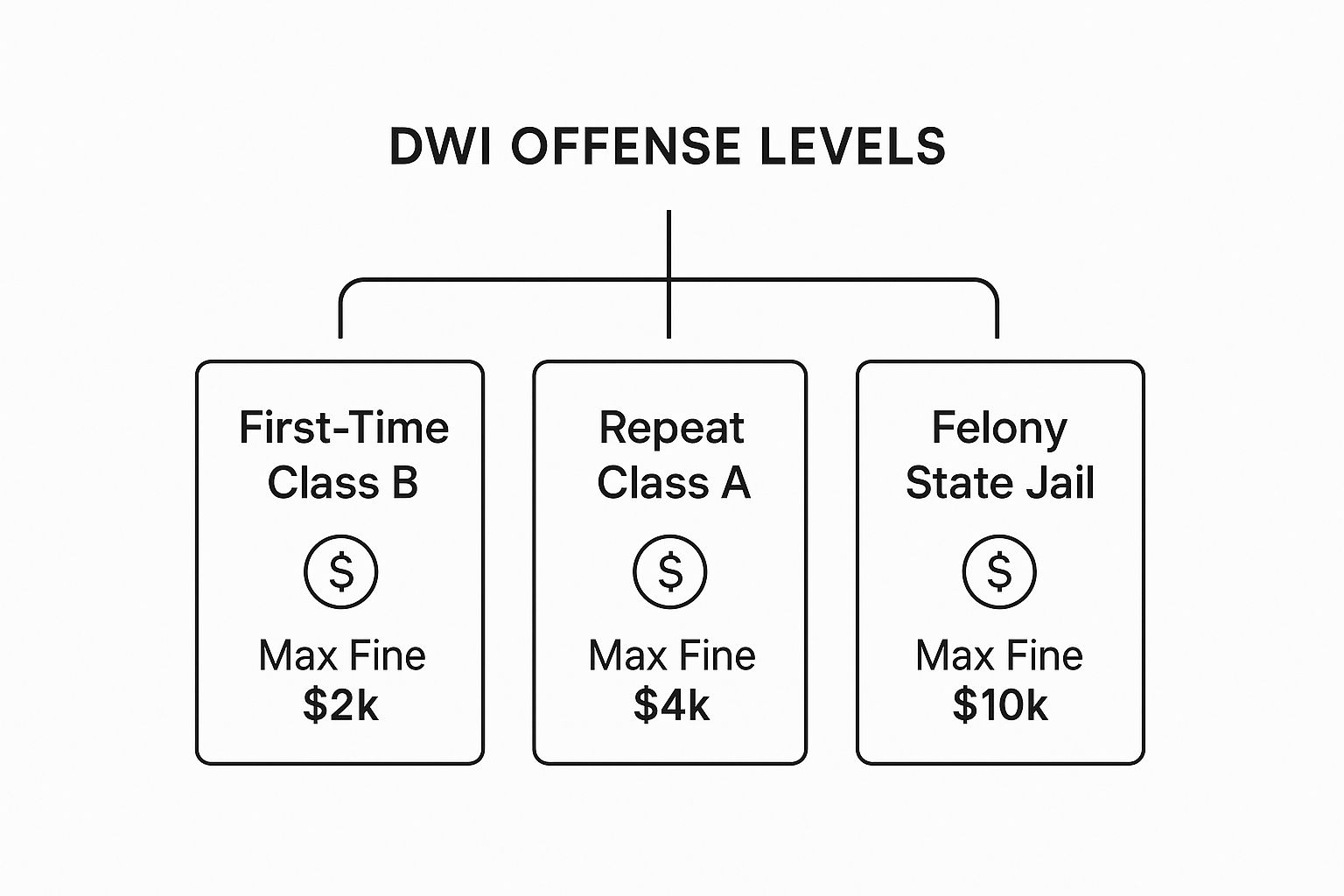
This visual demonstrates the stark progression from a misdemeanor to a felony, with the financial stakes escalating dramatically at each stage. Understanding the full consequences and penalties of a DWI conviction is the first, most critical step in mounting an effective defense.
To provide a clearer snapshot, here is a summary of the statutory fines and potential jail time you could be facing.
Texas DWI Fines and Penalties at a Glance
This table breaks down the maximum criminal fines and corresponding jail sentences for DWI offenses in Texas. It clearly illustrates how the stakes—both financial and personal—increase with each subsequent conviction.
| Offense | Maximum Criminal Fine | Potential Jail Time |
| DWI First Offense | $2,000 | Up to 180 days in jail |
| DWI Second Offense | $4,000 | 30 days to 1 year in jail |
| DWI with Child Passenger | $10,000 | 180 days to 2 years state jail |
| DWI Third or Subsequent Offense | $10,000 | 2 to 10 years in prison |
As you can see, the penalties are designed to be punitive. But even this table fails to capture the full picture of the ancillary costs, which we will now explore.
Texas Penalties Are Among the Nation’s Toughest
Make no mistake: DWI penalties in Texas are some of the most severe in the entire country, and they become exponentially worse for repeat offenders.
A key reason for this severity is that Texas has no “lookback period.” This means a DWI conviction from 5, 10, or even 20 years ago never disappears from your record. It will always be used to enhance the penalties for any future charge. This unforgiving system makes it absolutely essential to mount a strong defense from the very beginning.
First DWI Offense Fines and Penalties
A first-time DWI charge in Texas is a jarring experience, and the financial consequences are immediate. The starting point for a first offense, with no injuries and no child passengers, is a Class B Misdemeanor, which carries a statutory fine of up to $2,000. While that figure is intimidating, it’s merely the tip of the iceberg. The true cost quickly spirals as other mandatory expenses begin to accumulate.
Think of that court-ordered fine as just one piece of a much larger, more complicated financial puzzle. You must understand how different factors can dramatically inflate the total cost, because the circumstances of your arrest—especially your Blood Alcohol Content (BAC)—can change everything in an instant.
When a First Offense Becomes More Severe
Imagine you are driving home after dinner in Houston. You see flashing lights, are pulled over, and a chemical test reveals your BAC is 0.15 or higher. Even for a first offense, this single detail completely changes the legal landscape.
Texas law allows for elevating the charge from a Class B Misdemeanor to a Class A Misdemeanor. This is not a minor administrative change; it doubles the maximum criminal fine you face.
The maximum fine for a Class A Misdemeanor jumps to $4,000. That’s double the penalty, triggered by a single number from a breath or blood test. This demonstrates just how quickly the costs of a first-time DWI can escalate.
This automatic upgrade highlights the state’s aggressive stance on high-BAC cases. Prosecutors in Harris County and surrounding areas pursue these cases vigorously, making a strong legal defense absolutely critical to protect your finances.
The Immediate Out-of-Pocket Costs
Long before a judge mentions a fine, your wallet will already feel the strain. These are the immediate, out-of-pocket expenses required to navigate the first few days.
- Bail or Bond Fees: The very first expense is securing your release from jail. Depending on the county and the specifics of your case, this can range from hundreds to thousands of dollars.
- Vehicle Towing and Impound Fees: While you are being arrested, your car is towed. You are responsible for daily storage fees at the impound lot, and that bill grows every day.
- Attorney Retainer Fees: You should not mount a credible defense without an experienced lawyer. This is a crucial investment to protect your rights and challenge the evidence against you.
These initial costs can easily exceed the maximum fine for a standard first DWI, proving that the statutory penalty is just a fraction of the real financial burden.
Mandatory Programs and Device Installations
As a condition of your bond or as part of probation, the court will likely order you to complete certain programs or install specific devices—and you must pay for all of it.
One of the most common requirements is an Ignition Interlock Device (IID). This device requires you to provide a breath sample before your car will start. It comes with a series of fees:
- An initial installation fee, which could range $65-$200.
- A monthly leasing and monitoring fee. This is roughly $50-$100.
- A final removal fee when the requirement ends.
Additionally, you will almost certainly have to complete a DWI education program. This class is designed to educate offenders on the dangers of intoxicated driving, and you must pay the tuition to enroll and obtain your completion certificate. Each of these requirements adds another layer to the financial burden of a first DWI. Without a proactive defense strategy, these expenses can become overwhelming.
How Fines Escalate for a Second DWI Offense
If a first DWI offense is a wake-up call, a second charge is a five-alarm fire. The financial and personal stakes skyrocket, turning what might have been a serious mistake into potentially a life-altering crisis. A second DWI conviction in Texas places you in a much more severe category with consequences that can derail your life for years.

The statutory penalties immediately demonstrate this serious escalation. A second DWI is typically charged as a Class A Misdemeanor, doubling the maximum criminal fine from a first offense to $4,000. This significant increase signals how the state views repeat offenders. But, as with a first offense, this fine is only the beginning.
The Unforgiving “No Lookback Period” in Texas
One of the harshest realities of Texas DWI law is its “no lookback period.” Many people are caught off guard, assuming an old conviction from their younger years has been forgotten by the legal system. This assumption is dangerously incorrect.
In Texas, a DWI conviction from 5, 15, or even 25 years ago is permanently on your record. It can and likely will be used to enhance the charges for any new offense, regardless of how much time has passed.
This means a DWI final conviction from decades ago is treated the same as one from last year. There is no expiration date, which makes every subsequent charge exponentially more serious and expensive.
This policy guarantees severe penalties for a second offense, with little room for leniency. It is a critical detail that underscores why you need an aggressive defense from the moment you are charged.
Mandatory Jail Time and Its Financial Fallout
Beyond the larger fine, a second DWI conviction brings a greater threat to your freedom and financial stability: mandatory jail time. While a first offense might not always result in jail, a second one carries a required minimum sentence.
The jail sentence for a Class A Misdemeanor ranges from 30 days to a full year. Even a minimum sentence means a month of your life behind bars. This is not just a loss of freedom; it is a direct hit to your finances.
Consider the immediate financial damage of being incarcerated for 30 days or more:
- Lost Wages: An entire month without a paycheck can be devastating, leading to missed rent, mortgage, and car payments.
- Risk of Job Loss: Many employers will not hold a job for someone serving a jail sentence. Losing your job digs an even deeper financial hole.
The conviction itself creates long-term employment problems, but the immediate impact of mandatory jail time can trigger a complete financial collapse.
Snowballing Administrative and Ancillary Costs
The administrative penalties for a second DWI are also far more punishing. Your driver’s license can be suspended for up to two years. This extended suspension creates a new cascade of expenses.
You will have to pay hefty fees to eventually get your license back. The court will almost certainly order an ignition interlock device (IID) for a longer period, meaning you’ll pay those monthly leasing and monitoring fees for a year or more.
Finally, your auto insurance premiums will become crippling. After a second DWI, insurers view you as an extremely high-risk driver. Expect your rates to triple, quadruple, or your policy to be dropped entirely. These costs add thousands more to the total penalty, making a strong legal defense not just an option, but a financial necessity.
Third DWI Offense: The Felony-Level Financial Impact
A third DWI conviction in Texas is not just another charge—it is a terrifying leap across a critical legal threshold. It is no longer a misdemeanor; it is a third-degree felony. This escalation triggers a financial avalanche that permanently alters your economic future.
The statutory fine alone is staggering, with a maximum penalty of up to $10,000. That number is more than double the max for a second offense and five times that of a typical first offense. It is a clear message from the state: repeat DWI offenses will be met with the full force of the law.
But that massive fine is just the opening act.
The Lifelong Burden of a Felony Conviction
The most catastrophic financial consequence of a third DWI is not the fine—it is the lifelong economic prison of being a convicted felon. This status creates permanent barriers that can cripple your earning potential for the rest of your life. A felony on your record is a red flag that follows you everywhere.
Imagine trying to build a career or even find a decent place to live with that mark against you. The challenges are immense.
- Employment Doors Slam Shut: Many employers have strict policies against hiring convicted felons, especially for jobs requiring trust, security clearance, or financial responsibility.
- Professional Licenses Get Revoked: Careers in nursing, real estate, law, and skilled trades often require a state-issued license. A felony conviction can make you ineligible to obtain or keep that license, effectively ending your career.
- Housing Applications Are Denied: Landlords almost always run background checks. A felony conviction can lead to an immediate denial, making it incredibly difficult to find a safe home.
This is not a temporary setback. A felony conviction can permanently change your financial reality.
Skyrocketing Legal and Incarceration Costs
A third DWI charge also carries the potential for 2 to 10 years in a Texas state prison. A lengthy prison sentence means a total loss of income for years, which can plunge a family into financial crisis. Even with probation, the associated costs are far higher than for any misdemeanor.
Furthermore, the legal fees to defend a felony case are different than the fees to defend a misdemeanor case. Felony charges are more complex, involving deeper investigations, expert witnesses, and a more intensive court process. Investing in a powerful legal defense becomes absolutely essential to fight for your freedom.
A third-degree felony DWI is a life-altering event. The financial fallout is not just about paying a fine; it’s about navigating a future where your ability to earn a living, secure housing, and maintain your professional life is permanently compromised.
The stakes are astronomically high. Learning more about the specifics of a third offense DWI in Texas is a critical part of preparing for the fight ahead.
Uncovering the Hidden Financial Drain of a DWI
Most people focus on the court-ordered criminal fine, but that is just the beginning. A DWI conviction in Texas unleashes a financial avalanche, burying you in hidden costs and administrative penalties that can drain your bank account for years. These ancillary expenses often blindside people, quickly adding up to a total that dwarfs the initial fine.
This web of costs is a punitive system designed to have a lasting impact. Understanding these expenses is the only way to grasp the true financial weight of a DWI charge—and why building a strong defense from day one is so critical.
The SR-22 Insurance Nightmare
Other than possible prison for a felony conviction, one of the most brutal and long-lasting financial hits comes from your insurance company. After a DWI conviction, the Texas Department of Public Safety mandates that you file an SR-22 certificate. This is essentially a guarantee from your insurer that you carry the state’s minimum liability coverage.
The SR-22 instantly flags you as a high-risk driver, and the fallout is severe. It is not uncommon to see insurance premiums triple or even quadruple overnight.
Your monthly car insurance bill of $150 could suddenly jump to $450 or more. You’re required to keep that SR-22 on file for two years from your conviction date. That alone can add thousands of dollars to your budget long after the court case is closed.
For a deeper look into the mechanics of this, understanding insurance underwriting sheds light on how insurers assess risk and justify these staggering cost increases.
A Barrage of Mandatory Fees and Costs
On top of the insurance nightmare, a DWI conviction triggers a laundry list of other fees you have no choice but to pay. These costs add layer after layer to your financial burden.
- Probation Supervision Fees: If you receive probation, you will pay a monthly “supervision fee” to the county, typically from $60 to $100 per month.
- Court Administrative Costs: Separate from your criminal fine, every case includes administrative fees to cover the court’s processing costs, which can add several hundred dollars.
- Mandatory Alcohol Assessments and Classes: The court will order a substance abuse evaluation, which you pay for, along with any required DWI education programs.
- Ignition Interlock Device (IID) Lease: If the court orders an IID, you cover the entire bill, including installation, monthly leasing and calibration fees (often over $100 per month), and removal.
These are mandatory. Failure to pay can result in a probation violation and potential jail time.
The Ripple Effect of a Suspended License
Losing your driver’s license creates its own financial chaos, forcing you to find other, often expensive, ways to get to work, school, and other essential places.
The costs pile up quickly:
- Rideshare and Public Transit: Relying on services like Uber or public transit becomes a significant daily expense.
- Occupational License Fees: You may qualify for an occupational license to drive to essential locations, but you must first pay court fees and filing fees with the DPS.
- License Reinstatement Fees: When your suspension is over, you must pay a series of reinstatement fees to the Texas DPS, which can total hundreds of dollars.
The state’s tough stance is fueled by tragic statistics. The financial penalties are just one part of a system designed to be harsh, making an immediate and robust legal defense an absolute necessity.
Why an Immediate Defense Is Crucial for Your Financial Future
After reviewing the avalanche of fines and hidden costs, one fact becomes clear: waiting is the most expensive mistake you can make after a DWI arrest. Viewing a skilled defense attorney as just another expense is a fundamental misunderstanding of what is at stake.
Hiring the right lawyer is not an expense—it is the single most critical investment you can make to protect your financial well-being.
The costs of a conviction create a deep financial hole. An experienced defense attorney’s job is to meticulously challenge every piece of the state’s evidence, from the traffic stop to the chemical test results, to protect you.
Seizing the Opportunity to Mitigate Costs
A proactive defense aims to dismantle the prosecution’s case before it gains momentum. This could mean negotiating a reduction to a lesser offense with smaller fines or fighting for a complete dismissal. A victory in court does not just clear your name; it saves you from thousands of dollars in penalties.
The standard for DWI in Texas has been a blood alcohol concentration (BAC) of 0.08% since the late 1990s. But that number is not the end of the story. An attorney’s role is to scrutinize whether the state can truly prove its case beyond a reasonable doubt.
The Critical 15-Day Deadline You Cannot Afford to Miss
The clock starts ticking the moment you are arrested, and one deadline is non-negotiable. You have only 15 days to request an Administrative License Revocation (ALR) hearing.
This is a small but powerful window of opportunity to challenge the automatic suspension of your driver’s license. Missing this deadline means your license will likely be suspended, creating immediate financial and logistical chaos.
Taking swift, decisive action is the most powerful move you can make. Securing legal counsel right away empowers you to fight back against the charge and its devastating financial consequences. Find out more about why hiring an attorney early makes a difference and see how it can fundamentally change the outcome of your case.
Frequently Asked Questions About DWI Fines
Facing a DWI charge raises many urgent financial questions. Here are straightforward answers to some of the most common inquiries.
Can I Pay DWI Fines in Installments in Texas?
Yes. Texas courts understand that most people cannot pay thousands of dollars at once and typically allow a structured payment plan for court costs and fines.
While this helps ease the immediate burden, you must be disciplined. Missing a single payment can trigger a warrant for your arrest. A good attorney helps negotiate a manageable payment schedule to ensure you do not inadvertently violate your probation terms.
Do I Still Have to Pay Fines if My Case Is Dismissed?
No. If your DWI case is formally dismissed, you are not responsible for the criminal fines. A dismissal means those penalties are wiped away as if the charge never led to a conviction.
However, a dismissal does not erase all costs. You will likely still be responsible for expenses incurred before the dismissal, such as bail bond fees, towing costs, and legal fees. This is precisely why hiring a strong defense attorney is so critical—investing in your defense can save you thousands in fines and years of surcharges.
Are the Fines Different if an Accident Was Involved?
That depends. If a DWI involves a collision, especially one causing injury or property damage, the situation becomes far more serious and expensive. Prosecutors may pursue felony charges like Intoxication Assault or Intoxication Manslaughter. On top of the higher fines, you will likely face:
Restitution. This is money paid directly to victims to cover their losses, such as medical bills, car repairs, and lost wages. It is separate from court fines and can easily climb into the tens or even hundreds of thousands of dollars.
Navigating the maze of DWI fines and hidden costs requires a lawyer who can see the full picture and protect your financial future.
Discover more from David Smith Law Firm, PLLC
Subscribe to get the latest posts sent to your email.