
Being arrested for Driving While Intoxicated (DWI) in the Greater Houston area can feel like the end of the world. But a charge is not a conviction. Winning a DWI case isn’t about a magic bullet; it’s a deliberate process of dismantling the state’s case against you, piece by piece, with the help of a skilled legal professional. However, before you can focus on the criminal charge, you must deal with an immediate and time-sensitive threat: the automatic suspension of your driver’s license.
A critical first step is requesting an Administrative License Revocation (ALR) hearing, and in Texas, you only have 15 days from the date of arrest to do it. Missing this deadline means your license will be suspended automatically, regardless of the outcome of your criminal case. This is a crucial first battle, and winning it requires urgent action.
Your First Moves After a Houston DWI Arrest
The hours following a DWI arrest are a blur of confusion and anxiety. The decisions you make in this critical window are the foundation of your entire defense. Panicking is easy, but shifting to a strategic mindset can fundamentally alter the outcome of your case. Taking the right steps now isn’t just about damage control; it’s about laying the groundwork for a robust defense strategy.
Every detail—from the reason the officer initiated the traffic stop on a Houston roadway to the way they administered sobriety tests—is a potential weak point in the prosecution’s case. An experienced criminal defense attorney knows how to identify and exploit these weaknesses to your advantage.
The Critical 15-Day ALR Deadline
Let’s focus on that first, urgent task. When you are arrested for DWI in Texas and either refuse a chemical test or provide a sample over the legal limit, the officer notifies you your license will be suspensed UNLESS you request a hearing timely. They issue a temporary driving permit, but the clock starts ticking immediately.
You have exactly 15 calendar days from the date of your arrest to formally request an ALR hearing. This hearing is a civil proceeding, entirely separate from your criminal court case in Harris, Fort Bend, or Montgomery County. Its sole purpose is to determine the fate of your driving privileges.
If you fail to request this hearing in time, you forfeit your right to fight the suspension. The state will automatically suspend your license, making it harder to get to work, school, and manage daily life—all before you’ve even had your day in criminal court.
This process demonstrates how a single DWI arrest creates two distinct legal battles that must be fought simultaneously. The image below illustrates the typical flow of a DWI case, from the initial traffic stop to building a defense strategy for the courtroom.
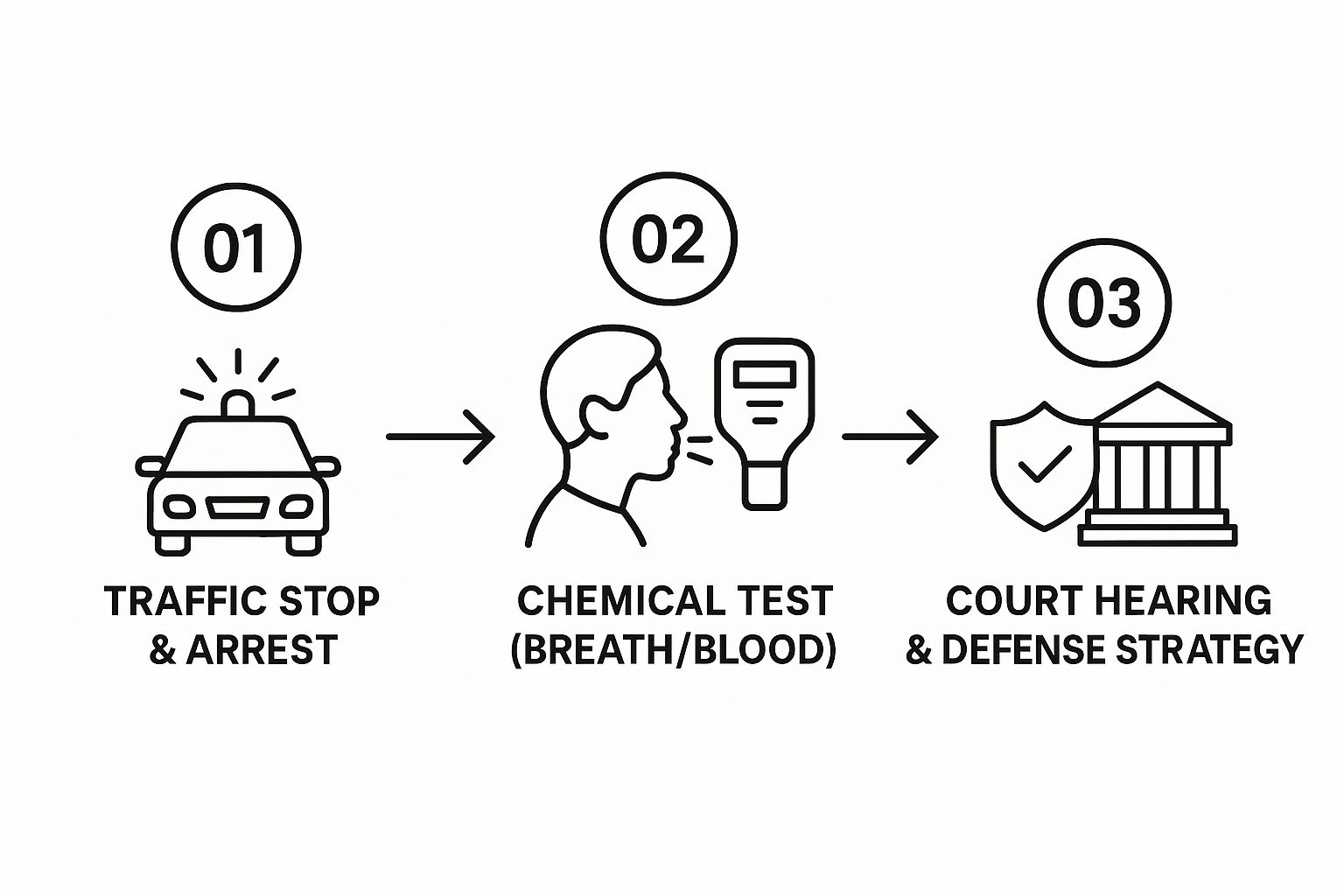
As you can see, every stage presents an opportunity for a skilled defense attorney to intervene, identify weaknesses, and challenge the prosecution’s narrative. The state carries the burden of proving every element of its case, and their evidence is often not as solid as they portray. From procedural errors during the arrest to faulty breathalyzer calibrations, numerous angles exist to challenge the charges.
Here is a table of common weak points a seasoned defense lawyer will investigate in a DWI prosecution.
Common Weaknesses in a DWI Prosecution Case
| Area of Challenge | Potential Defense Angle | Why It Matters |
|---|---|---|
| The Traffic Stop | The officer lacked the necessary reasonable suspicion to initiate the traffic stop. | If the stop was illegal, all evidence gathered as a result (including tests and statements) may be suppressed and ruled inadmissible. |
| Field Sobriety Tests | Improper instructions were given, the tests were conducted in poor conditions (uneven ground, bad lighting), or the client has medical issues affecting performance. | These tests are highly subjective. Demonstrating they were administered incorrectly or are unreliable for you can discredit the officer’s opinion of impairment. |
| Breathalyzer Machine | The machine was not properly calibrated, maintenance logs are missing or incomplete, or the operator was not certified to conduct the test. | The state must prove the machine was functioning perfectly. Any doubt about its accuracy can render the BAC result inadmissible in court. |
| Blood Test Procedure | An improper blood draw technique was used, the chain of custody was broken, or the sample was contaminated. | Strict scientific and legal protocols govern blood tests in Texas. A single procedural error can invalidate the results completely. |
| Officer’s Report | Inconsistencies exist between the written report, bodycam video, and the officer’s potential testimony. | Contradictions undermine the officer’s credibility and can create the reasonable doubt necessary for an acquittal. |
This is not an exhaustive list, but it highlights how many things can go wrong for the prosecution—and how those errors create opportunities for your defense.
Document Everything You Can Remember
While the arrest is still fresh in your mind, write down everything. Your memory is a crucial piece of evidence that will not appear in the police report. Focus on these key details:
- The Traffic Stop: What specific reason did the officer give for pulling you over? What were the road conditions like? Was it raining? Was traffic heavy on the Houston street or freeway?
- Your Interaction: What were the officer’s exact questions? What were your answers? Did they mention smelling alcohol immediately, or did that claim come later?
- Field Sobriety Tests: Where were the tests conducted? Was the ground flat, dry, and well-lit? Did the officer properly demonstrate how to perform each test first?
- Chemical Tests: Did the officer read you your rights regarding the breath or blood test (the Statutory Warning)? Did the person administering the test appear confident and properly trained?
Your personal account can expose critical inconsistencies in the official narrative and highlight procedural mistakes. Knowing the full picture is vital. You can learn more about the complete DWI arrest process and next steps in our guide. An experienced attorney can use these details to begin building a powerful defense from day one, ensuring no stone is left unturned in protecting your rights.
Questioning the Legality of the Traffic Stop

Every DWI case in Texas begins almost always the same way: with flashing lights in your rearview mirror. This initial encounter—the traffic stop—is the foundation upon which the prosecution builds its entire case. If that foundation has a crack, the whole case can crumble.
An officer cannot pull you over based on a hunch or because you were driving late at night in a particular part of Houston. The Fourth Amendment protects you from unreasonable searches and seizures. This means the officer must have reasonable suspicion that you have violated a law. This is a specific legal standard they must meet and be able to articulate and justify in court.
What Is Reasonable Suspicion in Texas?
Reasonable suspicion is more than a gut feeling but less than the proof needed for a conviction. The officer must be able to point to specific, observable facts that led them to believe a traffic violation or other crime was occurring. This is often the first—and most powerful—place to attack a DWI charge.
In Harris County and surrounding areas, officers often rely on a few common justifications:
- Weaving within a lane. This is a classic, but minor drifting while reaching for a coffee is not illegal. To be a valid reason for a stop, the weaving must be pronounced, unsafe, and continuous.
- A minor traffic infraction. Violations like a broken taillight or failing to signal a lane change can be valid reasons for a stop. However, the context matters. Was it a legitimate stop or a pretext to launch a DWI investigation?
- Driving too slowly. While less common, this can be used as a justification. The officer cannot simply say you were going slow; they must show your speed was actually impeding the normal and reasonable flow of traffic.
The officer’s justification for the stop is not the final word. It is a claim that must be tested against the evidence. If the stop was not legally justified, any evidence collected afterward—including field sobriety tests, statements, and even breath or blood test results—can be thrown out of court.
This is what lawyers call the “fruit of the poisonous tree” doctrine. An illegal stop is the “poisonous tree,” and any evidence derived from it is the “fruit,” which becomes inadmissible in court. A successful challenge here can end the case before it truly begins.
Using Video Evidence to Uncover the Truth
Today, the most objective witnesses are often the cameras mounted on an officer’s dashboard and body armor. Dashcam and bodycam footage are not just helpful; they are essential for dissecting the traffic stop. One of the first actions a skilled defense attorney will take is to demand this footage to see if the officer’s written report aligns with reality.
More often than one might think, the video tells a different story. An officer may report “significant weaving,” but the video shows a car barely drifting as the driver changes the radio. They might claim you ran a stop sign, but the footage clearly shows your wheels ceased rotation before the white line. These are not minor details; they can destroy an officer’s credibility and dismantle the entire basis for the stop.
This is not a long-shot strategy; it is a cornerstone of effective DWI defense. In fact, procedural faults are a key reason many cases end favorably.
A solid defense begins with a deep dive into the legality of that initial stop. To better understand what gives law enforcement valid reasons to pull you over, check out our detailed guide on the legal grounds for a traffic stop. Knowing your rights is the first step toward building a strong defense and learning how to beat DUI charges—sometimes before the case even gets off the ground.
Finding Flaws in Sobriety and Chemical Tests
When an officer directs you to perform a Field Sobriety Test (FST) or produces a breathalyzer, the process feels official, scientific, and intimidating. In court, the prosecution will present this evidence as if it’s definitive, infallible proof of intoxication.
The reality? These tests are far from foolproof. They are riddled with procedural requirements that are rarely followed perfectly, vulnerable to human error, and full of subjective interpretations that a skilled defense lawyer can expose.
Challenging this “scientific” evidence is a cornerstone of how to beat DWI charges. A powerful defense scrutinizes every detail—from the exact words an officer used on the side of a dark Houston road to the maintenance logs of a breathalyzer machine at the station. What the state believes is its strongest evidence can often become its biggest weakness.
Deconstructing Field Sobriety Tests
The National Highway Traffic Safety Administration (NHTSA) has only validated three specific standardized field sobriety tests. If an officer asks you to do anything else, such as reciting the alphabet backward or touching your nose, it is not a validated test, and its results are highly questionable in court.
Even the three “standardized” tests are notoriously unreliable and subjective:
- Horizontal Gaze Nystagmus (HGN): The officer looks for involuntary jerking in your eyes as they follow a stimulus. However, dozens of factors can cause nystagmus, including medical conditions, prescription medications, or even fatigue. Officers are trained to attribute it to alcohol, but that is often a significant leap.
- Walk-and-Turn: This test requires you to take nine perfect heel-to-toe steps, pivot exactly as instructed, and walk back nine more. It is a test of balance and memory, and perfectly sober people fail it frequently due to poor lighting, uneven pavement, nervousness, or confusing instructions.
- One-Leg Stand: Balancing on one foot for 30 seconds is challenging for many people on a flat gym floor in broad daylight. On the side of the road at night? Your age, weight, past injuries, and even your footwear can make passing this test nearly impossible.
An officer’s report will dutifully list every tiny “clue” of impairment they observed. But when we obtain the bodycam and dashcam footage, it often tells a completely different story. We frequently see officers giving incorrect instructions, conducting tests on unsafe surfaces, or misinterpreting a simple stumble as a sign of intoxication.
A police report is the officer’s version of events, written to justify the arrest. It is not an objective record. When an officer claims you “failed,” a deep dive into the video and testing conditions is the only way to show a judge or jury why that conclusion is completely unreliable.
Simply taking the officer’s report at face value is a critical mistake. Every instruction, every movement, and every environmental factor must be placed under a microscope to dismantle their opinion.
Uncovering Errors in Breath and Blood Tests
Chemical tests like breathalyzers seem more concrete than FSTs, but they are just as vulnerable to critical errors. Harris County and most of Texas use the Intoxilyzer 9000 breath testing device. Its results are only considered valid if a long list of strict protocols is followed to the letter.
Common areas where we challenge breath test results include:
- Improper Observation Period: Texas law requires the officer to be in your presence continuously for 15 minutes immediately before the test. This is to ensure you do not burp, vomit, or put anything in your mouth that could contaminate the breath sample. Any interruption—even turning their back for a moment—can invalidate the test.
- Operator Error: The officer administering the test must hold a current certification and follow the operational checklist perfectly. Cases have been won because an officer skipped a single, seemingly minor step.
- Machine Malfunctions or Calibration Issues: These are complex machines requiring regular maintenance and calibration. An experienced attorney will subpoena the device’s full service history to look for patterns of error, glitches, or missed inspections.
Blood tests are often called the “gold standard,” but they have their own set of weaknesses. The “chain of custody”—the chronological paper trail documenting everyone who handled the blood sample from the moment of the draw to the moment of testing—must be flawless. Any break in that chain opens the door to arguments about contamination or whether the sample tested was even yours.
Furthermore, medical conditions like acid reflux (GERD) or even a high-protein diet can produce compounds that trick a breathalyzer into giving a falsely high BAC reading. A thorough defense requires digging into your medical history to see if an underlying condition, not alcohol, is the real culprit. To learn more, you can explore the many available breath and blood test defenses that can be used to fight your case.
A number on a machine’s screen is not a conviction. It is a piece of evidence that must be fought, scrutinized, and validated. By exposing the flaws in how these tests were administered, we can undermine the very foundation of the prosecution’s case.
Building Your Proactive Defense Strategy

Simply poking holes in the prosecution’s case is not enough. That is a reactive approach, leaving the State in control of the narrative. A truly effective strategy for how to beat DWI charges is proactive—it involves building your own compelling narrative, backed by your own evidence.
This means moving beyond just questioning the officer’s version of events to constructing a timeline that introduces reasonable doubt. A winning defense does not wait for the prosecution to present its case; it actively gathers evidence to tell your side of the story and create a powerful counter-narrative that a jury can believe.
The Rising BAC Defense
One of the most powerful proactive strategies is the “rising BAC” defense. This is a scientific argument that does not necessarily dispute the chemical test result itself. Instead, it challenges what that number actually means about your intoxication level at the time you were driving.
Here’s a common scenario: you have a drink or two shortly before driving. Your body does not absorb alcohol instantly. It can take anywhere from 30 minutes to over an hour for it to fully enter your bloodstream and reach its peak concentration.
If you are pulled over quickly, but the breath or blood test is not administered until much later at the station, your BAC could have been climbing the entire time. You could have been under the legal limit of 0.08 while driving, but over the limit by the time they finally obtained a sample. An experienced attorney can bring in a toxicologist to map out a timeline—what you ate, what and when you drank—to show a jury that your BAC was on an upward trajectory and likely legal when it mattered most: when you were operating the vehicle.
When Medical Conditions Mimic Intoxication
Many medical issues and prescribed medications have side effects that look nearly identical to the signs of alcohol impairment. A proactive defense always investigates your medical history to determine if an underlying condition could explain what the officer claims to have observed.
- Balance Issues: Vertigo, inner ear problems, or old leg injuries can make it impossible for a completely sober person to pass the walk-and-turn or one-leg stand tests.
- Speech Patterns: Certain neurological conditions, or even the severe anxiety of a traffic stop, can cause slurred speech—a classic but often misinterpreted “clue” of intoxication.
- Eye Conditions: As mentioned, dozens of conditions unrelated to alcohol can cause the nystagmus (involuntary eye jerking) that officers look for in the HGN test.
Presenting medical records and expert testimony gives the jury an alternative, and often more believable, explanation for the officer’s observations. It shifts the entire narrative from “they were drunk” to “they were experiencing a medical symptom.”
Gathering Your Own Evidence
The police report is not an objective document. It is a story written by the arresting officer to justify the arrest. That is why building your own evidence file is so critical to challenging their official version of events.
You cannot rely solely on the evidence the police provide. Your defense team should immediately begin searching for and preserving evidence that supports your case. This may include:
- Witness Statements: Were you with friends or colleagues before driving? Their testimony about what you did (or didn’t) drink can be invaluable.
- Receipts and Timelines: Credit card receipts from a bar or restaurant can establish your timeline, proving when you stopped drinking and bolstering a rising BAC defense.
- Private Surveillance Footage: Retracing your route to look for cameras at businesses, gas stations, or homes can be crucial. Finding video that shows you driving perfectly can directly contradict an officer’s claim that you were weaving all over the road.
A cornerstone of any strong defense involves understanding the burden of proof. This legal standard dictates that the prosecution must prove your guilt beyond a reasonable doubt. Gathering your own evidence is vital—it’s not just about telling your story, but about directly attacking the evidence the state is required to present to meet that high burden.
Ultimately, a proactive defense is multi-faceted and must be tailored to your specific situation. Exploring these angles requires deep legal and scientific knowledge. Reviewing strategies like these 10 common DWI defense strategies in Texas can provide a better sense of what is possible. Attempting to build such a case without an experienced criminal defense attorney is a serious gamble with your future.
Understanding the True Cost of a DWI Conviction
When facing a DWI charge, it is natural to focus on the immediate threats of jail time and court fines. However, to truly understand what is at stake, you must look beyond the courtroom. A DWI conviction is not a one-time punishment; it is the beginning of a long, expensive, and personal ordeal that can follow you for the rest of your life.
The real cost of a DWI in Texas is a brutal combination of a permanent criminal record, a massive financial drain, and a constant roadblock in your personal and professional life. Understanding the full picture makes it clear why mounting a strong legal defense is one of the most important financial and personal decisions you can make.
The Permanent Criminal Record
The most significant consequence is a permanent criminal record. In Texas, a DWI conviction is for life. It generally cannot be expunged or sealed. This means that for the rest of your life, anytime a background check is run—by a potential employer, a landlord, or a professional licensing board—that DWI will be front and center.
- Job Opportunities: Many companies, especially for jobs involving driving or positions of trust, will not hire someone with a DWI. It can be an automatic disqualification.
- Professional Licenses: If you are a nurse, pilot, teacher, or hold any other state-issued professional license, a conviction can trigger a review by your licensing board, potentially leading to suspension or revocation of the license you worked so hard to earn.
- Housing and Loans: Landlords frequently deny rental applications based on criminal records. Lenders might also see a DWI as a sign of poor judgment, making it harder to get approved for a mortgage or a personal loan.
The Hidden Financial Burdens
The fine handed down by the judge is just the tip of the iceberg. The financial fallout from a DWI conviction can easily climb into the tens of thousands of dollars, creating a debt that feels insurmountable.
The costs continue to pile up:
- Court Costs and Fees: These are completely separate from the actual fine.
- Probation Fees: You will pay these every month you are on probation.
- Mandatory DWI Classes: These are not free and are paid out of your own pocket.
- Ignition Interlock Device: Installation and monthly monitoring fees can run into hundreds, sometimes thousands, of dollars over the required period.
The costs after the court case are what truly hurt. These are the long-term penalties that drain your bank account for years, which is why fighting the charge from day one is so critical to your financial future.
This is not a one-time hit; it is a relentless financial strain that will impact your budget for years.
Skyrocketing Insurance Premiums
One of the most immediate and painful financial impacts comes from your auto insurance. After a DWI conviction, insurance companies label you a “high-risk driver,” and your premiums skyrocket. This is not a small bump; it is a massive increase.
On average, insurance premiums can jump by a staggering 71% after a DWI. This means your annual insurance bill could easily double or even triple, and you will likely be stuck paying that inflated rate for the next three to five years. That amounts to thousands of extra dollars you are forced to spend just to legally drive your car.
Beyond the criminal case, a DWI can also lead to devastating civil liabilities for drunk driving accidents, particularly if your case involved a collision. This opens the door to personal injury lawsuits that can be financially catastrophic, completely separate from what happens in criminal court.
Fighting the charge from the very beginning is the only way to protect yourself from this cascade of consequences. A conviction is not just a legal problem—it is a life-altering financial event.
Common Questions in Texas DWI Cases
When you are facing a DWI charge, your mind races with questions. It is a stressful and uncertain time. This section tackles some of the most common concerns we hear from people arrested for DWI in the Houston area, offering straight answers to help you understand what you are up against.
Should I Refuse the Breathalyzer Test in Texas?
This is one of the toughest decisions to make on the side of the road, with immense pressure from law enforcement.
Here is the situation: Texas is an “implied consent” state. This means that by holding a Texas driver’s license, you have already legally agreed to provide a breath or blood sample if an officer lawfully arrests you for DWI. Refusing has immediate consequences.
If you refuse, the state will automatically move to suspend your driver’s license through a separate civil process called an Administrative License Revocation (ALR). This occurs whether you are eventually found guilty of DWI or not. Furthermore, the prosecutor will argue to a jury that your refusal is evidence of guilt.
So why would anyone refuse? Because providing a sample hands the prosecutor their most powerful piece of evidence: a number. A specific blood alcohol concentration (BAC) can feel like a slam dunk to a jury.
By refusing, you deny the state that number. You force them to build their case on more subjective evidence, like the officer’s opinion, your performance on field sobriety tests, and dashcam video. It is a strategic trade-off: you face an automatic license suspension, but you may deprive their criminal case of its strongest evidence.
There is no one-size-fits-all answer. It is a critical decision that hinges on the specific facts of your stop. This is a moment where the immediate guidance of an experienced DWI lawyer can make all the difference.
Can My DWI Charge Be Reduced to Reckless Driving?
Getting a DWI charge reduced to a lesser offense like reckless driving is a potential goal and often an excellent outcome for some people. This is typically achieved through a “plea bargain,” which results from careful negotiation between your defense attorney and the prosecutor.
A prosecutor’s job is to secure convictions. If your lawyer can expose serious holes in their case, they become much more willing to negotiate. Some counties that surround Houston would rather secure a conviction on a lesser charge than risk losing at trial completely. Houston rarely, if ever, offer alternate charges on DWI cases.
What weaknesses convince a prosecutor to make a deal?
- Shaky BAC Results: Perhaps the breathalyzer has a spotty maintenance record, or the chain of custody for your blood sample was broken. If the number is unreliable, the case is weaker.
- A Bad Traffic Stop: If the officer lacked a legitimate reason to pull you over, all evidence gathered afterward could be suppressed.
- Solid Field Sobriety Test Performance: If the officer’s bodycam video shows you looking coordinated and balanced, it directly contradicts their written report claiming you were impaired.
A reduction to reckless driving or another driving offense helps you avoid the severe stigma and mandatory penalties of a DWI conviction. It could be a huge win for your criminal record, your insurance rates, and your peace of mind. Achieving this outcome almost always requires a sharp defense lawyer who knows the local Houston-area courts and how to negotiate effectively.
How Much Does a Good DWI Lawyer Cost in Houston?
The cost of hiring a strong DWI lawyer in the Greater Houston area varies significantly. The final price depends on factors like the attorney’s experience, the complexity of your case, and whether it is resolved through a plea agreement or proceeds to a jury trial.
Cases that demand deep investigation, hiring expert witnesses (like a toxicologist), or a multi-day trial will naturally have a higher fee.
Most experienced DWI defense attorneys in Houston work on a flat fee basis. This is a significant benefit to you because you know the total cost upfront, with no surprise bills or hourly charges.
While the cost may seem substantial at first, it must be viewed as an investment in your future.
A DWI conviction can easily drain you of tens of thousands of dollars over the years through fines, court costs, probation fees, mandatory classes, ignition interlock devices, and sky-high insurance premiums. That does not even account for the potential cost of losing your job or being passed over for future opportunities.
Hiring the right attorney provides the best opportunity to avoid these devastating long-term financial consequences. You are not just paying a lawyer; you are protecting your freedom, your finances, and your future.
If you are facing a DWI in the Greater Houston Area, the time to act is now. The legal system is complex, and navigating it alone is a risk you cannot afford to take. Secure expert legal representation to ensure your rights are protected at every turn.
Discover more from David Smith Law Firm, PLLC
Subscribe to get the latest posts sent to your email.