
When facing a DWI charge in Texas, it is a grave mistake to focus only on the initial fine. Seeing a number like $2,000 for a first offense might seem manageable, but that figure is merely the tip of a massive financial iceberg. The true cost of a DWI conviction explodes once the full scope of court-mandated fees, state surcharges, and long-term penalties comes into view.
The reality is that the official fine is often just a small fraction of the total financial devastation.
The Shocking Cost Beyond the Initial DWI Fine
Too many individuals fixate on the statutory fine for a DWI. This is a critical error in judgment. What you see is nothing compared to the immense, financially crippling burden hidden just beneath the surface.
A DWI conviction initiates a costly chain reaction. Court costs, administrative fees, and state-imposed surcharges rapidly accumulate, easily doubling or even tripling that original fine. A conviction is not a single event; it’s the start of a prolonged financial ordeal.
This is what that financial iceberg truly entails.
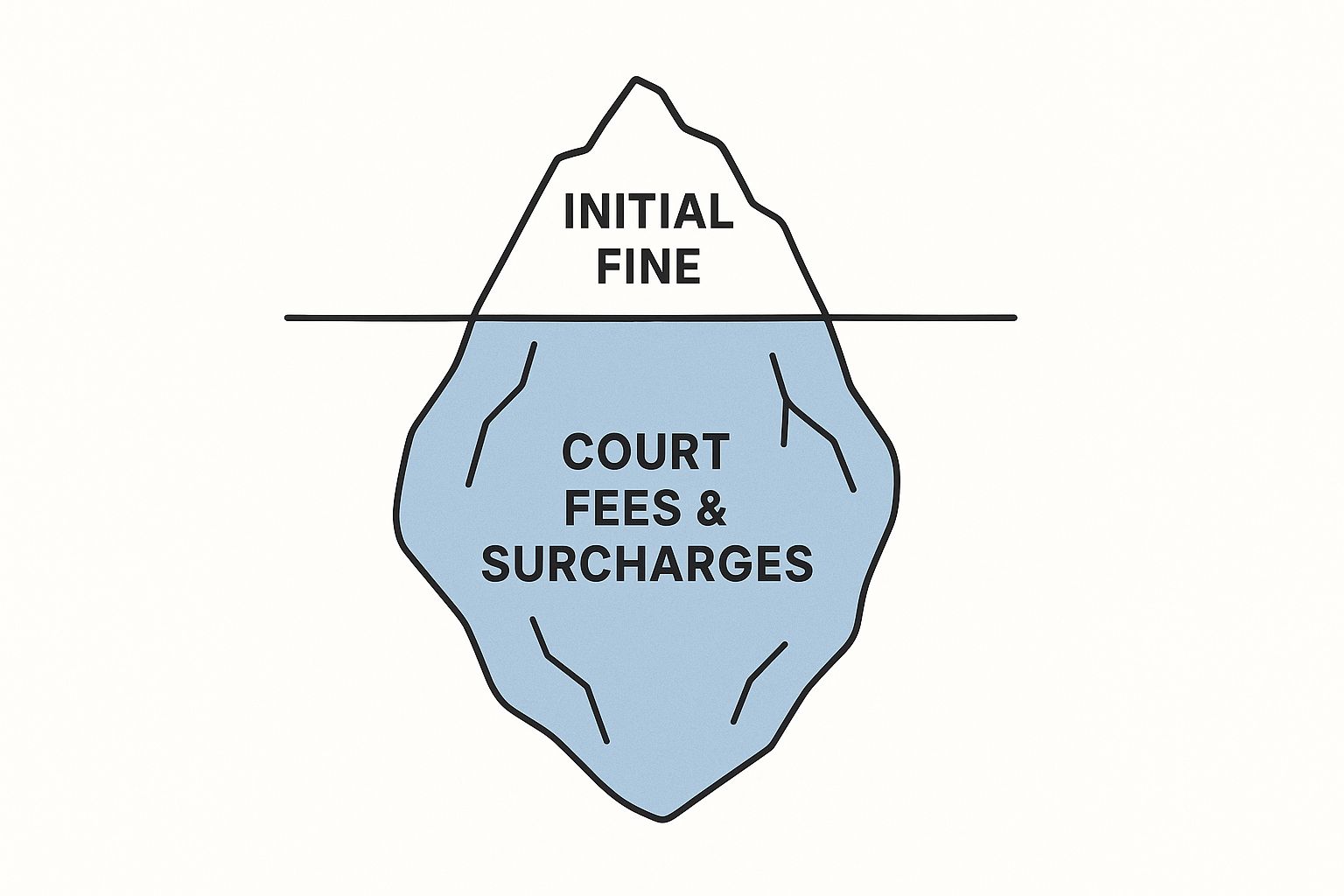
As this breakdown illustrates, the fine itself is just one component. The majority of the financial impact stems from secondary costs that are rarely discussed upfront but become mandatory obligations upon conviction.
A Financial Storm on the Horizon
These additional costs are not optional; they are legally required payments triggered by a conviction. This financial storm includes:
- Court Costs: Fees charged by the court system to process your case, often adding hundreds of dollars to your total obligation.
- State Surcharges: Under the Texas Driver Responsibility Program, a conviction results in annual fees for three consecutive years. These surcharges alone can add thousands to your debt.
- License Reinstatement Fees: Regaining your driving privileges is not free. A series of administrative fees must be paid to get your driver’s license back.
To provide a clear reference for how these penalties escalate, here is an overview of the maximum fines and jail time for DWI offenses in Texas.
Texas DWI Penalties at a Glance
This table breaks down the statutory maximums you could face. Remember, these are merely the starting points before all other costs are added.
| Offense Level | Maximum Fine | Maximum Jail Time | License Suspension |
|---|---|---|---|
| First DWI | $2,000 | Up to 180 days | Up to 1 year |
| Second DWI | $4,000 | Up to 1 year | Up to 2 years |
| Third DWI | $10,000 | 2 to 10 years in prison | Up to 2 years |
Again, the figures in the “Maximum Fine” column do not account for the thousands more you will pay in court costs, surcharges, and other mandatory fees.
The ripple effects of a Texas DWI extend far beyond financial strain. In 2021 alone, drunk driving caused 963 deaths and 2,114 serious injuries in our state. This tragic human cost is precisely why the financial penalties are so severe. A conviction can drain your savings, lead to job loss, and place immense stress on your personal relationships. More data on these statewide impacts is available on the TxDOT website.
A DWI charge is not a simple traffic ticket. It is a major financial event with the power to derail your life for years. The sheer volume of penalties makes attempting to navigate this process alone an incredibly high-stakes gamble.
We have not yet discussed the long-term pain of skyrocketing insurance premiums. You can learn more about the SR-22 requirements and DWI impact on insurance in our detailed guide.
Protecting yourself from this overwhelming financial burden requires swift, strategic action. The only way to challenge the charges and mitigate these crushing costs is with a robust defense strategy from the moment of your arrest.
Deconstructing the Cost of a First DWI Offense
When you hear about a first-time DWI charge in Texas, the figure most often cited is the fine: up to $2,000. But fixating on that number is a profound mistake. That initial fine is not the total bill—it is merely the first wave of a financial tsunami.
A first DWI is a Class B Misdemeanor, but the financial penalties are in a category of their own. Before the fine is even considered, the court system imposes its own mandatory fees for case processing, often adding several hundred dollars immediately. These are non-negotiable costs of entry into the legal process.
Beyond the Initial Fine
The most significant financial blow for most people comes from the state-mandated surcharge system. Upon conviction, the Texas Department of Public Safety (DPS) imposes annual surcharges that must be paid for three consecutive years to maintain your driver’s license.
These surcharges, or “DWI Super Fines”, are a separate penalty from the criminal court fine. The annual amount varies but can easily range from $1,000 to $2,000 per year. Over three years, this amounts to as much as $6,000—a penalty that often dwarfs the original fine issued by the judge.
A DWI conviction triggers a cascade of financial obligations. The initial fine is just the first domino to fall, setting off a chain reaction of administrative fees and long-term surcharges that can create a significant financial burden for years.
The Compounding Effect of a Conviction
These costs accumulate quickly, transforming a seemingly manageable problem into a financially overwhelming crisis. The pressure does not end with fines and surcharges. A conviction almost always includes court-ordered requirements, each with its own price tag.
For example, many sentences mandate attendance and completion of specific educational programs. You can learn more about what these involve in our complete guide to DWI education and treatment programs. These courses are not free; you are responsible for all enrollment fees and associated costs.
Every element—the criminal fine, court costs, state surcharges, and program fees—builds upon the last. What begins as a $2,000 problem can rapidly escalate into a financial crisis exceeding $10,000 by the time it is resolved. This is precisely why challenging the charge from the outset is so critical. An effective defense does more than contest the accusation; it works to prevent this devastating financial domino effect.
How Fines Escalate for Repeat DWI Offenses
If a first DWI offense is a financial storm, a subsequent charge is a full-blown hurricane. Texas law shows little leniency for repeat DWI offenders, and the penalties become dramatically steeper with each new conviction. The fines, potential jail time, and long-term consequences escalate from a serious misdemeanor to a life-altering felony.
While a first offense is typically a Class B Misdemeanor, a second DWI is elevated to a Class A Misdemeanor. This upgrade immediately doubles the potential maximum fine to $4,000. It also increases the possible jail time to a full year, creating a much more serious legal situation from the start.
This jump in penalties is not merely a slap on the wrist. It is a clear signal that the state views a second offense not as another mistake, but as a dangerous pattern of behavior requiring severe intervention.
The Felony Threshold
The landscape changes completely with a third DWI offense. At this point, the charge becomes a third-degree felony in Texas, and the consequences become catastrophic. A conviction carries a staggering fine of up to $10,000 and a prison sentence of two to ten years.
These are not just fines; they are designed to be punishing. Furthermore, the state imposes even higher annual surcharges, extending the financial pain for years after any sentence is served. This cycle can easily trap an individual in debt, making it incredibly difficult to rebuild their life.
With a third DWI, you are no longer facing a misdemeanor. You are staring down a felony conviction that will follow you for the rest of your life, impacting your ability to find a job, secure housing, and even keep your right to vote.
Understanding Enhancement Provisions
It is crucial to understand how your history impacts a new charge. Texas law utilizes “enhancement” provisions, which grant prosecutors the authority to use past convictions to increase the severity of a current offense.
Think of it as a legal multiplier. A new charge is not viewed in isolation; your entire record is brought to the forefront. This is the legal engine driving the state’s aggressive stance against repeat offenders. You can learn more about how this works by reading our article on repeat offender enhancements in sentencing.
Facing a repeat DWI charge means the stakes are exponentially higher. The threat of a felony conviction and a massive financial burden makes securing experienced legal representation immediately a non-negotiable step toward protecting your freedom and your future.
Uncovering the Hidden Costs of a DWI Conviction
The fine a judge announces in court is only the opening chapter of a very long and expensive story. Too many individuals are blindsided by the cascade of secondary costs that follow a DWI conviction, turning what appears to be a single financial penalty into a multi-year economic burden.
These are not minor fees. They are significant, mandatory expenses that can easily dwarf the original court fine. Think of it less like a one-time ticket and more like a series of expensive subscriptions you never signed up for but are legally obligated to pay.

The Ripple Effect On Your Finances
One of the most immediate and intrusive expenses is the ignition interlock device (IID). If the court orders you to install one in your vehicle, you are responsible for every cost: the installation fee, a monthly monitoring fee, and a final removal fee. These expenses can easily exceed $1,000 in the first year alone.
Next, you will likely be required to complete a state-approved alcohol education program. While these courses can be beneficial, they are not free. You must pay the tuition out-of-pocket, and failure to complete the program can lead to further penalties. It is another non-negotiable expense.
A DWI conviction triggers a financial chain reaction. The court fine is just the first link; it’s the subsequent costs—from mandatory technology to administrative penalties—that create the most significant and lasting financial strain.
Long-Term Financial Consequences
The financial pain does not stop there. Once your license suspension period ends, you must pay a license reinstatement fee to the Texas Department of Public Safety simply to regain your driving privileges.
Then comes the insurance nightmare. Your auto insurance provider will almost certainly classify you as a high-risk driver, causing your premiums to skyrocket for years. You will also be required to obtain an SR-22 certificate of insurance, which adds another layer of cost and administrative burden.
These expenses do not even account for potential vehicle impound fees following the arrest or the devastating loss of income if the conviction jeopardizes your employment. To learn more about the career risks, review our guide on the impact of a conviction on employment and professional licenses.
To provide a clearer picture, here is a breakdown of some of the most common hidden costs associated with a Texas DWI.
Potential Hidden Financial Costs of a Texas DWI
| Expense Category | Estimated Cost Range | Frequency |
|---|---|---|
| Ignition Interlock Device | $70 – $150 Installation; $60 – $90 Monthly | Monthly |
| SR-22 Insurance | $25 – $50 Filing Fee; Premium increase varies | Annually for 3 years |
| Alcohol Education Program | $100 – $300 | One-time |
| License Reinstatement Fee | $125 | One-time |
| Vehicle Impound/Towing | $150 – $400+ | One-time |
Seeing these figures laid out makes it evident why you must address a DWI charge proactively. A strong defense is not just about fighting the criminal charge—it is about protecting yourself from this overwhelming and long-lasting financial fallout.
How a Skilled Attorney Can Change the Outcome
Being arrested for a DWI in Texas can feel like a conviction is inevitable. Many people assume the case is open-and-shut and that they should simply accept the maximum Texas DWI fines and prepare for the worst.
This is a monumental and often costly mistake. An arrest is not a conviction, and the state’s case against you may be far weaker than you realize.
A skilled DWI lawyer does not accept the police report at face value. Their role is to deconstruct the entire case, piece by piece, searching for procedural errors, flawed evidence, and violations of your constitutional rights. This process is not about finding minor technicalities; it is about building a formidable defense to protect your freedom and financial stability.
Challenging the Evidence Against You
An effective DWI defense strategy often begins long before anyone enters a courtroom. It starts with a meticulous examination of the arrest details. An experienced attorney will scrutinize every element, asking the critical questions that can fundamentally alter the trajectory of your case.
Key areas of focus include:
- The Legality of the Traffic Stop: Did the officer have a valid, legal reason to pull you over in the first place? If the initial stop was unlawful, any evidence gathered subsequently—including breath or blood tests—could be suppressed.
- Field Sobriety Test Administration: Were the roadside tests conducted in strict accordance with national standards? These tests have rigid protocols. If the officer provided improper instructions, conducted them on an unsuitable surface, or failed to follow procedure, the results become unreliable.
- Breathalyzer and Blood Test Accuracy: The testing equipment is not infallible. Was the breathalyzer properly calibrated? Were maintenance logs meticulously kept? If a blood sample was taken, was it handled, stored, and tested according to strict scientific guidelines to prevent contamination or degradation?
A single procedural failure can provide powerful leverage for your defense.
A DWI case is a chain of evidence, with each piece acting as a link. A knowledgeable attorney knows how to identify and break the weakest links, causing the prosecution’s entire case to collapse. This is how charges are reduced or dismissed entirely.
The data supports this reality. A DWI charge does not automatically result in a conviction. In 2021, Texas law enforcement made 89,457 DWI arrests. While many resulted in convictions, 1,917 were dismissed outright. That represents nearly 2,000 cases where a strong defense made all the difference.
Ultimately, retaining the right legal counsel is not just another expense—it is a critical investment in your future. It is the single most important action you can take to fight back against the crushing financial penalties of a DWI. Through tenacious negotiation or a powerful courtroom defense, a skilled attorney can work to have charges reduced, fines slashed, or the entire case thrown out.
Common Questions About Texas DWI Fines
A DWI charge can throw your life into chaos, with financial uncertainty often being the most stressful component. Understanding your financial obligations—and your legal rights—is the first step toward regaining control.
Here are straightforward answers to the most frequently asked questions about DWI fines in Texas.
Is It Possible to Get DWI Fines Reduced in Texas?
Yes, it is absolutely possible to have DWI charges—and their associated fines—reduced or even dismissed. However, this outcome is not achieved by chance. It requires a robust legal strategy executed by an attorney who understands how to dismantle the prosecution’s case.
A skilled lawyer will scrutinize every detail for weaknesses, asking critical questions such as:
- Was the initial traffic stop legally justified?
- Were the field sobriety tests administered correctly according to established protocols?
- Are the maintenance and calibration records for the breathalyzer complete and accurate?
Identifying procedural errors or evidentiary flaws provides your attorney with powerful leverage. They can use these issues to negotiate for a lesser charge, such as reckless driving, which typically carries significantly smaller fines and lighter penalties. In the strongest cases, these flaws are sufficient to have the entire case dismissed.
While no outcome is ever guaranteed, a proactive defense is your best opportunity to minimize the financial impact.
Can I Get a Payment Plan for My DWI Fines?
Many Texas courts offer payment plans if you can demonstrate a genuine inability to pay the entire fine at once. This is not an automatic right; it is granted at the discretion of the presiding judge.
If the court approves a payment plan, it is imperative that you adhere strictly to the schedule. A single missed payment can result in a warrant being issued for your arrest.
It is also crucial to remember that court fines are separate from state-mandated surcharges. Those are managed by the Texas Department of Public Safety, which may have its own payment options. An attorney can help you navigate these dual obligations and ensure you remain in compliance with the law.
What Happens If I Cannot Pay My DWI Fines?
The worst possible action is to ignore court-ordered fines. This path almost invariably leads to an arrest warrant and a host of new legal troubles. If you genuinely cannot pay, you must formally notify the court.
Judges have several options. They might convert your fine into community service hours or establish a more manageable payment schedule based on your financial circumstances. You are far more likely to receive a fair alternative if you are transparent about your hardship.
Having an attorney petition the court on your behalf can make a significant difference. They know how to effectively present your financial situation and advocate for a resolution that prevents further legal complications.
Are Fines Higher If My BAC Was Over 0.15?
Yes, they can be. Texas law imposes much harsher penalties on drivers with a high Blood Alcohol Concentration (BAC). If your BAC is 0.15 or higher, a first-time DWI is elevated from a Class B Misdemeanor to a more serious Class A Misdemeanor.
This enhancement has a massive financial impact. The maximum fine doubles to $4,000—twice the maximum for a standard first offense. This elevated charge makes it even more urgent to secure a strong legal defense immediately to protect your financial future.
Discover more from David Smith Law Firm, PLLC
Subscribe to get the latest posts sent to your email.