

When you hear someone on TV or in real life “plead the Fifth,” they’re tapping into one of the most powerful shields in the American legal system. In plain English, it’s your constitutional right to refuse to answer any questions—from police or in a courtroom—that could incriminate you.
This isn’t just a dramatic movie line. It’s a fundamental protection baked right into the Fifth Amendment, and understanding how it works is critical if you ever find yourself facing law enforcement questioning in Houston, Texas. The moments following an accusation are disorienting, and without immediate legal guidance, your own words can become the prosecution’s strongest weapon.
The Foundation Of Your Right To Remain Silent

Think of the Fifth Amendment as a legal stop sign. You can hold it up to prevent the government from forcing you to be a witness against yourself in a criminal case.
Here’s a crucial point that people often misunderstand: invoking this right is not an admission of guilt. It is a strategic and necessary legal maneuver to protect yourself from the immense power of the prosecution. It forces the state to prove its case without your forced cooperation, which is its burden alone.
A Protection for Everyone
The right against self-incrimination dates back to the ratification of the Bill of Rights in 1791. The founders wanted to prevent the kind of government overreach they’d seen in England, where people could be tortured or coerced into confessing. You can learn more about the Fifth Amendment’s history and its broad protections.
This protection isn’t just for the guilty. It’s a vital safeguard for the innocent, too.
The U.S. Supreme Court has repeatedly emphasized that the privilege was designed to protect all citizens from the pressures of interrogation. An innocent person, confused or intimidated, could easily say something misleading that makes them look guilty. The Fifth Amendment prevents that from happening.
To make this even clearer, let’s break down what this right really means for you in a practical sense, especially if you are facing a criminal charge in the Greater Houston Area.
Your Fifth Amendment Rights at a Glance
This table gives you a quick snapshot of what your right against self-incrimination covers and how it applies in real-world situations.
| Key Aspect | What It Means for You |
|---|---|
| Right to Remain Silent | You cannot be forced to answer questions from police, prosecutors, or a judge that could reveal your involvement in a crime. |
| Applies Everywhere | This right applies during a police interrogation in Harris County, at a grand jury proceeding, in a civil deposition, or on the witness stand in a criminal trial. |
| Protects the Innocent | It prevents innocent individuals from being tricked or pressured into making statements that could be twisted and used against them later. |
| Not an Admission of Guilt | In a criminal trial, a jury cannot be told that your silence is evidence of guilt. The prosecutor is not allowed to comment on it. |
| It Must Be Invoked | You have to clearly state that you are exercising your right to remain silent or that you are “pleading the Fifth.” It is not automatic. |
Ultimately, your right to remain silent is a cornerstone of a fair justice system. It ensures the burden of proof stays exactly where it belongs: on the government. A failure to assert this right at the correct time can have devastating and irreversible consequences.
The History Behind Your Right to Remain Silent

Your right to remain silent isn’t some modern legal loophole. It was forged in the fire of historical battles against oppressive governments. Its roots go back centuries to English common law, created as a direct response to tyrannical courts where forced confessions and brutal interrogations were standard procedure.
The founders of the United States saw these abuses up close. They knew that a truly fair justice system needed a shield—something to protect people from being forced to hand over the very evidence that could convict them.
From Abusive Courts to a Constitutional Right
Centuries ago, English criminal trials often forced the accused to speak, sometimes under the threat of torture. The privilege against self-incrimination grew out of a need to stop this kind of coercion, especially in courts like the infamous Star Chamber, which was notorious for its abusive tactics. This protection was so fundamental that it was written directly into the Bill of Rights in 1791, marking a massive shift toward fairness in the legal system.
This isn’t just a dry history lesson. It’s the bedrock of the legal protections you have today in Texas, including the warnings an officer must give you during an arrest.
Pleading the Fifth isn’t about hiding guilt. It’s about upholding a centuries-old principle designed to protect the innocent from an unfair fight against the full power of the state.
The right to remain silent forces the government to do its job and prove its case on its own, without making you help them prosecute you. Understanding this right, especially how it connects to modern procedures like your Miranda Rights, is critical for anyone facing a legal fight. You can learn more by reading our guide on how Miranda Rights apply to DWI cases in Texas.
When You Can Plead the Fifth in a Texas Case
It’s one thing to know you have the right to remain silent. It’s another thing entirely to know exactly when to use it. This isn’t just for dramatic courtroom scenes; it’s a powerful shield you can and should use in real-world situations right here in Houston.
The key is to recognize any moment where your own words could dig you into a legal hole. This right isn’t just for trial. You can invoke it at any stage of a criminal investigation—even during casual-seeming chats with police that are really designed to get you to incriminate yourself.
Common Scenarios for Invoking Your Rights
So, when does it actually come up? Here are a few common situations where pleading the Fifth is not just smart, it’s essential for your protection:
- During a Traffic Stop: A routine stop for speeding in Harris County can quickly turn into a DWI investigation. When an officer asks, “How much have you had to drink tonight?” they’re not making small talk. They’re gathering evidence. You have the right to politely decline to answer that question.
- Police Interrogations: Once you’re in a formal interrogation room, the pressure is on. This is a critical time to state clearly that you are invoking your right to remain silent and that you want an attorney. You should not say another word until your legal counsel is present.
- As a Witness: Let’s say you’re called to testify in someone else’s criminal case in Houston. If a prosecutor asks you a question and the honest answer could connect you to a crime, you can plead the Fifth. It protects you from being forced to implicate yourself, even on the witness stand.
At its core, the logic is simple. The decision tree below breaks it down.
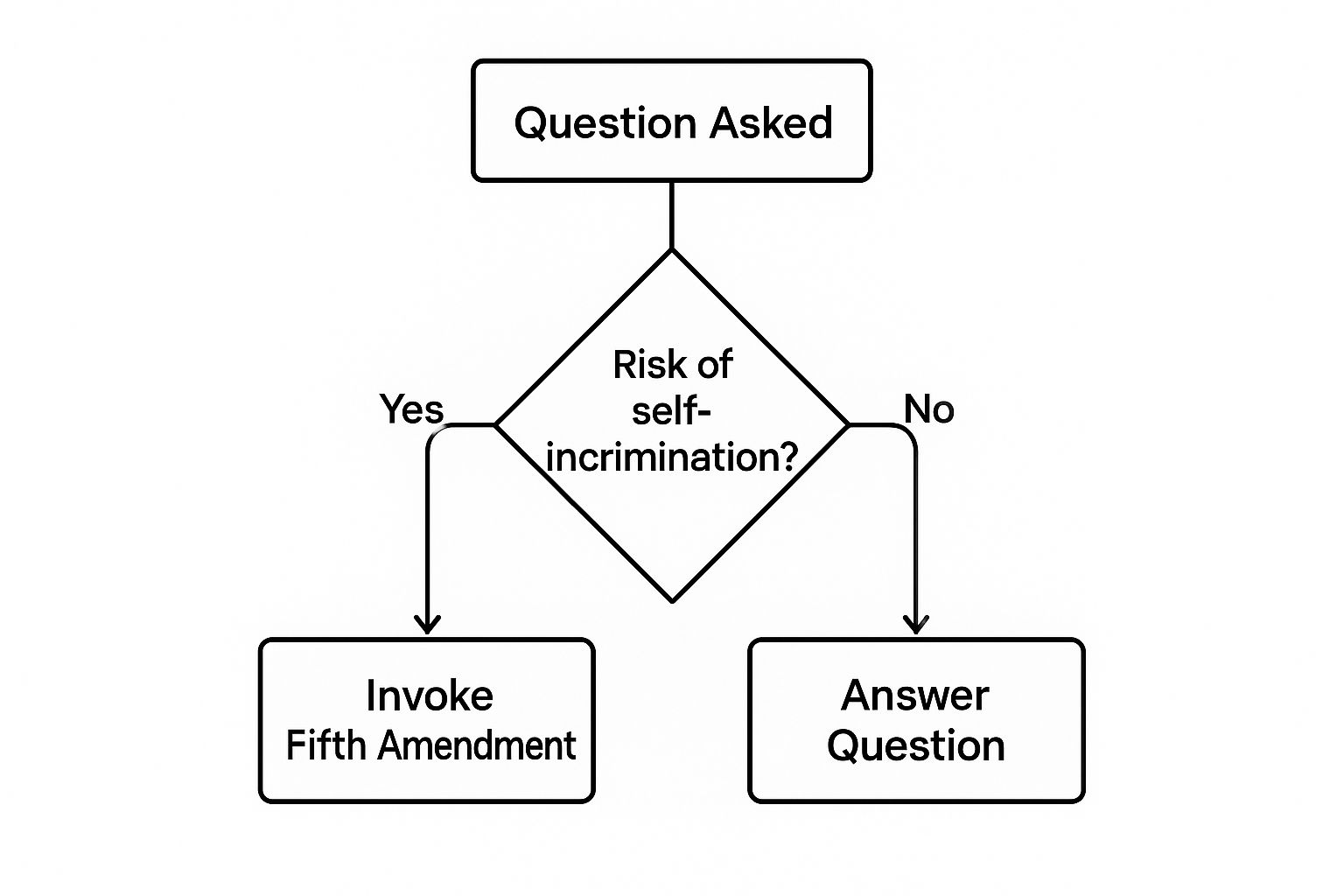
This visual gets to the heart of it: if there’s any chance your answer could be used against you, staying silent is the safest bet until you have legal representation.
Remember, the right to remain silent isn’t just for defendants. It is available to anyone, at any stage of an investigation, whose words could link them to a crime.
This protection is so strong it even applies in civil lawsuits. If you’re being questioned in a civil deposition and an answer could open you up to criminal charges, you can refuse to answer. Knowing when and how to assert this right is your first and most important line of defense. The moments during and after an arrest are chaotic and confusing, which is exactly why you need to learn how to protect your rights during police interrogations before you’re ever in that situation. One wrong move can have permanent consequences, which makes obtaining professional legal advice an immediate priority.
The Risks of Waiving Your Fifth Amendment Rights

It’s a powerful human impulse to want to seem helpful or explain your side of the story. But in a criminal investigation, that impulse can be a devastating mistake. The single most critical danger you face is waiving your right to remain silent, because once you start talking, you open a door that is almost impossible to shut.
Imagine you only answer a few “simple” questions before deciding you should stop. Too late. A prosecutor can argue that by answering those first few questions, you waived your privilege on that specific topic. Now you’re caught in a legal trap: you either have to keep answering, or you risk being held in contempt of court. This is a classic pitfall that many well-intentioned people stumble right into, with severe repercussions.
How Your Words Can Be Used Against You
The biggest risk isn’t that you’ll confess—it’s that your innocent statements will be manipulated and twisted. Police and prosecutors are trained to build a case, not to prove your innocence. They will pick apart every word, looking for inconsistencies, accidental admissions, or anything that can be yanked out of context.
Think about a basic question like, “Where were you last night?” An honest person might misremember a small detail—the time they left a friend’s house or the exact route they drove home in Houston. To a skilled prosecutor, that tiny error isn’t a simple mistake. It’s a lie. That’s all it takes to destroy your credibility in front of a jury.
The safest action is always to state clearly that you wish to remain silent and that you want to speak with a lawyer. This isn’t defiance; it’s the single most effective way to protect your future from unintentional self-incrimination.
Cooperation Without Counsel Is a Gamble
Trying to cooperate with law enforcement without a lawyer by your side is like handing the prosecution the ammunition to build their case against you.
Let’s say you confirm you were at a certain location, even if you did nothing wrong. You’ve now placed yourself at the scene of the crime. That fact alone can become a central piece of the state’s evidence. A skilled attorney knows how to manage this communication and can ensure that if any evidence was gathered improperly, it gets challenged. You can learn more about this process in our guide on the suppression of illegally obtained evidence.
Ultimately, the smartest move is to let a legal professional handle every conversation. The second you’re being questioned, the stakes become incredibly high. The risks of speaking on your own are far too great.
Debunking Common Myths About Pleading the Fifth
Thanks to countless cop shows and courtroom dramas, the Fifth Amendment is wrapped in some seriously damaging myths. The biggest one? The idea that only guilty people plead the Fifth.
That couldn’t be further from the truth. It completely misses the whole point of this constitutional protection.
The right to remain silent was created to protect innocent people from the overwhelming pressure of a police interrogation. In a high-stress, confusing situation, anyone can get flustered, mix up details, or get tripped up by a detective’s tricky, leading questions. Innocent statements are twisted or ripped out of context all the time to make someone look guilty. Pleading the Fifth isn’t an admission of anything. It’s a smart, strategic move to stop your own words from being turned into weapons and used against you.
It Is Not an Admission of Guilt
Let’s be crystal clear: exercising your constitutional right is not evidence of wrongdoing. In fact, a significant number of defendants—somewhere between 20% to 40%—invoke their Fifth Amendment rights, especially when the facts are complicated.
The Supreme Court has been very firm on this point, ruling that a jury can’t use your silence to infer guilt. This principle is a cornerstone of our justice system, designed to protect people from unfair prejudice. You can discover insights about the Fifth Amendment for innocent people to learn more about this crucial protection.
The Fifth Amendment is not a confession of guilt but a declaration of rights. It is a shield for the innocent, not just a refuge for the guilty.
Other Common Misunderstandings
Beyond the “guilt” myth, a few other misconceptions can put your rights in jeopardy. It’s critical to know what the Fifth Amendment does—and, just as importantly, what it doesn’t do.
Here are a couple of other common myths you need to be aware of:
- Myth: You can plead the Fifth to avoid giving physical evidence.
- Reality: This is a big one. The Fifth Amendment protects you from being forced to give “testimonial” evidence—meaning, your words. It generally does not protect you from having to provide physical evidence like fingerprints, a DNA swab, or a breathalyzer sample in a Texas DWI case. In those instances, you can refuse, but not if their is a court order that says police must obtain fingerprints, a DNA swab, or a blood specimen in a Texas DWI case.
- Myth: The right applies automatically if you just stay quiet.
- Reality: You have to speak up to shut up. You must clearly and verbally invoke your right. You need to say something direct like, “I am exercising my right to remain silent” or “I plead the Fifth.” Just staying silent might not be enough to legally protect you.
Understanding these truths is the first step toward using your rights effectively. In the complex world of the Houston criminal justice system, your silence is a powerful tool for self-preservation. Do not let myths and misinformation take it away from you.
Why an Attorney Should Be Your First Call
This guide is an important starting point, but information alone will not protect you when law enforcement comes knocking. When you’re facing a criminal investigation in Houston, your first and only move should be to call an experienced criminal defense lawyer.
Think of an attorney as more than just your voice; they are your shield. They step between you and the investigators, making sure your rights are respected and preventing you from walking into the common legal traps designed to get you to incriminate yourself.
Navigating the Legal Minefield
Trying to handle an investigation without a lawyer is like trying to cross a minefield blindfolded. A skilled attorney understands the subtle, tricky parts of Texas law. They know exactly when you should speak and—more importantly—when you absolutely must stay silent.
They see the situation from a purely legal perspective, free from the stress and emotion you’re going through. That clarity allows them to make the right strategic calls on your behalf. Hiring a lawyer isn’t for the guilty—it’s the single most important, proactive step anyone can take to protect their freedom.
An experienced attorney knows that the prosecution builds its case on statements people make before they have a lawyer. By taking over all communication, your lawyer immediately cuts off that supply of potential evidence.
Knowing how to choose a criminal defense attorney who is the right fit is critical. The right legal expert ensures your rights are protected from day one, working to secure the best possible outcome in your case.
A Few Final Questions About Pleading the Fifth
To wrap things up, let’s tackle a few of the most common questions people in Texas ask about what it really means to plead the Fifth. These quick answers cut to the chase and show why you absolutely need a lawyer in your corner.
If I Plead the Fifth, Can a Jury Use That Against Me?
Absolutely not. In any criminal trial in Texas, it is unconstitutional for a prosecutor to even mention your decision to stay silent. A jury cannot be told to look at your silence and think, “Well, that must mean they’re guilty.”
This is a core protection. It ensures the right isn’t twisted into a weapon to be used against you. But making sure this rule is actually followed in the heat of a trial? That takes a sharp defense attorney who is watching every move the prosecution makes.
Does the Fifth Amendment Protect Physical Evidence?
Generally, no. The right protects you from being forced to give “testimonial” evidence—in other words, your own thoughts or words.
It typically does not stop the government from compelling you to provide physical evidence. Think fingerprints, blood samples for a DWI test, or documents they’ve subpoenaed. The line between what’s “testimonial” and what’s purely “physical” can get incredibly blurry and has been the subject of countless legal battles. This is exactly where a lawyer’s guidance is indispensable.
Can I Just Answer Some Questions but Plead the Fifth to Others?
This is an extremely dangerous game to play, and one you should never attempt without legal counsel.
Once you start answering questions on a certain topic, a court can rule that you’ve “waived” your right to silence for that entire subject. This can back you into a corner, forcing you to answer follow-up questions you desperately wanted to avoid. The safest, smartest approach is always to invoke your right to silence across the board until you’ve spoken with your lawyer.
Navigating the complexities of the Fifth Amendment is not something you should ever try to do alone. If you are facing a criminal investigation in the Greater Houston area, the most important step you can take is to secure expert legal representation.
For dedicated and experienced legal support, consider the David Smith Law Firm, PLLC. You can learn more by visiting https://www.davidsmith.law.
Discover more from David Smith Law Firm, PLLC
Subscribe to get the latest posts sent to your email.