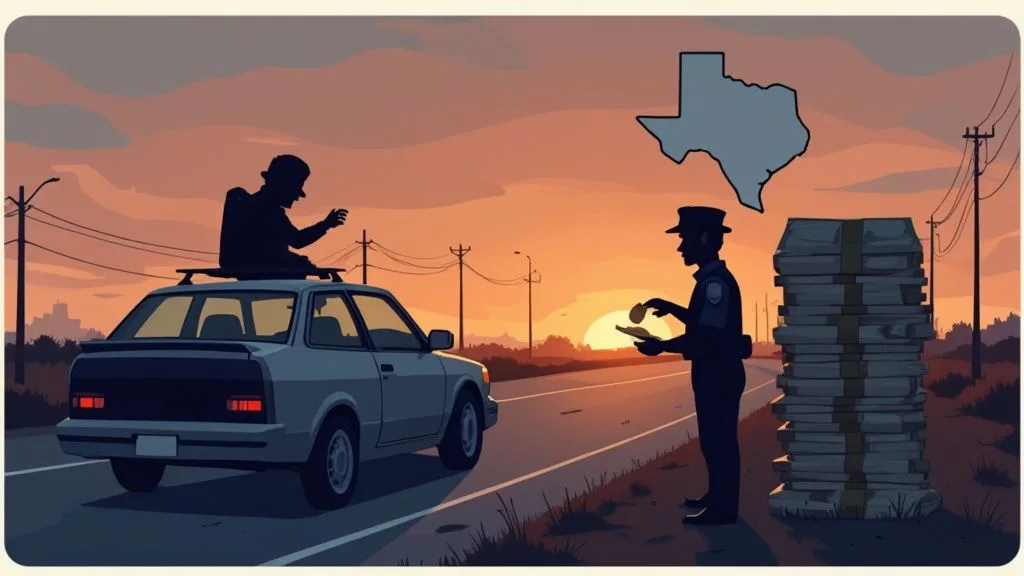
So, when can police search your car? It’s one of the more common questions Texas drivers have, and the answer is almost never simple. While the Fourth Amendment protects you from unreasonable searches and seizures, a traffic stop on a Houston highway puts you in a unique legal situation.
In Texas, police can often search your vehicle without a warrant if they have probable cause, if you give them consent, or if they see illegal items in plain view. Understanding the difference between these scenarios is critical, as a routine traffic stop can escalate into a serious criminal charge in a matter of minutes. The decisions you make when you see flashing lights in your rearview mirror can have lasting consequences, and a mistake made on the roadside can be difficult to undo later.
Your Rights During a Texas Traffic Stop
Seeing police lights in your rearview mirror is enough to make anyone’s heart pound. For drivers in the Greater Houston area, your mind starts racing. In that high-stress moment, knowing your rights isn’t just a good idea—it’s your best line of defense. An interaction that seems minor can quickly lead to an arrest, making every word and action critical.
The U.S. Constitution acts as a shield against government intrusion. But when it comes to vehicles, the courts have decided that this shield is far more flexible than it is for your home. That’s a crucial distinction, because it gives a Harris County or Houston police officer more authority than you might think. A misunderstanding of these rules can lead to you unintentionally giving up your rights, potentially resulting in severe charges for DWI, drug possession, or other offenses.
Knowing the Boundaries of a Lawful Stop
A traffic stop starts for a specific reason, like speeding or a broken taillight. Everything the officer does is supposed to be related to that initial reason. But things can escalate quickly if they see or hear something that raises new suspicions. An officer is trained to look for any sign that could justify a deeper investigation.
The key is knowing where that line is drawn. To protect yourself, you first need to understand what makes a stop lawful in the first place. You can learn more about how to spot potential violations in our guide to unlawful stops and your Fourth Amendment rights.
This knowledge is the first step toward protecting your future. What you say—and what you don’t say—in those first few moments can determine whether a routine ticket turns into a full-blown search of your car and a potential criminal case.
To make sense of it all, let’s quickly break down the legal terms that really matter when an officer is at your window.
Key Legal Terms for a Vehicle Search
This table summarizes the core legal principles that govern police searches of vehicles during a traffic stop. Understanding these concepts is not just academic; it is essential for protecting your freedom.
| Legal Concept | What It Means for You |
|---|---|
| Reasonable Suspicion | This is the minimum needed to pull you over. The officer must have a concrete reason to believe you’ve committed a traffic violation. It’s more than a hunch. |
| Probable Cause | This is a higher standard needed to search your car (without a warrant). The officer must have solid facts to believe a crime was committed and your car contains evidence of it. |
| Consent | If you agree to a search, you’ve just given up your Fourth Amendment rights for that specific interaction. Remember: you always have the right to say no. |
| Warrant Requirement | Police almost always need a warrant to search your home. Your vehicle is the biggest exception to that rule, which is why these other concepts are so important in a criminal defense case. |
Understanding these ideas isn’t about being confrontational; it’s about being prepared. When the stakes are this high, preparation is everything. The nuances of these legal standards are often the battleground where a criminal case is won or lost.
The actions you take and the words you speak during a traffic stop can be just as crucial as the facts of the case. An officer is trained to observe everything, and a seemingly minor misstep can provide the justification needed to probe deeper into your affairs. Protecting your rights begins with calm, informed conduct.
The small details of a police encounter can make or break a criminal case down the road. An experienced criminal defense attorney will scrutinize every detail to make sure your rights were protected from start to finish. Without this level of expert review, critical errors made by law enforcement may go unnoticed, leaving you to face the consequences.
The Fourth Amendment and the Automobile Exception

The Fourth Amendment to the U.S. Constitution is the bedrock of your privacy rights. It’s what protects you from unreasonable searches and seizures by the government. Think of it like a shield, strongest around your own home, which the law considers your most sacred private space. For police to get past that shield and into your house, they almost always need a warrant signed by a judge.
But once you get behind the wheel of a car, that shield becomes a bit more flexible. The protection is still there, but it works differently. This is all because of a powerful legal principle known as the “automobile exception.”
Understanding this exception is the key to knowing your rights during a traffic stop in Houston or anywhere else in Texas. It’s the main reason the answer to the question “when can police search your car?” is so complicated, and why you need skilled legal counsel if you believe your rights were violated.
Why Cars Are Treated Differently Than Homes
So, why the special treatment for cars? It boils down to one simple word: mobility. The Supreme Court first carved out this exception way back in 1925, recognizing a fundamental difference between a house and a car. A vehicle can be driven away, and any evidence inside it can vanish, in the time it takes an officer to go find a judge and get a warrant.
This inherent mobility creates what the law calls “exigent circumstances”—a fancy term for a situation that demands immediate action. Because of this, the courts have given law enforcement more latitude to search vehicles without a warrant than they have for homes.
But this doesn’t give police a free pass. It just means they don’t always need a judge’s permission first, provided they meet a very specific legal standard. That standard is probable cause, which we’ll break down in a moment. For now, the big takeaway is this: your car has a lower expectation of privacy than your home, not because it’s less important, but because it’s on wheels.
The automobile exception creates a critical legal distinction that every driver should understand. An officer’s ability to search your vehicle without a warrant hinges on this principle, turning a routine traffic stop into a situation where your constitutional protections can be lawfully bypassed if certain conditions are met. This is a complex area of law where having an experienced attorney is vital.
The Scope of the Automobile Exception
This legal rule isn’t just about the car’s frame. If an officer has the legal justification to search your vehicle under the automobile exception, that search can extend to almost every part of it.
What does that look like during a real-life stop on a Houston highway?
- Containers and Compartments: The search can cover any container inside the vehicle where the suspected evidence could reasonably be hidden. This puts the trunk, glove compartment, and center console frequently on the table.
- Personal Belongings: Officers might also be able to search personal items found in the car, like a backpack, purse, or luggage, if they believe those items could contain what they are looking for.
Let’s say police have probable cause to believe you have illegal drugs in your car. They can then look in any area or container where those drugs could logically be stashed. The rationale is that if the car itself is fair game for a warrantless search, so are the places inside it that could be used to hide evidence.
This is exactly why so many vehicle searches end up being challenged in court. The line between a lawful, warrantless search and a violation of your Fourth Amendment rights can be razor-thin. It often comes down to the specific, moment-by-moment details of the traffic stop. Every word you say and every action you and the officer take can become critical evidence later. A skilled criminal defense attorney will pick apart these facts to see if law enforcement went too far. A successful challenge could mean the difference between a conviction and a dismissal.
Understanding Probable Cause for a Vehicle Search

The “automobile exception” gives police more leeway to search a car than a home, but it isn’t a blank check. For a warrantless search to be legal, an officer must have probable cause. This is the single most common justification officers use, making it a critical concept for every Texas driver to understand. Without it, you are risking your freedom.
Probable cause is more than just a gut feeling or a vague suspicion. It’s a legal standard that requires an officer to have specific, articulable facts—things they can point to—that would lead a reasonable person to believe a crime has been committed or that evidence of a crime is inside the vehicle.
Think of it as the bridge between a simple traffic violation and a full-blown search of your property. If an officer’s justification for probable cause is weak or nonexistent, any evidence found during that search can be challenged and potentially thrown out of court. This is a crucial defense strategy that requires immediate legal intervention.
What Creates Probable Cause in Texas
So, what does probable cause look like during a real traffic stop on a Houston road? It’s not about an officer’s hunch; it’s about what they can see, smell, or hear. These aren’t just abstract legal theories but tangible observations that can dramatically alter the course of a routine stop.
Courts in Texas have consistently recognized certain scenarios as establishing a solid basis for a search:
- The Smell of Contraband: The distinct odor of marijuana or alcohol coming from the car is one of the most common justifications police use.
- Plain View of Illegal Items: If an officer shines their flashlight inside and sees a baggie of drugs, an open container of alcohol, or an illegal weapon on the seat, that immediately creates probable cause.
- Driver’s Admission: If a driver admits to having something illegal in the car, they have directly handed the officer probable cause on a silver platter.
- Suspicious Movements: An officer watching a driver or passenger frantically trying to hide something under a seat can use that observation to help build their case for probable cause.
These examples show how an officer builds a justification for a search based on concrete evidence, not just intuition. Each fact adds another layer. An experienced attorney knows how to challenge these observations and question their validity.
What Does Not Qualify as Probable Cause
Just as important is understanding what doesn’t meet the legal standard. An officer cannot legally search your vehicle based on flimsy or subjective reasoning. Acting quickly to consult a lawyer is the only way to effectively challenge an improper search.
A police officer’s authority to search your car is not unlimited. Probable cause requires them to point to specific facts. If their reason for the search is based on a hunch, a driver’s nervousness, or the neighborhood you’re in, the search may be illegal.
Actions or circumstances that generally do not provide probable cause on their own include:
- General Nervousness: Being anxious during a police interaction is normal for most people. It is not, by itself, a sign of criminal activity.
- The Nature of the Traffic Violation: Speeding or running a stop sign does not automatically give an officer the right to search your car for unrelated crimes.
- Refusing to Consent to a Search: You have a constitutional right to say no. Exercising that right can never be used as the reason an officer develops probable cause.
While these factors might make an officer more suspicious, they don’t provide the legal grounds needed to launch into a warrantless search of your car.
Unfortunately, how probable cause is applied isn’t always consistent. While police searches are subject to legal standards, the reality on the ground can vary. A deep analysis of about 98 million traffic stops revealed significant racial disparities in search rates, suggesting that systemic bias can influence when and how these searches happen. You can explore more about these disparities and traffic stop data at Futurity.org.
The line between a lawful search and an unconstitutional intrusion can be incredibly fine, and every detail matters. An experienced criminal defense attorney will meticulously review every aspect of the stop to determine if law enforcement overstepped their authority. Retaining counsel immediately is the best way to ensure your rights are protected.
The Power of Consent in a Police Search
Of all the things an officer might say during a traffic stop, one question is more loaded than any other: “Do you mind if I take a look inside your vehicle?”
It sounds casual enough, but your answer can instantly erase some of your most important constitutional protections. This is the incredible power of consent. While the law normally requires an officer to have probable cause for a warrantless search, that requirement disappears the moment you give them permission. The consequences of this one decision can be devastating, highlighting the urgent need for sound legal advice.
Understanding this isn’t about being difficult or uncooperative. It’s about knowing your rights when it matters most. It’s also confusingly worded! To be very clear in your answer, don’t just say yes or no–state politely–“I do not consent to a search”.
The Trained Art of Asking for Consent
Police are trained to ask for consent in ways that feel routine, friendly, or even like a command. They know how to use language to their advantage to get you to agree.
You might hear questions phrased like this:
- “You don’t have anything illegal in the car, do you? So you won’t mind if I look?”
- “I’m just going to take a quick peek inside, okay?”
- “If you have nothing to hide, a quick search won’t be a problem, right?”
These aren’t genuine questions; they’re psychological tools. They’re designed to make you feel like saying “no” is the same as admitting you’re guilty or that refusing will just make things worse. It’s an incredibly effective tactic, and many people agree to a search out of nervousness, intimidation, or simply not realizing they have a choice. This mistake can be the difference between driving home and going to jail.
But you always have a choice. Your constitutional rights don’t just vanish because an officer asks a clever question.
The Consequences of Saying You Consent
When you grant an officer consent to search your car, you are legally waiving your Fourth Amendment protections for that search. It’s like handing them the keys to your constitutional rights, and the consequences are immediate and serious.
Once you’ve said “yes,” any evidence of a crime they find can be used against you in court. It doesn’t matter if they had zero legal reason to search your car before you agreed. Your permission makes the search lawful.
This is a huge risk even if you’re certain you have nothing to hide. Maybe a friend left something in your car without you knowing. Maybe an ordinary item is misinterpreted by the officer. By consenting, you open the door to misunderstandings that can lead to serious legal trouble—trouble that was entirely avoidable. This is why it is so important to speak with an attorney before making any statements or decisions.
A “yes” to a search request is one of the most powerful tools police have. It bypasses the need for a warrant and the probable cause standard, making anything they find legally admissible. Knowing you have the right to decline is your strongest defense, but this right is meaningless if you don’t use it.
How to Politely Refuse a Search
Exercising your right to refuse a search doesn’t need to be confrontational. You can be firm and clear while remaining respectful.
If an officer asks to search your vehicle, you can simply and calmly state:
“Officer, I do not consent to a search.”
That’s it. You don’t need to give a reason, make an excuse, or apologize. A simple, direct refusal is all it takes to assert your rights. Remember, exercising a constitutional right cannot be used as the basis for probable cause. An officer cannot legally search your vehicle just because you said no.
If they search anyway, do not physically resist. Your fight isn’t on the side of the road; it’s in the courtroom. An experienced attorney can later challenge the legality of that search. If it was conducted without your consent and without probable cause, any evidence found may be thrown out. This is a critical legal maneuver that requires immediate action from a qualified lawyer.
Other Times Police Can Legally Search Your Car
While probable cause and consent are the most common gateways for police to search a car without a warrant, they aren’t the only ones. The law carves out several other exceptions, each one highly dependent on the specific facts of your traffic stop.
Understanding these scenarios is critical. A simple stop for speeding can quickly spiral into a full-blown search if an officer sees something, arrests you, or has your car towed. Every detail of your interaction with law enforcement suddenly matters, and the outcome of a potential criminal case can hang in the balance.
The Plain View Doctrine
One of the most straightforward exceptions is the Plain View Doctrine. At its core, this rule isn’t complicated: if an officer sees evidence of a crime out in the open from a place they are legally allowed to be, they can seize it without a warrant.
Think of it this way: the Fourth Amendment protects you from unreasonable searches. If contraband is sitting on your passenger seat in plain view, an officer doesn’t have to “search” for it. For the plain view doctrine to hold up in court, three things must be true:
- The officer must be in a lawful position to see the item.
- It must be immediately obvious that the item is incriminating.
- The officer must have a legal right to access the object.
So, if you’re pulled over in Houston and the officer spots a baggie of what looks like cocaine on the dashboard while talking to you through the window, they can seize it. That discovery then often creates brand new probable cause to search the rest of the car, which is how so many traffic stops lead to drug arrests.
Search Incident to a Lawful Arrest
Another major exception is a search incident to a lawful arrest. If an officer legally arrests you during a traffic stop, they are generally allowed to search your person and the area immediately around you.
The logic behind this rule is twofold: protecting officer safety by finding hidden weapons and preventing you from destroying evidence. In the context of a vehicle, police can typically search the passenger compartment—and any containers inside it—if it’s reasonable to think evidence of the crime you were arrested for might be found there.
The moments after an arrest are pivotal. A search that follows can turn up evidence for completely new charges, dramatically raising the stakes of what started as a minor stop. Knowing the legal limits of this type of search is a cornerstone of a solid defense, and you need an attorney to ensure those limits were respected.
Inventory Searches of an Impounded Vehicle
If your car gets towed and impounded after an arrest, police can conduct what’s called an inventory search. This isn’t technically a search for criminal evidence; it’s considered an administrative procedure.
Police departments do this for a few key reasons:
- To protect your property while it’s in their custody.
- To protect themselves from false claims of lost or stolen items.
- To ensure there are no dangerous items (like weapons) inside the vehicle.
Even though finding evidence isn’t the stated goal, if police find illegal items during a routine inventory, that evidence can absolutely be used against you. The critical factor is that the search must follow a standard, department-wide policy. It can’t just be a flimsy excuse for a fishing expedition. This is a common area for legal challenges, but one that requires an expert eye.
The infographic below shows other emergency situations, known as exigent circumstances, that can also justify a warrantless search.
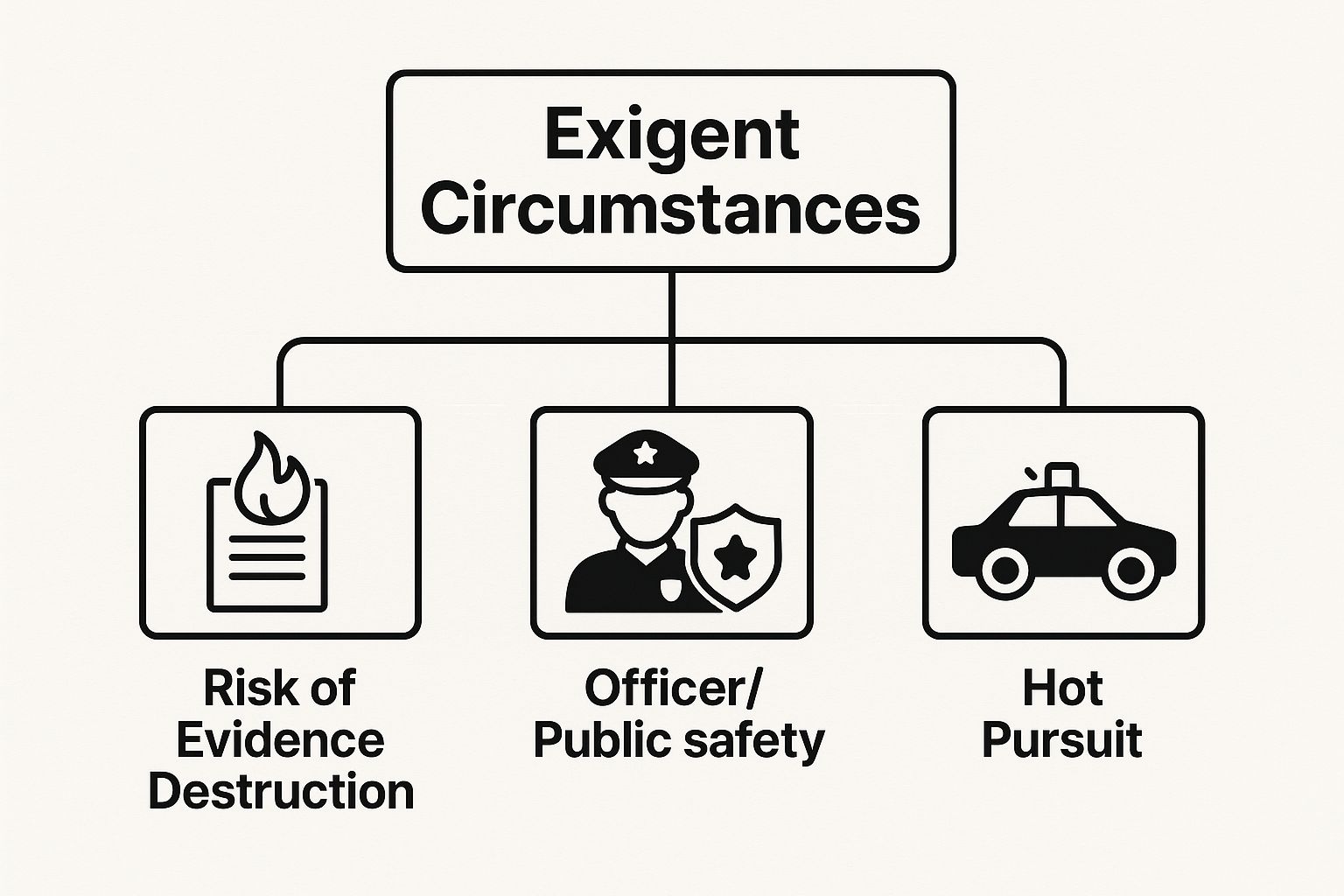
As the graphic shows, urgent needs—like stopping someone from destroying evidence—can give police the green light to act immediately without waiting for a warrant.
Each of these exceptions comes with its own set of rules and limitations. If law enforcement oversteps those boundaries, the search can be ruled illegal, and any evidence they found could be thrown out of court. An experienced attorney will meticulously review every report and procedure to make sure your rights were protected. Time is of the essence in these situations.
What to Do After an Illegal Car Search
If you believe police just searched your car illegally, what you do in the minutes and hours that follow can make or break your case. Your first instinct might be to argue or get angry, but the single most important rule is to stay calm during the search itself. Physically resisting is a losing battle on the side of the road and can lead to new charges like resisting arrest, which only makes things worse.
Your real fight doesn’t happen on the shoulder of a Houston highway. It starts the moment the encounter is over, by strategically preparing to challenge the officer’s actions in a court of law. This requires immediate legal assistance.
Immediately Document Everything
Your memory is the most powerful piece of evidence you have right after a traffic stop. As soon as you are safe and able, write down every single detail you can remember. Don’t put it off—memories fade fast, and a tiny detail you forget could have been the key to your entire defense.
Be as specific as possible. Your notes should include things like:
- The exact time and location of the stop.
- The reason the officer gave for pulling you over.
- Everything the officer said to you, and everything you said in return.
- Whether they asked for consent to search, and your precise answer.
- The names or badge numbers of the officers on the scene.
- Whether anyone else was around who might have seen what happened.
This detailed account gives your attorney the raw material they need to start picking apart the legality of the stop and the search that followed. The sooner you get this information to a lawyer, the better.
The Legal Remedy: A Motion to Suppress
When your constitutional rights are violated by an illegal search, the law provides a powerful tool to fix it: the motion to suppress evidence. This is a formal legal challenge filed by your lawyer asking the judge to throw out any evidence the police found illegally.
An illegal search isn’t just a technicality; it’s a direct violation of your Fourth Amendment rights. A successful motion to suppress can get the illegally seized evidence excluded from court, often gutting the prosecution’s case against you. This is not something to attempt without experienced legal representation.
For example, if an officer searched your trunk without probable cause or your consent and found something illegal, that evidence can be suppressed. Without their main piece of evidence, prosecutors often have no choice but to dismiss the charges completely.
This is why acting fast is so critical. The same principles apply to other parts of a stop, too; knowing your rights is just as important when it comes to refusing field sobriety and chemical tests.
An unlawful search is more than just a mistake by law enforcement—it’s often the cornerstone of a winning defense. But leveraging it requires urgent, skilled legal action to hold police accountable and protect your freedom. Do not wait to seek help.
Answers to Common Questions About Texas Vehicle Searches
Getting pulled over is stressful enough. When an officer starts asking to look around your car, it can be confusing and intimidating. Here are some quick, straightforward answers to the questions we hear most often from drivers in Texas.
If I’m Just a Passenger, Can Police Search My Stuff?
Yes, they often can. If an officer has probable cause to believe there’s contraband somewhere in the car, their authority to search usually extends to any container that could reasonably hide that item. That includes a passenger’s backpack, purse, or luggage.
The key question is whether the probable cause was aimed at the car in general or at a specific person. It’s a subtle but critical distinction, and the specific facts of your encounter will determine whether the search of your personal items was legal. If you were a passenger and your belongings were searched, it is imperative to have your case reviewed by an attorney.
Can the Police Bring a Drug-Sniffing Dog to a Traffic Stop?
In most cases, yes. The Supreme Court has ruled that having a trained K-9 sniff the outside of your car isn’t technically a “search” under the Fourth Amendment. Because of that, police don’t need probable cause to walk a dog around your vehicle.
But there’s a major limitation here. An officer cannot legally make you wait an unreasonable amount of time for a K-9 unit to show up. If the officer has already written you a ticket or warning and finished the original purpose of the stop, they are required to let you leave. Holding you there just to wait for a dog could make any evidence they find illegal. This is a frequent point of legal contention and requires an urgent review of the facts of your case.
Exercising your right to refuse a search is a powerful protective measure, not an admission of guilt. While it may feel uncomfortable, stating “Officer, I do not consent to a search” is a clear assertion of your constitutional rights. If police proceed with a search anyway, they must justify it on separate legal grounds.
Does Saying “No” to a Search Make Me Look Guilty?
Absolutely not. You have a constitutional right to refuse a search, and your refusal cannot be used against you as the sole reason to create probable cause.
Politely saying, “Officer, I do not consent to a search,” is simply you exercising a right, not admitting you did something wrong. If the police decide to search your vehicle anyway, the burden is on them to prove their actions were justified by another legal exception. An experienced attorney will make sure your proper assertion of your rights isn’t twisted into an admission of guilt in court. Knowing you have the right to say no is the first step in protecting yourself, and seeking immediate legal counsel is the critical next step.
Discover more from David Smith Law Firm, PLLC
Subscribe to get the latest posts sent to your email.