

Being hit with a first-time assault charge in Texas is a terrifying and disorienting experience. One moment, life is normal; the next, you are facing a criminal justice system in Houston that can feel overwhelming and hostile. While this is an undeniably serious situation, it is not hopeless. The key is understanding what you are up against and recognizing the urgent need for a strategic defense, because the actions you take right now are the most critical ones you will make.
What Really Happens After an Assault Arrest in Texas
An arrest in Harris County can be over in minutes, but the legal fallout can last for years. The initial moments are often a blur of confusion, flashing lights, and urgent questions. It is critical to understand that the second the state gets involved, everything changes. What might have started as a heated argument or a simple misunderstanding is now a formal criminal case. You are no longer in control.
From the moment an officer makes an arrest, the case is officially out of the alleged victim’s hands. This is where one of the most dangerous myths in Texas criminal law trips people up: the belief that the person who called 911 can simply “drop the charges.” They cannot.
Once a criminal charge is filed in Texas, the case belongs to the State. The Harris County District Attorney’s Office takes over. The alleged complaining witness becomes just a witness for the state, and they have zero power to decide whether the case goes forward or gets dismissed.
This means that even if the other person has a change of heart, regrets calling the police, or states they do not want to press charges, the prosecutor can—and very often will—push the case forward anyway. They will make their decision based on the evidence they have, such as the police report, photos from the scene, and any witness statements gathered.
The First Steps in the Legal Maze
Your journey through the Texas criminal justice system kicks off the second you’re in handcuffs. Getting a handle on these initial stages is vital, as every action taken here can shape the outcome of your entire case. Here’s what you can expect right away:
- Booking and Processing: Once you’re in custody, you will be “booked in.” This is the administrative part—they’ll take your fingerprints, snap a mugshot, and record all your personal information.
- Seeing the Magistrate (Arraignment): You’ll be brought before a judge or magistrate. They will formally inform you of the charges you’re facing, set your bail conditions, and might even issue a protective order on the spot.
- Getting Out on Bail or Bond: The court decides if you can be released from jail while your case is pending. If so, they’ll set a bond amount—the money or collateral required to guarantee you’ll show up for future court dates.
Attempting to navigate these first steps without a skilled criminal defense lawyer is a high-stakes gamble. An attorney can immediately start fighting for reasonable bail conditions and begin building your defense strategy from day one. Every single decision matters—from what you say to the police to how you handle that first court appearance. You should not face this alone. Securing the right legal representation is the single most important thing you can do for your future.
Understanding the Different Types of Texas Assault Charges
In Texas, “assault” is a broad term. It covers a wide range of actions, from an unwanted touch that causes no pain to a life-threatening attack. The very first step in building a solid defense is understanding exactly what kind of charge you’re up against.
Think of it like this: a parking ticket is a minor annoyance with a small fine, but a DWI is a serious criminal matter that can land you in jail. Texas assault charges work the same way, falling on a spectrum from less severe misdemeanors to devastating felonies. The state does not treat them all the same, and each level has its own rules, required evidence, and potential consequences.

From Misdemeanors to Felonies
How a first time assault charge in Texas is classified depends entirely on the specific facts of the incident. Prosecutors in Houston will look at several key factors to decide which charge to file, and these elements can dramatically elevate a case from a minor offense to a major one.
Here are the main classifications you might see:
- Class C Misdemeanor Assault: This is the lowest level of assault, often compared to a traffic ticket. It usually involves offensive physical contact where no one was actually hurt.
- Class A Misdemeanor Assault: This is a much more serious charge. It typically comes into play when an act causes bodily injury to someone else. A conviction here can mean significant jail time and hefty fines. Bodily injury simply means pain and doesn’t require actual visible injuries.
- Third-Degree Felony Assault: A charge can jump to the felony level if the alleged assault involves certain situations, like assaulting a public servant or if it’s a family violence case and you have a prior conviction, or if it is alleged the breath or circulation of the complaining witness was impeded.
- Second-Degree Felony (Aggravated Assault): This is reserved for the most serious cases. An assault becomes “aggravated” if it causes serious bodily injury or if a deadly weapon was used or even just shown. The penalties increase dramatically here.
- First-Degree Felony (Aggravated Assault +SBI+DW+FV): This level is reserved for allegations of the most serious type of assault–one that involves allegations of causing serious bodily injury, using or exhibit a deadly weapon, and the complaining witness meets the definition of family or household member.
The line between these levels can be blurry, and that’s often where a skilled defense attorney can make a huge impact by challenging the prosecution’s version of the facts. You can dig deeper into the various https://www.davidsmith.law/practice-areas/assault/ and their complexities.
What Elevates an Assault Charge?
Certain factors act as “enhancements,” giving prosecutors the power to file much more severe charges. It’s critical to understand these triggers, as they can turn a simple misdemeanor allegation into a felony with life-altering consequences.
The presence of a weapon, the severity of the alleged injury, or your relationship to the accuser can all dramatically change the legal stakes. What the prosecution has to prove becomes more complex, but the potential penalties also become far more severe.
For example, a simple push might be a Class C misdemeanor. But if that same push causes someone to fall and break an arm (“bodily injury”), it instantly becomes a Class A misdemeanor. If the argument was with a family member, it could be charged as assault family violence, which carries its own unique and harsh set of penalties.
While many first-time assault charges are simple assault, things can escalate quickly. A simple assault can range from a Class C misdemeanor (fine up to $500, no jail) to a Class A misdemeanor (fines up to $4,000 and up to a year in jail) if there’s an injury. Aggravated assault, on the other hand, is always a felony with much harsher outcomes. The stakes are simply too high to face these distinctions without expert legal guidance.
Navigating the Texas Criminal Court Process
If you’re facing a first-time assault charge in Texas, the criminal court system can feel like stepping into another world. It has its own language, its own rules, and the whole process is often slow, confusing, and incredibly intimidating, especially in a large jurisdiction like Harris County.
Understanding the road ahead can make a huge difference. It helps cut through the anxiety and shows you where the critical moments are—the points where the right decision can completely change your future. The journey starts the second an arrest is made, and from then on, a series of formal legal steps begin to unfold.
From Arrest to Arraignment
After the arrest and booking process, the first major event you’ll face is the arraignment. This is your first formal appearance in court, where a judge will read the official charges against you. You’ll then be asked to enter a plea—usually “guilty,” “not guilty,” or “no contest.”
But this hearing is much more than a formality. It’s a critical early moment where decisions about bail and your release conditions are made. A sharp attorney can argue for a lower bond amount or even for your release on a personal recognizance bond, which doesn’t require you to pay anything upfront. To get a better handle on this first step, you can learn more about what happens at an arraignment hearing and why it sets the tone for your entire case.
The path from an incident to a final court resolution is a sequence of defined stages, each one requiring careful navigation.
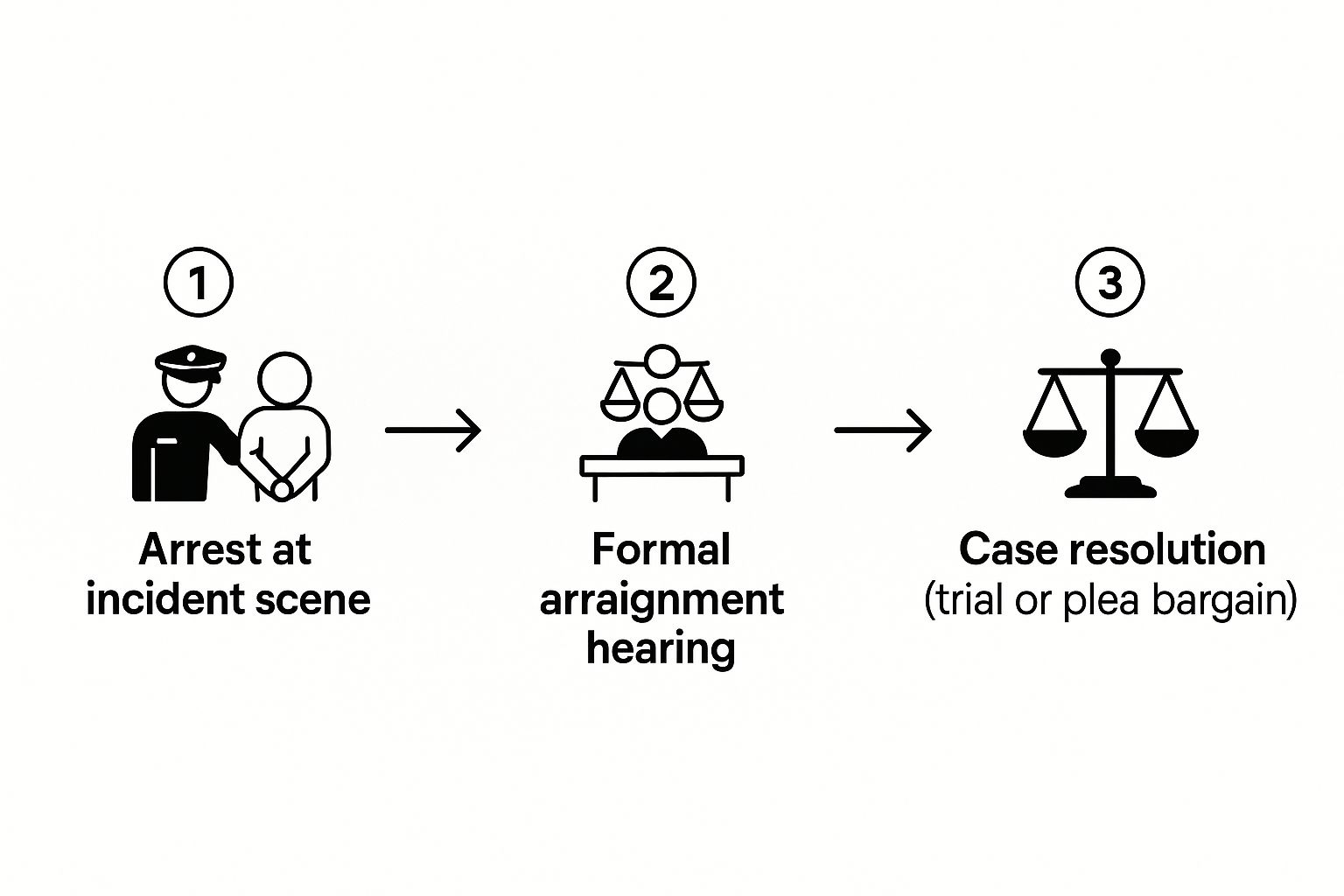
As you can see, this isn’t a single event but a process. Protecting your rights at every stage is imperative.
Pre-Trial Phase: The Heart of the Battle
The time between your arraignment and a potential trial is known as the pre-trial phase. This is not a passive waiting game; it’s where the real legal work happens and where a strong defense is built from the ground up.
During this period, your lawyer will be focused on several key activities:
- Discovery: Your attorney will formally request and dig into every piece of evidence the prosecution has against you. This means poring over police reports, witness statements, photos, videos, and anything else they plan to use. This is where weaknesses in their case are found.
- Pre-Trial Motions: A good lawyer can file motions to challenge the evidence itself. For instance, if evidence was collected during an illegal search or if your rights were violated during questioning, a motion to suppress that evidence can be filed. A successful motion can gut the prosecution’s case before it even gets started.
- Negotiations with the Prosecutor: Armed with the facts and any weaknesses uncovered, your attorney will negotiate directly with the prosecutor. This is often where cases get resolved long before anyone sees the inside of a courtroom.
The goal here is simple: achieve the best possible outcome. That could mean getting the charges dismissed completely, reduced to a lesser offense, or securing a favorable plea agreement that avoids the risk and stress of a trial.
Case Resolution: Dismissal, Plea Bargain, or Trial
Ultimately, every criminal case ends in one of three ways: a dismissal, a plea agreement or a trial. The overwhelming majority of cases in Texas—and everywhere else—are resolved through plea bargains. A plea bargain is a negotiated deal where an agreement is made in exchange for a lighter sentence or a reduced charge.
But if a fair deal cannot be reached, your case will head to trial. There, the prosecutor has the massive burden of proving your guilt beyond a reasonable doubt to a jury or a judge. This is the highest standard of proof in our legal system.
A skilled defense attorney’s job is to challenge the state’s evidence, cross-examine their witnesses, and tell your side of the story to create that doubt. Deciding whether to accept a plea or take your chances at trial is one of the most important decisions you’ll make. It’s a conversation you must have with an attorney who can clearly lay out the risks and potential rewards of each path.
Common Defenses Against an Assault Charge
Getting arrested is not the same as getting convicted. An arrest is just the start of the legal process, and just because you’ve been charged doesn’t mean the state can prove its case.
In Texas, the prosecutor has the heavy burden of proving every single element of the assault charge against you beyond a reasonable doubt. A strong defense is all about poking holes in their story, providing context at times, and showing a judge or jury that reasonable doubt exists.
For anyone facing a first-time assault charge in Texas, understanding your defense options is the first step toward taking control of the situation. These aren’t just legal loopholes; they’re powerful arguments based on facts and your constitutional rights that can lead to a dismissal, reduced charges, or a “not guilty” verdict. It all starts with a deep dive into the facts of what really happened.

Arguing Self-Defense or Defense of Others
This is one of the most powerful and common defenses in assault cases. Texas law is clear: you have the right to protect yourself and others from harm. But you cannot just claim self-defense; it must be proven.
To make a successful self-defense claim, your attorney must show that you had a reasonable belief that force was immediately necessary to stop someone else from using unlawful force against you. Just as important, the force you used must be proportional to the threat you were facing.
For example, imagine someone backs you into a corner, gets in your face, and raises their fist as if to swing. Pushing them away to create space and escape would likely be considered justified self-defense. The key question is always: would a reasonable person in your exact situation have felt threatened in the same way?
The same logic applies to defending someone else. If you step in to protect a third person from what you reasonably believe is an immediate threat, your actions may be justified under the law.
Challenging the Prosecution’s Evidence
A prosecutor’s case is only as good as the evidence they have. A skilled Houston defense attorney will pick apart every report, statement, and video, looking for weaknesses, inconsistencies, or procedural mistakes. This is often where cases are won long before anyone ever sees a courtroom.
A thorough review will scrutinize:
- Police Reports: Law enforcement officers are human. They can misremember events, leave out crucial details, or write a report that doesn’t match what video evidence shows.
- Witness Statements: Eyewitness testimony can be notoriously unreliable. Witnesses might be biased, have a poor view of the incident, or simply get the facts wrong.
- Video Footage: In this day and age, there is often a camera somewhere. Surveillance footage or a cell phone video can be your best evidence, proving you were not the aggressor or that the accuser’s story doesn’t hold up.
If the police violated your constitutional rights while gathering evidence, your lawyer can file a motion to suppress. If the motion is granted, the prosecutor cannot use that illegally obtained evidence against you—sometimes gutting their entire case.
Lack of Intent and Factual Innocence
For most assault charges, the state must prove you acted intentionally, knowingly, or recklessly. If what happened was a true accident and you never intended to hurt anyone, you have not committed a criminal assault. Bumping into someone in a crowded bar is a world away from intentionally shoving them.
And sometimes, the police simply get it wrong. Cases of mistaken identity happen more than you’d think, especially in chaotic situations with poor lighting. A defense of factual innocence is simple: “It wasn’t me.” To prove it, an attorney would look for alibi witnesses, receipts, or other evidence showing you were somewhere else entirely when the incident occurred.
Building a winning defense takes a deep knowledge of Texas law and a strategic plan for dismantling the state’s case. To find out more about what a strong defense looks like in practice, you can learn about how a lawyer can help get charges dropped or reduced by challenging the prosecutor’s narrative. When your future is at stake, trying to handle this alone is a risk you cannot afford to take.
The Hidden Consequences of an Assault Conviction
The penalties listed in the Texas Penal Code—fines and potential jail time—are only the beginning. The real cost of an assault conviction in Texas goes far beyond the courtroom, creating a ripple effect that can disrupt your life for years to come.
These are the hidden, long-term consequences that can follow you long after your case is closed. An assault charge isn’t just a fight to stay out of jail; it’s a fight to protect your entire future. A conviction means a permanent criminal record, a red flag that pops up on nearly every background check you’ll face for the rest of your life.
Career and Professional Roadblocks
One of the most immediate and painful impacts of a conviction is on your ability to earn a living. Many employers in the competitive Houston job market will not take a chance on hiring someone with a violent crime on their record, no matter the circumstances. This can slam the door shut on job opportunities you’ve spent years working toward.
For certain professions, the damage is even more severe.
- Licensed Professionals: If you’re a nurse, teacher, real estate agent, or hold another state-issued professional license, an assault conviction can lead to suspension or outright revocation.
- Future Applications: Even if you don’t have a license now, a conviction can stop you from ever getting one, derailing career goals before they even get started.
The impact of a conviction on employment and professional licenses can be a lifelong punishment. Your livelihood and professional reputation are squarely on the line.
A criminal conviction acts like a permanent shadow, affecting not just your freedom, but your fundamental ability to provide for yourself and your family. It quietly closes doors to housing, education, and career advancement.
Personal Freedoms and Family Life
The consequences do not stop when you clock out. A conviction can cut deep into your personal freedoms and relationships. For example, under both Texas and federal law, a conviction for certain types of assault—especially those involving family violence—triggers a lifetime ban on owning or possessing a firearm. This is a constitutional right that, once gone, is gone for good.
It also gives others ammunition to use against you in family court. If you’re going through a divorce or a child custody battle, an assault conviction on your record becomes a powerful weapon for the other side. They can argue you are an unfit parent, potentially limiting or even denying you access to your own children.
Then there’s the social stigma, which is very real. Being labeled a violent person can strain relationships with friends, family, and your community. All of this just reinforces how critical it is to build the strongest possible defense right from the start.
Common Questions About First-Time Assault Charges in Texas
When you’re facing a first-time assault charge, your mind is probably racing with urgent, confusing questions. In moments like these, getting straight answers is what matters most. Here are some of the most common questions people ask when they find themselves in this tough spot.
“Can the Charge Be Dropped if the Complaining Witness Doesn’t Want to Press Charges?”
This is one of the most dangerous and widespread myths in criminal law. Once an arrest is made, the case no longer belongs to the alleged complaining witness—it belongs to the State of Texas. The prosecutor, and the prosecutor alone, decides whether to move the case forward.
Of course, the accuser’s wishes are taken into account. But they are just one witness for the state. Prosecutors can and often do pursue the case even when the victim asks for it to be dropped. This is exactly why you need a defense attorney in your corner; they negotiate directly with the prosecutor who holds all the cards.
“Will I Go to Jail for a First-Offense Assault?”
Jail time is a very real possibility for many assault charges, but it’s not a guarantee—especially for a first offense. The outcome really hinges on the specific charge, the unique facts of what happened, and, most importantly, the strength of your legal defense.
An experienced lawyer can often negotiate for outcomes that protect both your freedom and your permanent record. These alternatives might include:
- Deferred Adjudication: This is a special kind of probation. If you complete it successfully, the charge gets dismissed entirely.
- Probation (Community Supervision): This allows you to stay in the community, but you have to follow specific court-ordered rules.
- Fines or Counseling Programs: Sometimes, a case can be resolved without needing formal probation or any time behind bars.
A powerful legal argument can often convince a prosecutor or judge that putting you in jail is not the right answer.
Your first court date is not a formality. It’s a critical opportunity. The time between your arrest and that first hearing is the most important window for a lawyer to start building your defense, preserving evidence, and opening up a dialogue with the prosecution.
“How Quickly Do I Need to Hire an Attorney?”
Immediately. The moments right after an arrest are when the foundation of a strong defense is built. If you wait, crucial evidence can disappear, witnesses’ memories can fade, and the prosecution gets a valuable head start building its case against you.
Getting a qualified criminal defense attorney involved early gives you the best shot at protecting your rights. A lawyer can get to work right away, potentially changing the entire direction of your case long before it ever gets near a courtroom. Do not wait to make the call.
Discover more from David Smith Law Firm, PLLC
Subscribe to get the latest posts sent to your email.