

When you’re facing an assault allegation in Texas, one of the most pressing questions is about time. Is it on your side? The law governing this is the statute of limitations, a critical deadline for prosecutors. For assault charges, this is typically two years for a misdemeanor and three years for a felony.
This isn’t a minor legal technicality; it’s a hard deadline that dictates how long the State of Texas has to file formal charges. Think of it as a shot clock in a basketball game—once that clock runs out, the prosecution can no longer take a shot. The sense of urgency this creates is real, and for anyone accused of a crime in the Houston area, every day that passes is significant.
Understanding the Ticking Clock on Texas Assault Charges
The statute of limitations is a powerful legal doctrine. It represents the state’s final opportunity to bring a case against you. Once this legal clock expires, the government generally loses its authority to prosecute, regardless of the evidence they might have.
This built-in deadline creates an immediate need for strategic action. Understanding these timelines isn’t just helpful; it’s the foundational first step in building a formidable defense. From the moment an allegation is made, the clock is running, and every single day matters in the fight to protect your future. Acting with urgency is not just an option; it’s a necessity.
Defining the Deadlines for Different Assault Charges
Not all assault charges carry the same weight, and neither do their deadlines. The seriousness of the alleged offense dictates the timeline. The distinction between a misdemeanor and a felony is the most crucial factor, as it dramatically changes how much time the state has to make its move against you.
Here’s a quick breakdown of the general rules:
- Misdemeanor Assault: These are less severe charges, such as a simple bar fight (Class A Assault) or a verbal threat that constitutes an assault (Class C Assault). For these offenses, prosecutors typically have a two-year statute of limitations.
- Felony Assault: This category includes more serious allegations like Aggravated Assault or certain domestic violence cases. Here, the timeline extends, usually to three years or more.
To help you visualize how these timelines compare, here’s a quick-reference table.
Texas Assault Charges and Their Statutes of Limitations
This table breaks down the standard time limits prosecutors have to file different types of assault charges in Texas.
| Type of Assault Charge | Classification | Statute of Limitations |
|---|---|---|
| Simple Assault (Threatening) | Class C Misdemeanor | 2 years |
| Assault Causing Bodily Injury | Class A Misdemeanor | 2 years |
| Aggravated Assault | Second-Degree Felony | 3 years |
| Aggravated Assault w/ Deadly Weapon | First-Degree Felony | 3 years |
| Assault on a Public Servant | Third-Degree Felony | 3 years |
Remember, these are general guidelines. As we’ll explore, there are critical exceptions that can change everything, making professional legal analysis indispensable.
This visual helps clarify the standard time limits for filing assault charges in Texas.
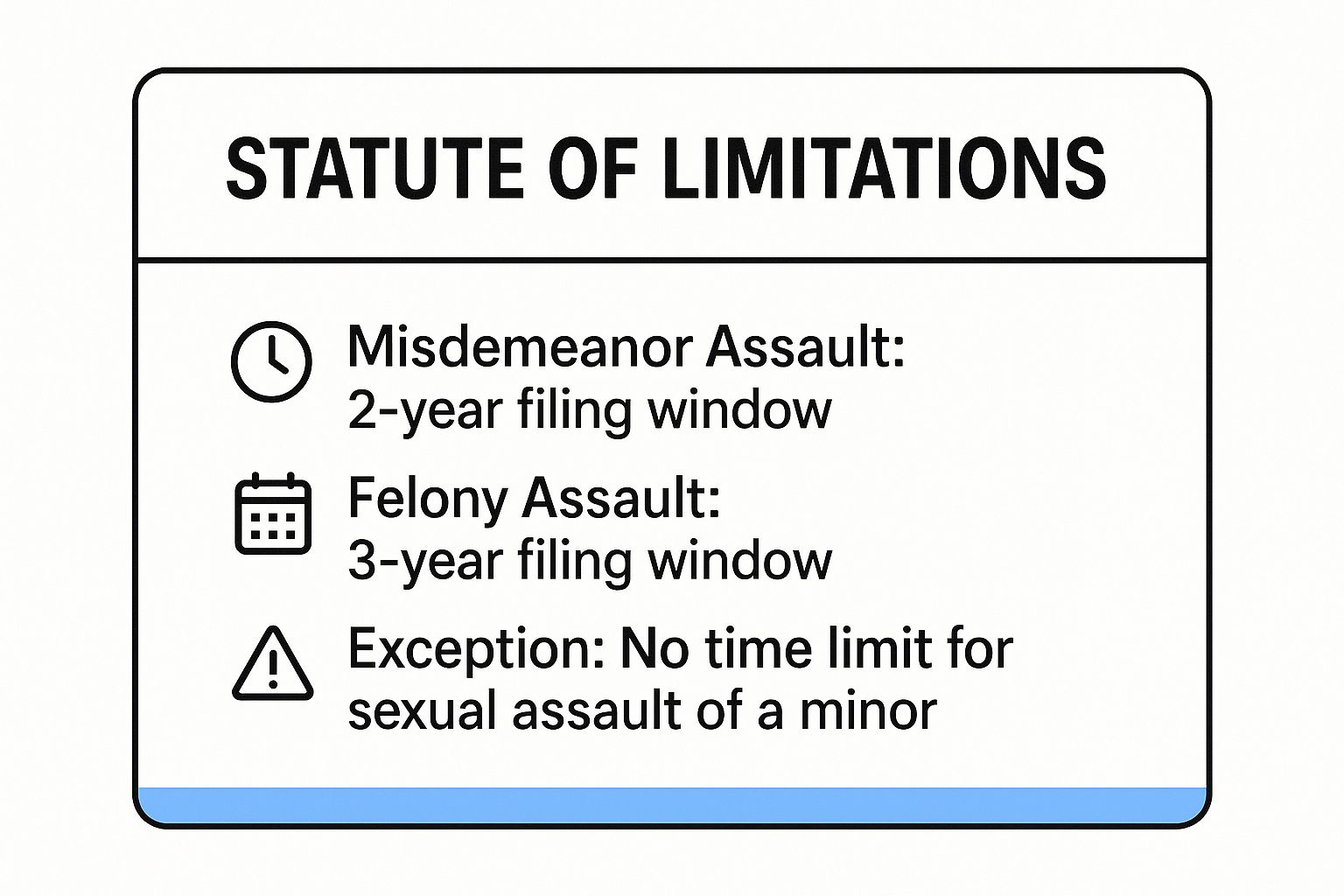
As the infographic shows, it’s a two-year window for misdemeanors and a three-year window for most felonies. But notice the critical exception for the most serious offenses—some have no time limit at all, underscoring the gravity of certain allegations.
How Charge Severity Impacts the Legal Timeline
So, why the different deadlines? It all comes down to how Texas law classifies the offense. For a simple assault—the least severe type—the statute of limitations is a firm two years from the date of the incident. If the District Attorney’s office doesn’t file charges by then, the case cannot legally move forward.
When bodily injury is involved, the situation becomes more complex. If it’s charged as a misdemeanor, the two-year limit still applies. If it an alleged assault family violence misdemeanor, it is a three year statute of limitations. But if circumstances elevate it to a felony, the clock extends to three years. For a deeper dive into these charges, you can find a detailed overview of Texas assault laws on our site.
The specific classification of an assault charge—whether it’s a misdemeanor or a felony—is the single most important factor in determining the statute of limitations. An incorrect assumption about this deadline can have irreversible consequences for your defense.
This isn’t just academic theory; it’s a crucial piece of strategic information for anyone accused of assault in Houston. A skilled criminal defense attorney can analyze the specifics of your situation to determine the correct deadline. And it’s critical to remember these timelines aren’t always set in stone. Various legal exceptions can pause or even extend the clock, which we’ll cover next.
Why These Legal Deadlines Exist and What They Mean for You

Statutes of limitations aren’t arbitrary rules designed to complicate the legal system. They are a fundamental part of a fair and reliable justice process, built to balance the rights of the accused with the state’s duty to prosecute. These deadlines exist for practical reasons that ultimately protect everyone involved.
At their core, these laws acknowledge a simple truth: time erodes certainty. As weeks turn into months and months bleed into years, the integrity of a criminal case can weaken dramatically. Understanding this concept is the first step in seeing why the statute of limitations for assault in Texas is such a powerful legal tool.
Preserving the Integrity of Evidence
One of the primary reasons for these deadlines is to ensure legal decisions are based on solid, reliable evidence. You can think of evidence as having a ‘shelf life.’ After a certain point, its quality becomes questionable, making a fair trial nearly impossible.
This applies to everything from physical proof to human memory. Over time, physical evidence like photos, documents, or even DNA samples can be lost, degrade, or become contaminated. More importantly, people’s memories fade and become distorted. A case built on faint recollections from years ago rests on a shaky foundation for justice.
The purpose of a statute of limitations is to compel the exercise of a right of action within a reasonable time so that the opposing party has a fair opportunity to defend. This prevents stale claims and ensures that cases are decided on evidence that is still fresh and reliable.
By setting a firm deadline, the law promotes prompt investigations and prosecutions while evidence is still intact and memories are clear. This ensures that if a case does go to trial, it’s decided on the most accurate information available—not speculation. Grasping these time limits is a key part of effective strategies for managing litigation risk.
Protecting Individuals from Endless Threats
Imagine living under the constant, unending threat of being charged for something that happened decades ago. That kind of uncertainty would make it impossible to move on with your life, secure a job, or maintain relationships. Statutes of limitations are a critical safeguard against this exact scenario.
They provide something lawyers call legal repose—a sense of finality and closure. Once a certain amount of time has passed, you can be reasonably sure that you won’t face prosecution for a past event. This principle offers several key protections:
- Finality: It prevents the state from holding the threat of prosecution over someone’s head indefinitely.
- Fairness: It ensures you can build a defense while you can still locate witnesses and access evidence.
- Stability: It allows individuals to move forward without the constant fear of old accusations resurfacing.
Without these deadlines, the power would be skewed heavily in favor of the prosecution, which could theoretically wait forever to bring charges. This protection is a cornerstone of our legal system’s commitment to fairness.
The Deadline as a Critical Defense Strategy
For someone accused of assault in the Greater Houston area, this legal expiration date can be more than just a procedural rule—it can be the key to getting a case dismissed entirely. The time leading up to the deadline is fraught with uncertainty, but once that clock runs out, a powerful defense emerges.
An experienced criminal defense attorney will meticulously dissect the timeline of events. They’ll pinpoint the exact date of the alleged incident and calculate the deadline based on the specific charge. If the prosecution files charges even one day too late, a motion to dismiss can be filed on the grounds that the statute of limitations has expired.
This isn’t a loophole; it’s a fundamental right. Successfully arguing that the deadline has passed can end a case before it truly begins, saving you the stress, time, and expense of a trial. It highlights just how critical it is to seek legal help immediately, as a detailed timeline analysis could be your strongest defense.
How the Prosecution’s Clock Can Be Paused
The statute of limitations isn’t always a simple countdown. In criminal law, certain situations can hit a pause button on the prosecution’s clock. This legal concept is known as tolling, and it’s one of the most critical complexities of the statute of limitations for assault in Texas.
Think of it like pausing a stopwatch during a race. The race isn’t over; the clock just stops running temporarily, extending the total time available to finish. This legal mechanism means you can never simply assume a deadline has passed and you’re in the clear.
Tolling adds a layer of legal uncertainty that makes navigating this on your own incredibly risky. An event that seems like a distant memory might still be well within the legal window for prosecution if the clock was paused along the way.
Common Reasons the Clock Stops Ticking
Texas law specifies situations that can suspend, or “toll,” the statute of limitations. These rules are designed to prevent individuals from evading justice by simply disappearing for a few years. Understanding these scenarios is vital because they can dramatically alter the timeline of a case.
The most common reason for tolling is straightforward: the accused person is not present in Texas.
- Leaving the State: If a person leaves Texas after an alleged assault, the statute of limitations clock can be paused for the entire duration they are gone. This rule prevents someone from simply moving to another state to wait out the deadline.
- The Clock Resumes: The moment the person returns to Texas, the clock starts ticking again right where it left off.
This ensures that geography doesn’t become a get-out-of-jail-free card. The law is structured to hold people accountable, regardless of where they may try to go.
The Impact of a Pending Indictment
Another major event that stops the clock is the formal filing of charges. Once an indictment or information is filed in court against someone, the statute of limitations clock stops permanently for that specific charge.
An indictment is a formal accusation from a grand jury, while an information is a formal charge filed directly by a prosecutor.
The filing of an indictment or information essentially freezes the timeline. It means the State has officially commenced its case within the legal deadline, so the rest of the court process can unfold without the pressure of an expiring clock.
This means that even if the case takes years to resolve after charges are filed, the statute of limitations defense is no longer available. The legal battle shifts from deadlines to the facts of the case. For anyone facing allegations, this underscores the urgency of getting ahead of the situation before it reaches this formal stage. You can learn more about these crucial first steps and what happens at an arraignment hearing to better understand the court process.
Other Tolling Scenarios to Consider
Beyond leaving the state or a pending indictment, other situations can pause the clock, often related to the circumstances of the complaining witness or unique legal challenges.
Age of Complaining Witness
When the alleged complaining witness is a minor, the statute of limitations is often tolled until they turn 18. This gives them time to come forward and report the incident as an adult.
Fraud or Concealment
If it can be proven that a person took active steps to fraudulently hide their identity or the crime itself, a court may agree to extend the filing deadline.
These exceptions create a complex legal landscape. Determining whether the clock was paused in your specific situation requires a deep understanding of Texas statutes and case law. A miscalculation here could be the difference between getting a case dismissed and facing a long, stressful court battle. This is not something you should try to determine without professional guidance from a seasoned criminal defense attorney.
When Domestic Violence Changes the Timeline

Not all assault allegations are treated equally under Texas law. This is especially true when domestic violence is a factor. If an accusation involves a family or household member, the standard legal timelines don’t just bend—they often break, giving prosecutors significantly more time to file charges against you.
This isn’t an arbitrary legal quirk. The law carves out these exceptions because it recognizes the incredibly complex and sensitive dynamics at play in domestic situations. For anyone in the Houston area facing such an accusation, this distinction is critical. The classification of an assault as “domestic violence” can fundamentally alter the legal landscape, extending the window where you remain at risk of prosecution.
Why the Law Gives Prosecutors More Time
Why the longer clock? The extended statute of limitations for assault in Texas in domestic violence cases is grounded in the harsh realities some complaining witnesses may face. Fear, financial dependence, and emotional manipulation often prevent people from reporting incidents immediately. The legal system acknowledges these hurdles by giving prosecutors a much longer runway to build a case.
Several factors justify this extension:
- Fear of Retaliation: Complaining witnesses can be terrified of worsening their situation or endangering their children by speaking up.
- Emotional Complexity: The decision to report a loved one is rarely simple or quick.
- Financial Dependence: When the accused is the primary provider, reporting an incident can feel like a threat to the reportee’s ability to provide for themselves.
By stretching the deadline, the law aims to provide complaining witnesses more opportunity to come forward, ensuring the justice system can intervene even after significant time has passed. It’s a clear signal that the state views domestic violence as a uniquely serious offense requiring special legal handling.
Recent Legislative Changes Extend Deadlines Even Further
And that clock has recently gotten longer. The Texas Legislature has acted to give prosecutors even more time in these sensitive cases, reflecting a commitment to holding offenders accountable.
As of September 1, 2023, a new law dramatically extended the statute of limitations for domestic violence charges. Under House Bill 467, the deadline for misdemeanor domestic violence jumped from two to three years. For felony domestic violence, it went from three to five years. You can learn more about these significant updates to Texas domestic violence laws.
This recent change is a massive development. It means an old allegation that might have been too late to prosecute under the old rules could now be very much active.
The extension of these deadlines highlights a clear trend: Texas is providing prosecutors with more powerful tools and longer timelines to pursue domestic violence allegations. Relying on an outdated understanding of the law is a dangerous gamble.
This legal shift makes obtaining immediate legal guidance more critical than ever. What you thought you knew about the deadlines may no longer apply, and this new reality could have profound consequences for your case.
Comparing Statutes of Limitations Standard vs Domestic Assault in Texas
When you see the timelines side-by-side, the practical impact of these new rules becomes crystal clear. The “domestic violence” label can trigger years of additional legal exposure.
| Charge Type | Standard Assault Limitation | Domestic Violence Assault Limitation |
|---|---|---|
| Misdemeanor Assault | 2 years | 3 years |
| Felony Assault | 3 years | 5 years |
As the table shows, a standard misdemeanor assault case is time-barred after two years. But if it’s classified as domestic violence, that case remains a threat for a full three years. Likewise, a felony accusation gets an extra two years tacked on. This isn’t a minor tweak; it’s a fundamental change to your legal jeopardy.
This added time creates a long, stressful period of uncertainty and risk. The complexity of these rules, combined with the severe penalties for a domestic violence conviction, makes attempting to handle this alone a grave mistake. A skilled attorney can dig into the specifics of your situation, determine the correct deadline, and begin building a defense tailored to the facts.
The Critical Window Before Charges Are Filed
An assault allegation doesn’t materialize in court overnight. There is a critical, often misunderstood period between the initial police report and the prosecutor’s final decision—the pre-charge investigation. This is not a time for passive waiting. It is an active phase where law enforcement builds its case against you, and it represents your single best opportunity to influence the outcome.
What happens here can set the course for your entire future. It’s a window of opportunity where a proactive defense can make a monumental difference. Many people mistakenly believe they can’t do anything until they are formally charged, but that is a costly error. The steps you take—or fail to take—right now can dramatically impact whether charges are ever filed at all.
The Journey from Allegation to Formal Charge
When someone reports an assault in the Greater Houston area, a specific process begins. It’s not simply one person’s word against another’s; police and prosecutors follow a methodical path to decide if there is enough evidence to build a criminal case.
First, a police report is filed. That document triggers an investigation. An officer or detective starts gathering evidence, piecing together a narrative of what occurred. Without early intervention, that narrative will be shaped entirely by law enforcement and your accuser.
This evidence-gathering phase typically includes:
- Witness Interviews: Investigators will locate and question anyone who might have seen or heard something relevant.
- Evidence Collection: This could involve taking photos of alleged injuries, securing surveillance footage, or collecting physical items from the scene.
- A Statement from You: Law enforcement will almost always attempt to get you to talk.
Once the police compile their file, they forward it to the District Attorney’s office. A prosecutor then reviews everything and makes the final decision. They determine whether to file charges, what specific charges to file (a misdemeanor vs. a felony), or to “decline” the case and drop the matter entirely.
Why Early Intervention Is a Game Changer
The pre-charge investigation is the most crucial stage of any criminal case. During this period, a skilled defense attorney does far more than just wait. They can actively intervene, engage with investigators, and work to shape the narrative before it solidifies into a formal charge.
This is not about obstructing justice; it’s about ensuring your side of the story is heard from the very beginning. An attorney can uncover favorable evidence that law enforcement may have missed or was unaware of. This could involve finding witnesses the police overlooked, discovering text messages that provide crucial context, or presenting information that calls the accuser’s credibility into question.
The goal of pre-charge intervention is to give the District Attorney’s office a complete picture, not just the one-sided version from the police report. When a prosecutor sees from day one that there are serious weaknesses or contradictions in their case, they are far more likely to consider reducing the charges or declining to prosecute altogether.
This proactive approach is incredibly powerful. By identifying holes in the prosecution’s theory before it ever reaches a courtroom, a defense attorney can sometimes stop a case dead in its tracks. It transforms you from a passive subject of an investigation into an active participant in your own defense—and that can change everything.
The Strategic Advantage of a Proactive Defense
Engaging a lawyer the moment you learn of an allegation provides a massive strategic advantage. Instead of reacting to charges already filed, your attorney can work to prevent them from ever materializing. This early intervention involves several key actions.
A defense lawyer can:
- Serve as a Barrier: They can handle all communication with investigators for you, preventing you from making statements that could be twisted or used against you later.
- Conduct an Independent Investigation: They can gather evidence and interview witnesses while memories are still fresh, preserving key facts that might otherwise disappear over time.
- Present Mitigating Evidence: Information about your character, clean record, or other circumstances can be presented to the prosecutor to argue for a more favorable outcome.
Ultimately, the time before charges are filed is your single best opportunity to influence the outcome. If you wait until you’re arrested or served with court papers, you’ve already lost invaluable ground. The importance of seeking immediate legal help cannot be overstated—it’s the most effective way to protect your rights, your reputation, and your future.
Why Waiting Is the Biggest Mistake You Can Make
Relying on the statute of limitations for assault in Texas to expire on its own is a high-stakes gamble with your freedom. While it can be a powerful defense, it is not a passive shield. The clock isn’t always as simple as it seems—with complexities like tolling rules and special extensions for domestic violence, that deadline might not arrive when you expect.
The time before charges are officially filed is the single most valuable asset you have. Every day that passes, evidence degrades and witness memories fade. A strategic, proactive defense uses this critical window to build a counter-narrative, secure crucial evidence, and interview key people while their recollections are still sharp. Waiting is not a strategy; it’s a surrender of your best opportunity to fight back.
The moment an allegation is made is the moment your defense must begin. Protecting your rights and your future isn’t something to postpone, regardless of where the case stands on the legal timeline.
Don’t Let Time Work Against You
Taking immediate action gives a skilled attorney the chance to engage with investigators and prosecutors from the start. Understanding why hiring an attorney early makes a difference is the first step toward protecting yourself. This pre-charge intervention can sometimes persuade the state to reduce the charges—or never file them at all.
This critical window is precisely why you need experienced legal counsel immediately. Don’t let your best opportunity to defend yourself slip away by waiting.
Got Questions About Texas Assault Deadlines? We’ve Got Answers.
The legal system can be incredibly confusing. Let’s cut through the jargon and get straight to the point on some of the most common questions about the statute of limitations for assault in Texas. Gaining clarity on these concepts is the first step toward taking informed, decisive action.
Can I Be Charged if the Complaining Witness Reports the Assault Years Later?
Yes, absolutely. This is a common and dangerous misconception. The statute of limitations is a deadline for the prosecutor to file charges, not for an alleged complaining witness to file a police report.
A report can be made years after the fact, and as long as the state has enough time left on the clock to investigate and formally charge you, the case can proceed. Never assume you are in the clear just because time has passed since an incident. A late report can easily trigger a full-blown investigation, leading to serious charges you thought were long behind you.
What’s the Difference Between Assault and Aggravated Assault?
The distinction between these two charges is enormous, and it dramatically changes the timeline prosecutors have to work with.
In Texas, a simple assault typically involves threats or causing offensive physical contact. It is usually a misdemeanor, meaning the state has a two-year deadline to file charges.
Aggravated assault, however, is a much more serious felony. This charge applies when an assault allegedly causes “serious bodily injury” or involves the use or exhibition of a deadly weapon. Because of its severity, the statute of limitations is longer—prosecutors generally get up to five years to bring a case.
Does Leaving Texas Stop the Statute of Limitations Clock?
It does, and this is a critical detail to understand. The legal rule of “tolling” allows the statute of limitations clock to be paused if you leave the state after an alleged offense.
This rule is designed to prevent people from evading prosecution by simply moving away and waiting for the deadline to pass. The clock can remain frozen for the entire time you are outside of Texas, and it only resumes ticking the moment you return. This makes it nearly impossible to calculate the true deadline on your own. An old charge you assumed was expired could still be very much active.
Similarly, an old conviction can create lifelong barriers, but it’s important to know your options for moving forward. In some cases, you may be able to explore how to expunge criminal records and clear your name.
An assault allegation isn’t something to face alone. The complexities of legal deadlines and the risk of life-altering consequences demand immediate and experienced legal guidance.
Discover more from David Smith Law Firm, PLLC
Subscribe to get the latest posts sent to your email.