

In Texas, getting your criminal record expunged is a formal legal process designed to permanently destroy the records of an arrest and prosecution. When handled by an experienced attorney, the process completely erases the event from your public record. It offers a true fresh start for those who qualify, but navigating the complex Texas legal system is a significant challenge that requires professional guidance.
Your Path to a Clean Slate in Texas

A criminal record can cast a long shadow, making it harder to get a job in Houston, find a good place to live in Harris County, or even secure a professional license. The weight of a past mistake can feel like a life sentence, closing doors long after you’ve paid your dues. Expungement is the legal remedy designed to lift that weight, but achieving it demands a deep understanding of Texas criminal law.
It’s crucial to understand this isn’t the same as sealing a record. Sealing just hides a record from public view, but an expungement results in the complete destruction of all files related to the arrest. That means you can legally deny the arrest ever happened—a powerful outcome that is difficult to secure without skilled legal representation.
The Real-World Impact of Expungement
The difference between having a record and having it gone is night and day. A successful expungement means you can confidently and legally answer “no” when asked about prior arrests on applications for:
- Employment opportunities
- Apartment and housing rentals
- Admissions to educational programs
- Certain professional licenses
This is a powerful legal tool because it truly restores your reputation and removes the stigma that can follow you for years. It’s a definitive way to reclaim your future from a single moment in your past.
However, the process is far from a simple paperwork drill. Texas law is notoriously complex, with strict eligibility requirements, precise procedural rules, and unforgiving deadlines. Even a small mistake on a petition or a failure to properly notify every relevant agency can get your case denied by a Harris County judge, forcing you to start over or lose your chance entirely.
The legal journey to a clean slate is not a DIY project. It is a formal court proceeding where precision matters. One missed detail can derail the entire effort, which is why working with a knowledgeable criminal defense attorney is so critical to get it right the first time.
Navigating Evolving Legal Standards
Expungement laws have been changing across the United States. There’s a growing trend toward policies that make it easier for people to clear their records, often through automatic sealing or expungement for certain offenses after a set waiting period. In fact, by 2025, several states will have laws that automatically seal misdemeanor convictions—and even some felonies—after three to ten years. You can explore a state-by-state comparison of these evolving laws to see how things are shifting nationally.
While these reforms show progress, Texas still maintains a very specific and often difficult process. Understanding these intricate local rules is the very first step toward figuring out if an expungement is even possible for you. The stakes are simply too high to rely on guesswork when your future is on the line. The only way to chart a clear path forward is with a thorough and professional review of your case history by an attorney who specializes in Houston criminal defense.
Are You Eligible for Expungement in Texas?

Before you can even think about clearing your record, you have to answer the single most important question: are you actually eligible under Texas law? This is the first hurdle, and frankly, it’s where most pro se (self-represented) attempts fail. The rules aren’t a simple checklist; they’re a maze of specific circumstances that require a lawyer’s eye to interpret correctly.
The core idea behind a Texas expungement is to help people whose cases were resolved in their favor. It’s a legal remedy for situations where the justice system never reached a final, guilty verdict. If you don’t meet these strict criteria from the start, a judge will likely deny your petition without a second thought.
Primary Grounds for Eligibility
So, what does a qualifying outcome look like? A criminal defense lawyer can confirm your eligibility, but generally, you might qualify if your case ended in one of these ways:
- You were acquitted. This is the cleanest path. A judge or jury heard the evidence and found you “not guilty.”
- Your case was dismissed. The prosecutor decided to drop the charges, and the time limit for them to refile (the statute of limitations) has passed.
- You were arrested but never formally charged. This happens more than you’d think. Houston police arrest you, but the Harris County District Attorney’s office looks at the file and decides not to pursue a case.
- You completed a pretrial diversion program. These programs, common for first-time offenders in places like Harris County, lead to a dismissal once you finish all the requirements. That dismissal then opens the door to an expungement.
Imagine someone gets arrested for misdemeanor theft in Houston. The prosecutor reviews the evidence, sees it’s too weak to win at trial, and dismisses the case. Once the mandatory waiting period is over, that person is usually a prime candidate to file for an expungement and wipe the arrest from their record.
An expungement is not a reward for good behavior or something you get just because a lot of time has passed. It is a specific legal remedy tied directly to the final outcome of your criminal case, and proving your eligibility requires meticulous legal work.
Strict Waiting Periods Are Mandatory
Even with a dismissal in hand, you can’t just file the next day. Texas law makes you wait. These mandatory waiting periods are non-negotiable and are calculated from the date of your arrest, not the date of the dismissal.
Ignoring these timelines is a surefire way to get your petition denied. The clock starts ticking on the arrest date, and the waiting periods are:
- Class C Misdemeanor: 180 days
- Class A or B Misdemeanor: One year
- Many Felonies: Three years
Why the wait? The law gives the State time to refile charges if they get new evidence before the statute of limitations runs out. Filing too early is a waste of your time and money, demonstrating precisely why professional legal guidance is essential to avoid such costly errors.
What Disqualifies You from Expungement?
Just as crucial as knowing if you qualify is understanding what will block you. The biggest wall you can hit is a final conviction.
If you pleaded guilty or “no contest” and the judge sentenced you to jail time, a fine, or regular probation, you are almost certainly ineligible for an expungement for that offense.
Another common dead end is deferred adjudication. If you successfully completed deferred adjudication for the exact charge you want to expunge, you are barred from seeking an expungement. For example, if you finished deferred adjudication for a drug possession case, you can’t expunge that arrest. You might, however, qualify for a different legal tool called an Order of Nondisclosure. The rules get particularly tricky here, which is why it’s smart to learn more about the specifics of how to expunge a drug crime in Texas to see how these exceptions might apply.
Ultimately, figuring out your eligibility requires a deep dive into your case history—the specific charge, the final disposition, and the key dates. Without that careful analysis from a qualified attorney, you could end up fighting a battle that was lost before it even began.
Why So Few Eligible People Actually Succeed

On paper, getting your record expunged seems straightforward enough. If you meet the criteria, you file some forms, and poof—your record is gone. The reality, however, is a different story. Many Texans who are legally eligible to clear their records never make it to the finish line, getting lost in the fine print of the legal system.
This isn’t just a Texas problem. Researchers call it the ‘uptake puzzle.’ Across the country, studies show that only a tiny fraction of eligible people—often just 1 to 6 percent—actually succeed in getting their records cleared. There’s a massive gap between the law’s intent and its real-world results, mostly due to procedural barriers baked into the system. You can read more about this expungement paradox from the Indiana Law Journal.
The process is a legal minefield. One small mistake can send you right back to square one, often with less money and even more frustration. This is why legal counsel is not a luxury, but a necessity.
The Maze of Procedural Requirements
One of the biggest hurdles is simply navigating the procedural maze. Every county in Texas can have its own local rules, procedures, and preferred forms. A petition that works perfectly in a Dallas court might get tossed out in Houston for failing to follow a specific local custom.
Then there’s the enormous task of identifying and notifying every single government agency that has a record of your arrest. It’s not just the court and the police department that arrested you. The list is surprisingly long and can include:
- The Texas Department of Public Safety (DPS)
- The county or district attorney’s office
- The clerk for the county or district court
- Any municipal court involved
- Any jail or detention center where you were held
If you miss even one of these agencies, your whole effort could be for nothing. The final order from the judge is only as good as the list of agencies it’s sent to. An agency that isn’t properly notified has no legal duty to destroy its records.
Costly Errors in Self-Filed Petitions
It’s tempting to handle the process yourself to save money, but countless self-filed petitions get denied over small but fatal errors. These mistakes often lead to a judge denying the request, forcing you to start all over again—and that includes paying new filing fees.
Here’s a common scenario: Someone in Harris County gets their misdemeanor case dismissed. Thrilled, they download a generic expungement form online and file it right away. What they don’t realize is they filed it two months before the mandatory one-year waiting period was up. The District Attorney’s office files a simple objection, the judge denies the petition, and that’s that. The person is out their filing fee and has wasted months, all because of one miscalculation an attorney would have caught.
A petition for expungement isn’t just a form you fill out—it’s a formal legal pleading. Every statement must be accurate, every date must be correct, and every procedural rule must be followed perfectly.
The Risk of an Uncontested Objection
Even if your petition is flawless, the State can still fight it. The District Attorney’s office reviews every expungement request and has the right to object if they believe you don’t meet the strict legal requirements.
When an objection is filed, the court schedules a hearing. At that point, you’re no longer just filing paperwork; you’re in a live, adversarial legal proceeding. A prosecutor will be there to argue against you. Walking into that hearing alone is like stepping into a boxing ring with no training. You’ll be expected to make legal arguments, present evidence, and respond to the State’s case. It’s in these complex situations where guidance from experienced criminal law practices becomes invaluable. For instance, the legal nuances for different offenses vary significantly, which is why understanding the specifics, like those covered in our guide on jail time and fines for drug crimes in Texas, is so critical.
These hidden complexities are exactly why so many eligible people fail. The system simply isn’t designed for easy DIY navigation. It demands precision, legal knowledge, and a deep understanding of state law and local court rules. When your future is on the line, professional help isn’t a luxury—it’s a critical investment.
Navigating the Texas Expungement Process
It’s a common mistake to think of expungement as just a bit of paperwork. In reality, it’s a formal legal proceeding—a structured journey through the court system with distinct stages, each with its own rules and potential traps. Understanding this process from start to finish shows you why getting every detail right is so important.
Here’s a high-level look at the key steps involved in a typical Texas expungement case.
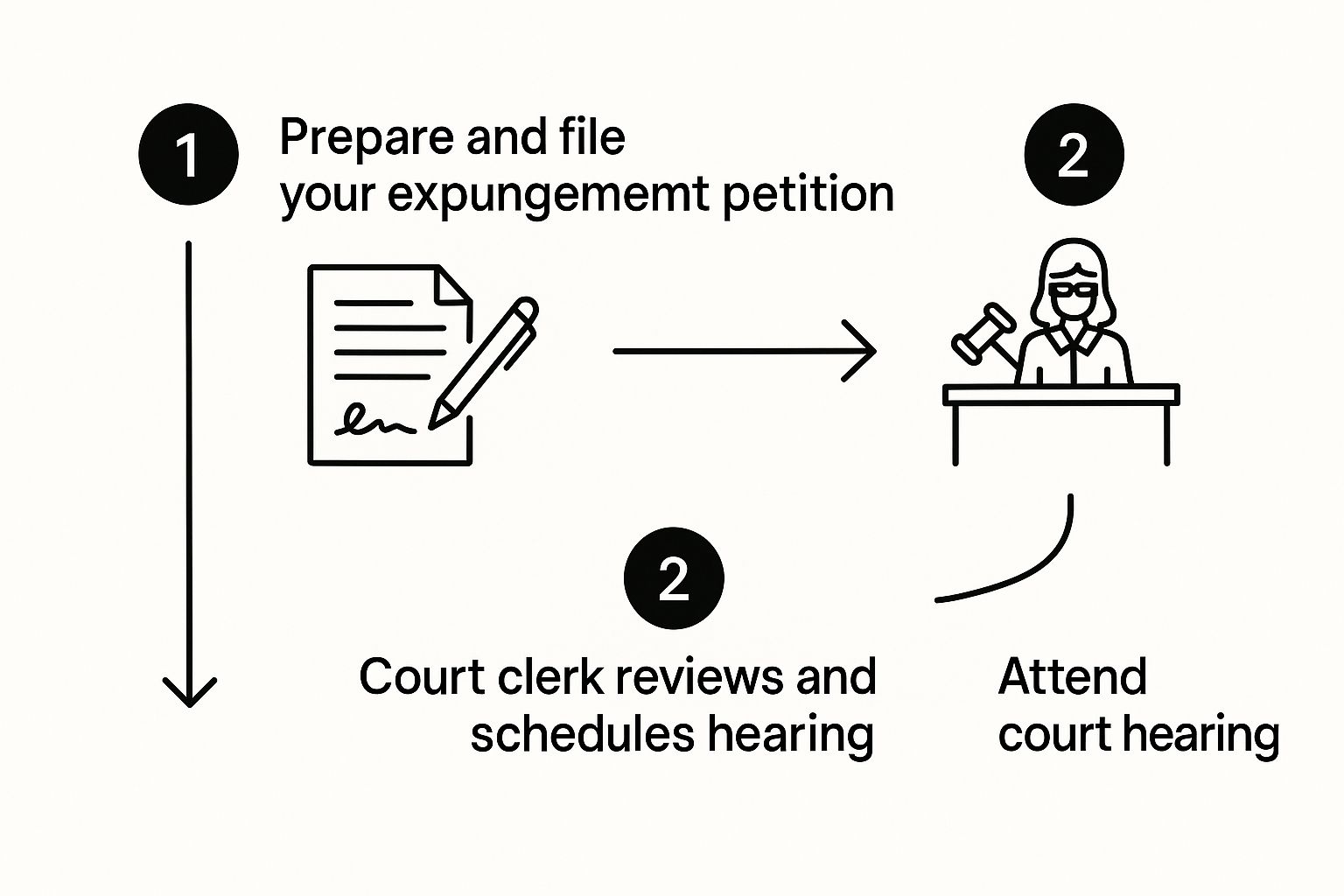
As you can see, the process moves from the initial filing to a court-driven scheduling and hearing phase, which highlights just how formal the procedure is. An attorney is your guide through each of these critical stages.
Preparing and Filing the Petition for Expunction
The whole thing kicks off with one crucial document: the Petition for Expunction. This isn’t just filling out a form; it’s a detailed legal document that must be drafted perfectly. It needs to correctly identify you, the specific arrest you want wiped clean, the date of the arrest, the original charge, and the agency that arrested you.
Even more importantly, you have to list every single government agency that has a record of your case. Think broader than just the police department—this includes the prosecutor’s office, the court clerk, and the Texas Department of Public Safety. If you miss even one, that agency will never get the order to destroy its records. The petition also has to be filed in the right court, which is usually the district court in the county where the arrest happened.
The Petition for Expunction is the foundation of your entire case. If it contains errors, inaccuracies, or fails to meet the legal requirements of the Texas Code of Criminal Procedure, a judge can reject it outright before it ever gets a chance.
The Response Period and Potential Objections
Once the petition is filed, it’s served on all the government agencies you listed. These agencies, especially the District Attorney’s office, have a set amount of time (usually around 30 days) to respond. They’ll pull your file and double-check that you’re actually eligible.
This is where you hold your breath. If no one objects, things can move forward smoothly, often toward an agreed order. But if the DA’s office finds a reason you might not be eligible—maybe a waiting period hasn’t passed or the case wasn’t dismissed in a qualifying way—they will file an objection. An objection instantly turns your case from a simple filing into a contested legal fight that demands an attorney’s intervention.
The Court Hearing and Final Order
If an objection is filed, the court will schedule a hearing. At that hearing, your lawyer must be ready to argue the legal points of your case against a prosecutor. They will need to present evidence and make legal arguments to convince the judge that you meet every single requirement for an expungement under the law. Trying to do this without a deep understanding of Texas law is incredibly risky.
If the judge sides with you—either because no one objected or because you won the hearing—they will sign a Final Order of Expunction. This legally binding document is your ticket to a fresh start. It commands every agency you listed to physically destroy all records related to your arrest.
The table below breaks down the typical timeline you can expect.
Texas Expungement Process Overview
| Stage | Key Action | Typical Duration |
|---|---|---|
| Petition Preparation | Gather all arrest details and draft the Petition for Expunction. | 1-2 weeks |
| Filing and Service | File the petition with the court and serve it on all relevant agencies. | 1-2 weeks |
| Agency Response Period | Agencies (like the DA) review eligibility and decide whether to object. | 30-45 days |
| Hearing or Agreement | If contested, a hearing is set. If not, an agreed order is drafted. | 30-90 days |
| Order Distribution | The signed Order of Expunction is sent to all agencies for compliance. | 30-60 days |
| Record Destruction | Agencies physically destroy records, a process that can take several months. | 60-180 days |
While this timeline gives you a general idea, remember that every case is different. A simple, unopposed expungement will move much faster than one that faces a legal challenge from the prosecutor’s office.
The final step is making sure that order is actually followed. The court clerk sends certified copies to each agency, but it’s crucial to follow up and confirm every single record has been destroyed. This complex process is why many people seek help navigating the ins and outs of Texas expungement and record sealing law. As you get ready to start this journey, knowing there’s professional legal support available can give you some much-needed peace of mind.
When Record Sealing Is Your Best Option
So you’ve discovered your criminal record doesn’t qualify for a full expungement. What now? For a lot of people in Texas, especially those who successfully completed deferred adjudication, this can feel like hitting a wall.
But it’s not the end of the road. There’s another powerful legal tool that can get you much of the way there: an Order of Nondisclosure, which most people just call record sealing.
Understanding the difference is absolutely critical. An expungement wipes your record off the map—it’s completely destroyed. A nondisclosure, on the other hand, seals it from public view. Think of it this way: expungement is like shredding a document into confetti, while sealing is like locking it away in a secure vault where only a few authorized people have the key.
For most day-to-day purposes, the result feels the same. A sealed record won’t pop up on the vast majority of background checks run by private employers, landlords, or universities.
Who Qualifies for an Order of Nondisclosure?
The most common path to sealing a record is by successfully completing deferred adjudication. This is a specific kind of plea deal where you plead guilty or “no contest,” and the judge places you on community supervision (probation) for a set time. If you jump through all the hoops and complete the conditions, the judge dismisses the case. You’re never actually convicted.
While that dismissal is great, it’s also what blocks you from getting an expungement. But here’s the silver lining: that very same outcome is often what makes you eligible for an Order of Nondisclosure. It’s a vital second chance for people who took responsibility and proved they could stay on the right track.
But it’s not automatic. Not every case that ends in deferred adjudication is eligible. Texas law specifically bars certain offenses from ever being sealed, including:
- Murder or Capital Murder
- Any charge that requires sex offender registration
- Most family violence offenses
- Stalking
- Violating a protective order
The rules are notoriously complex and loaded with exceptions. That’s why you absolutely have to get a professional to review the original charge and the final court disposition before you even think about filing.
The Power and Limits of Sealing Your Record
Once a judge signs an Order of Nondisclosure, government agencies are legally forbidden from releasing your case information to the public.
What does that mean in the real world? When a potential employer in Houston runs a standard background check, that sealed offense shouldn’t show up. This can open doors to jobs, apartments, and opportunities that were slammed shut before.
But it’s crucial to understand the record isn’t gone. It’s just hidden. Certain government and state licensing agencies will always be able to see sealed records. These entities include:
- Law enforcement agencies
- State licensing boards (for doctors, lawyers, teachers, etc.)
- Public school districts and hospitals
- Government agencies dealing with national security
An Order of Nondisclosure is designed to clean up your public-facing record, giving you a fresh start. But you have to remember it is not a complete erasure of your past.
Here’s a practical example: if you apply to be a teacher, the school district will still see the sealed offense. But if you apply for a job in retail, IT, or construction, that same record will be hidden from view.
This is exactly why getting personalized legal advice is so important. An experienced criminal defense attorney can analyze your specific situation—your old record and your future goals—to figure out if an Order of Nondisclosure is the right move for you.
For many people who thought they were out of options, discovering they qualify for record sealing is a life-changing moment. It just goes to show that even when the first path is blocked, a skilled guide can almost always find another way forward.
Your Top Questions About Texas Expungement, Answered
Clearing your name brings up a lot of questions. People want to know how long it takes, what’s possible, and what the process actually looks like. Below are some straightforward answers to the questions most often heard from clients considering an expungement in Texas.
Of course, every case has its own unique wrinkles, so the best strategy always comes down to a professional analysis of your specific circumstances.
How Long Does the Expungement Process Take in Houston?
This is the big one, and the honest answer is: it varies. The timeline can be very different depending on the county, the complexity of your record, and whether the Harris County District Attorney’s office decides to fight it.
Generally, you should plan for the process to take anywhere from three to six months from the day a petition is filed.
But delays can and do happen, especially if the paperwork isn’t perfect or a hearing is required. This is where an experienced attorney really makes a difference—they know how to avoid the common procedural mistakes that can set you back for months. The goal is always to file a flawless petition that gives the state no reason to object.
Can I Expunge a Felony Conviction in Texas?
This is a critical point that trips a lot of people up. In Texas, it is almost impossible to expunge a felony conviction. An expungement—the total destruction of the record—is almost always reserved for cases that didn’t end in a conviction.
Think of it this way. You’re likely eligible if you were:
- Arrested, but charges were never actually filed.
- Charged, but the case was later dismissed by the prosecutor.
- Found “not guilty” at trial (an acquittal).
If you finished deferred adjudication for a felony, you’re usually out of luck for an expungement. However, you might be a great candidate for an Order of Nondisclosure (record sealing), which is the next best thing and offers powerful protections. The law is filled with exceptions, so getting a professional case evaluation is the only way to know for sure where you stand.
What Is the Difference Between Expungement and Record Sealing?
The difference here is massive, and it all comes down to what happens to the actual record.
An expungement legally destroys the records of your arrest and prosecution. Once the judge signs that order, it’s like it never happened. You can legally deny the arrest ever occurred on job applications or anywhere else. The record is gone for good.
An Order of Nondisclosure, on the other hand, seals the record from public view. This means private employers, landlords, and nosy neighbors can’t see it on a background check. But—and this is a big but—law enforcement agencies and certain state licensing boards can still access it. Deciding which one you qualify for depends entirely on how your criminal case was resolved.
A successful expungement offers a powerful societal benefit. By giving individuals a true second chance, it dramatically reduces the likelihood of reoffending and promotes long-term stability.
You can see this impact in the research on recidivism. While national statistics show that roughly 77 percent of people released from state prisons are rearrested within five years, the story is completely different for those with cleared records. One major study found that people who had their records expunged had a recidivism rate of only 4 percent over five years. The data is clear: clean slates work. To dig deeper into these findings, you can read more about the impact of record sealing and expungement.
Do I Have to Go to Court for My Expungement?
Not always. If your petition is prepared perfectly and no state agency files an objection, it is often possible to get it done without you ever stepping foot in a courtroom. In these “agreed” cases, the judge simply signs the order based on the legally sound paperwork submitted.
However, if the state objects for any reason, a hearing will be set. In that situation, you absolutely want an experienced criminal defense attorney in your corner. The prosecutor will be there arguing against you, and you’ll need someone who can counter their points with solid legal arguments. The good news is, a skilled attorney can often appear on your behalf, saving you the time and stress of a court appearance while they fight to secure your clean slate.
Navigating the Texas legal system to clear your record requires precision and deep expertise. The complexities of expungement and nondisclosure law make it imperative to seek qualified legal counsel to protect your rights and your future. If you’re ready to see what your options are, an experienced Houston-based criminal defense attorney can provide the guidance you need.
Discover more from David Smith Law Firm, PLLC
Subscribe to get the latest posts sent to your email.