
A drug charge does not define you but it can follow you. A conviction can affect your employment, your housing, your professional licences, your right to possess a firearm, and your immigration status. The weight of that reality is why having the right attorney from the very beginning matters more than most people realize.
David Smith is Board Certified in Criminal Law by the Texas Board of Legal Specialization and a former Brazoria County prosecutor. He has seen how drug cases are built from the other side, what evidence prosecutors rely on, where that evidence is often weak, and how early intervention can change the outcome before charges are even formally filed.

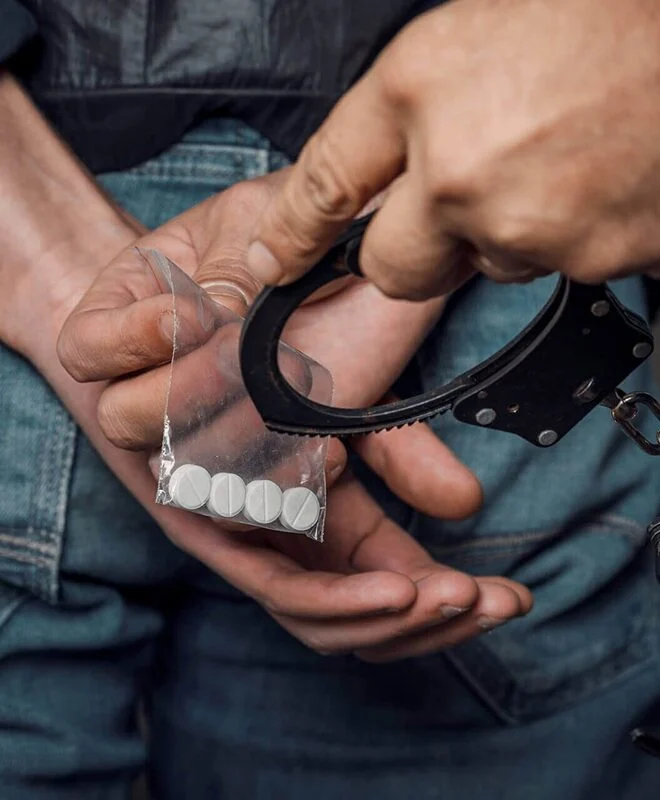
The distinction between legal and illegal possession often comes down to prescription status and quantity. Some controlled substances including cocaine, heroin, and methamphetamine are illegal under all circumstances and cannot be obtained through any lawful prescription. Others, such as opioids, benzodiazepines, and stimulant medications, are legal when properly prescribed but become a criminal matter the moment they are possessed without authorisation, in quantities exceeding the prescribed dosage, or with any indication of intent to distribute.
Under the Texas Controlled Substances Act, drugs are categorised into Penalty Groups 1 through 4, with Penalty Group 1 carrying the most serious penalties. The specific group, the quantity involved, and whether there is any allegation of intent to manufacture or deliver all determine the level of charge. Every one of those factors is also a potential point of challenge: the weight of a substance, its correct identification, and the circumstances under which it was found can all be examined and contested by an experienced drug defence attorney.
What many people facing a drug possession charge do not realize is that the state must prove several specific elements and each one is a potential point of challenge. The substance must be identified correctly. The quantity must be established accurately. And critically, the state must prove that you knowingly possessed the substance. Being near drugs is not the same as possessing them under Texas law. If the drugs were found during an unlawful search or seizure, that evidence may be suppressed entirely which can cause the case to collapse before it ever reaches trial. A conviction of a drug offense carries a mandatory license suspension of at least 180 days.
The distinction between legal and illegal possession often comes down to prescription status and quantity. Some controlled substances including cocaine, heroin, and methamphetamine are illegal under all circumstances and cannot be obtained through any lawful prescription. Others, such as opioids, benzodiazepines, and stimulant medications, are legal when properly prescribed but become a criminal matter the moment they are possessed without authorisation, in quantities exceeding the prescribed dosage, or with any indication of intent to distribute.
Under the Texas Controlled Substances Act, drugs are categorised into Penalty Groups 1 through 4, with Penalty Group 1 carrying the most serious penalties. The specific group, the quantity involved, and whether there is any allegation of intent to manufacture or deliver all determine the level of charge. Every one of those factors is also a potential point of challenge: the weight of a substance, its correct identification, and the circumstances under which it was found can all be examined and contested by an experienced drug defence attorney.
What many people facing a drug possession charge do not realise is that the state must prove several specific elements and each one is a potential point of challenge. The substance must be identified correctly. The quantity must be established accurately. And critically, the state must prove that you knowingly possessed the substance. Being near drugs is not the same as possessing them under Texas law. If the drugs were found during an unlawful search or seizure, that evidence may be suppressed entirely which can cause the case to collapse before it ever reaches trial. A conviction of a drug offense carries a mandatory license suspension of at least 180 days.
A drug arrest can feel overwhelming especially when you are uncertain whether you are facing a misdemeanor or a felony, or whether the charge reflects what actually happened. Texas drug charges fall into several distinct categories, each carrying different penalties and different defence opportunities. Understanding which category applies to your situation is the first step toward building a response.
Under Texas Penal Code §1.07(a)(39), possession means actual care, custody, control, or management of a substance. Proving possession is not always straightforward particularly in cases where drugs are found in a shared space such as a vehicle or home where multiple people were present.
The state must establish that you had knowledge of the substance and exercised control over it. Proximity alone is not sufficient. Texas courts consistently hold that being near drugs does not equal possessing them and building a defence often starts by challenging the specific links the prosecution is relying on to connect you to the substance.
Learn more about Drug Possession defence & charges
When investigators believe you intended to sell or transfer the drugs you are alleged to have possessed, the charge can be significantly enhanced carrying harsher penalties under Texas law and, in some cases, triggering federal prosecution depending on the type of substance and the quantity.
Law enforcement often infers intent from circumstantial evidence: the quantity of the substance, the presence of scales, small baggies, or large amounts of cash. These inferences can be challenged. The burden remains on the state to prove that the evidence genuinely supports a distribution allegation not just that the surrounding circumstances looked suspicious.
Learn more about Drug Distribution defence
Manufacturing or cultivating a controlled substance including producing synthetic drugs, processing raw materials, or growing marijuana is treated as one of the most serious categories of drug charge under Texas law. These allegations are prosecuted aggressively and frequently attract enhanced penalties or federal charges when large scale production or organised activity is alleged.
A manufacturing charge depends entirely on what the evidence actually shows. David Smith Law Firm evaluates the specific facts and physical evidence behind every allegation including whether the items found genuinely support a manufacturing claim or whether the prosecution is overreaching on the available evidence.
Learn more about Drug Conspiracy defence
The penalty you face for a drug charge in Texas depends on three primary factors: the type of controlled substance, the quantity in your possession, and whether there is any allegation of intent to manufacture or deliver. Texas law organises controlled substances into Penalty Groups 1 through 4 under the Texas Controlled Substances Act, with Penalty Group 1 carrying the most severe consequences.
Understanding exactly where your charge falls and whether that classification can be challenged is the foundation of an effective defence. A conviction also carries collateral consequences beyond sentencing. Under Texas law, a drug conviction triggers a mandatory driver’s licence suspension of at least 180 days.
Answer: What you do in the first hours can shape the whole case. Do not talk about what happened to the police or anyone else, because anything you say can be used against you later. Use your right to remain silent and ask for a lawyer. Do not consent to a search of your car, your phone, or your home, even if you believe there is nothing to find, since consent can give up a defense you would otherwise have. Be aware that important deadlines and bond conditions can start right away, so follow any conditions the court sets exactly. Then call a lawyer as soon as you can, because early involvement gives the best chance to protect your rights and your options.
Answer: A drug defense lawyer does far more than show up to court. A lawyer reviews how the stop, the search, and the arrest were handled, because evidence gathered in violation of your rights can sometimes be challenged or kept out. We examine the lab testing, the chain of custody, and whether the state can actually prove the case it has charged. We deal directly with the prosecutor on your behalf, and where the facts support it, we push for a dismissal, a reduction, or another outcome that protects your future. David Smith is Board Certified in Criminal Law by the Texas Board of Legal Specialization and is a former prosecutor, which means your case is handled by someone who knows both sides of a Houston courtroom.
Answer: The cost depends on the facts of your case, including whether the charge is a misdemeanor or a felony, the penalty group involved, how much evidence there is to review, the number of court settings, and whether the case goes to trial. Felony drug cases are more complex and carry higher stakes than a misdemeanor possession charge, so they generally take more work. The most reliable way to get a real answer is to talk through your specific situation with an attorney. We offer a free consultation with no obligation, and you can call any time at (713) 769-5000 to discuss your case and your options.
Answer: Texas sorts controlled substances into penalty groups, and the penalty depends on which group the substance falls in and the total weight involved, which includes any material mixed with the drug, not just the drug itself. A small amount of a lower group substance may be a misdemeanor, while higher group substances or larger weights can be charged as felonies that carry the possibility of prison time. Marijuana is handled under its own separate rules. There can also be added consequences, such as an automatic driver’s license suspension on a drug conviction. Because the penalty range turns on the specific substance and amount, the first step is getting a clear read on exactly what you are charged with. For the offense-specific details, see our possession, distribution, and conspiracy pages.
Answer: Yes, in the right circumstances. Drug charges are sometimes dismissed or reduced when the search that produced the evidence was unlawful, when the state’s evidence is weak, when there are problems with the lab testing or the chain of custody, or through negotiation with the prosecutor. In some cases, a charge can be lowered from a felony to a misdemeanor, and some people may qualify for a program that can lead to a dismissal. Only the prosecutor can dismiss or reduce a charge, so having a lawyer who can challenge the evidence and advocate for you matters from the start. To learn more about program-based options, see our diversion page.
Answer: The strongest defenses depend on the facts, but several come up often. The most common is an unlawful search and seizure, because both the U.S. The Constitution and the Texas Constitution protect you from improper searches, and if law enforcement searches without a valid warrant, proper consent, or a recognized legal exception, the evidence may be suppressed. When key evidence is kept out, the state is often left without a case. Other defenses include a lack of knowledge of the substance, problems with how the drugs were tested, and breaks in the chain of custody. Examining the traffic stop, the basis for the search, and whether proper procedures were followed is a core part of any drug defense.
Answer: It can. An arrest and a pending or past charge can appear on a background check, and a conviction is generally permanent in Texas, since the state does not automatically clear convictions. That record can affect your job, a professional license, housing, financial aid, and, for non-citizens, your immigration status, which is why the outcome of the case matters so much. Some cases that end in a dismissal or a not guilty verdict may qualify to be cleared, and some that involve successfully completed deferred adjudication may qualify to be sealed. To understand whether clearing or sealing your record may be possible in your situation, see our expunction and nondisclosure pages.
Answer: Look for a lawyer whose practice is focused on criminal defense, who knows the local courts and prosecutors, and who has real trial experience rather than someone who simply moves cases toward a quick plea. Board Certification is worth asking about, because in Texas it is granted by the Texas Board of Legal Specialization and signals a high level of tested experience in criminal law. A former prosecutor brings added insight into how the other side builds and values a case. It also helps to ask how the firm communicates, how fees work, and who will actually handle your case. David Smith is Board Certified in Criminal Law and a former prosecutor who handles Houston and the surrounding counties, and we offer a free consultation to talk through your case.

