How to Prepare for a Criminal Trial in Texas: A Winning Guide
Your trial preparation begins the moment you are charged with a crime in Texas. The actions you take within the first crucial 48 hours can fundamentally shape your defense. The strategy is straightforward but critical: remain silent, retain an experienced criminal defense attorney, and quickly get a grasp on the court proceedings barreling your way. These initial decisions will have a lasting impact on every phase of your case.
Your First Moves After an Arrest in Texas
The moments immediately following an arrest in Texas can be a disorienting blur. But while you are trying to process what’s happening, the prosecutor’s office in Harris County or a neighboring jurisdiction is already building its case. They are gathering police reports, scheduling witness interviews, and systematically constructing the narrative they will use against you.
This is not the time to wait and see. This is the moment your defense must spring into action, as every word you utter and every move you make is under intense scrutiny.
The absolute first priority is not to explain your side of the story to law enforcement. It is to invoke your constitutional right to remain silent and unequivocally ask for a lawyer. Even with the best intentions, your statements can be manipulated, taken out of context, or used to fill gaps in the prosecution’s theory. Protecting your future starts with controlling the flow of information.
Understanding the Arraignment Hearing
Shortly after your arrest, you will be brought before a judge for an arraignment hearing. This is your initial formal appearance in court. The judge will read the official charges against you and ask for your plea—typically guilty, not guilty, or no contest.
This is a pivotal moment. The plea you enter has immediate and long-term consequences. Pleading “not guilty” is almost always the correct strategic move at this early stage. It preserves all your legal options and provides your defense lawyer with the necessary time to meticulously review the case.
An impulsive plea entered without the guidance of a skilled attorney can be catastrophic, potentially waiving your right to a trial and leading directly to sentencing.
The choices made at your arraignment can permanently alter your defense strategy. Entering that courtroom without an attorney is like navigating a legal minefield blindfolded—one wrong step can close doors that can never be reopened.
The Urgency of Securing Legal Counsel
Attempting to navigate the initial stages of a criminal case on your own is an immense and unnecessary gamble. The prosecutor is a trained professional whose sole function is to secure a conviction. You require an advocate with an equal level of expertise in your corner, one who will fight for your interests, dissect the state’s evidence, and construct a robust defense.
An experienced Houston criminal defense lawyer begins working immediately. They will:
- Manage all communication: Your lawyer becomes the exclusive point of contact for police and prosecutors, preventing you from making accidental, damaging statements.
- Analyze the charges: They will obtain the complaint and begin searching for weaknesses, procedural errors, or constitutional rights violations.
- Represent you at arraignment: Your attorney ensures the correct plea is entered and will advocate for reasonable bail conditions, fighting for your release while the case is pending.
- Preserve critical evidence: Evidence such as surveillance footage or witness memories can disappear rapidly. A proactive lawyer initiates their own investigation without delay.
To help you focus during this overwhelming period, here is a quick checklist of your immediate priorities.
Immediate Priorities Checklist for Your Defense
This table outlines the most critical actions to take immediately after being charged. Handling these correctly from the outset can make a profound difference in protecting your rights and building a formidable defense.
| Priority Action | Why It Matters for Your Case | Critical Mistake to Avoid |
|---|---|---|
| Exercise Your Right to Remain Silent | Prevents you from accidentally providing incriminating statements or details that can be used against you. | Trying to “explain” your side of the story to the police. They are not there to help you. |
| Request a Lawyer Immediately | Secures professional legal advocacy from the very beginning, ensuring your rights are protected at every step. | Waiting until after your first court appearance. Key strategic decisions are made at the arraignment. |
| Do Not Discuss Your Case with Anyone | Conversations with family, friends, or cellmates are not privileged and can be used as evidence by the prosecution. | Posting about the incident on social media or discussing details over a recorded jail phone line. |
| Plead “Not Guilty” at Arraignment | This preserves all your legal rights, including the right to a trial, and gives your attorney time to review the evidence. | Pleading “guilty” without legal advice, which forfeits your rights and moves you directly to sentencing. |
Taking these steps is not an admission of guilt—it is a smart, strategic move. It ensures your defense is built on the strongest possible foundation from day one.
This infographic illustrates how a defense team methodically constructs your case from the ground up.
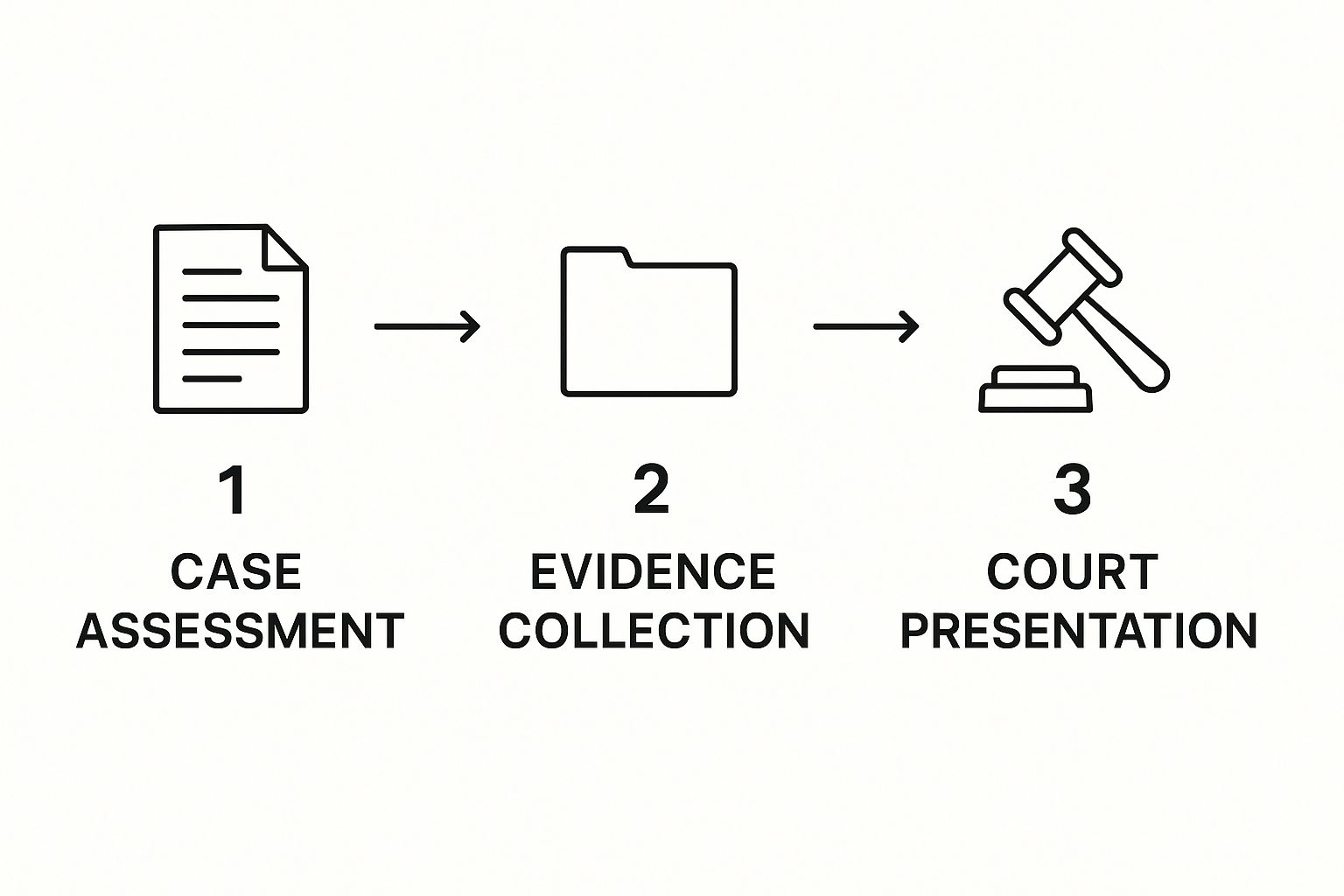
As you can see, a powerful defense is not a single event but a deliberate, multi-stage process. It begins with a deep analysis of the case facts, progresses to our own evidence gathering, and culminates in a strategic presentation in court. The quality of the work in the first two phases directly dictates our strength in the third.
Building a Defense Beyond the Police Report

When you’re facing criminal charges in Houston, it is easy to view the police report as the final word on your case. Many people make this critical error. They read an officer’s sworn statement and assume it’s an unchangeable fact—a dangerous assumption that can pave the road to a conviction.
The reality is that a police report is merely the prosecution’s opening argument. It’s a document crafted to justify an arrest, not to present a complete and unbiased story. A winning defense is never constructed from the state’s version of events. It is built by creating your own compelling counter-narrative.
This is where the intensive work of trial preparation truly begins. It starts with a formal legal process known as discovery, where your attorney demands every piece of evidence the prosecution holds against you—reports, witness statements, lab results, videos, and more. But obtaining their file is just the beginning. The next critical move is to launch a thorough, independent investigation.
Uncovering What the Official Report Leaves Out
Police investigations often conclude the moment they believe they have enough evidence to secure an arrest. They are not obligated to interview every witness or track down every piece of surveillance footage, particularly if it contradicts their theory of the case. A defense investigation operates differently. It picks up where law enforcement left off, driven by a singular goal: to uncover reasonable doubt.
A skilled defense team does not just passively review the state’s evidence; we actively search for what is missing. This frequently involves:
- Finding and Interviewing New Witnesses: Police may have only spoken to individuals who confirmed their narrative. We canvass the area to find people they overlooked—witnesses who saw events from a different angle or can provide crucial, exonerating context.
- Securing Overlooked Video Evidence: In a city like Houston, cameras are ubiquitous. We subpoena footage from nearby businesses, traffic cameras, and Ring doorbells that may depict a version of events entirely different from the one in the officer’s report.
- Re-examining Physical Evidence: The state’s evidence is not infallible. We engage our own trusted experts to re-analyze everything from DNA and fingerprints to cell phone data, looking for errors in the state’s analysis or alternative explanations they disregarded.
This independent deep dive is how you unearth the game-changing details that can completely alter the trajectory of a case.
The Power of an Independent Investigation in Action
Imagine you are arrested for a DWI in Harris County. The police report states you failed the field sobriety tests and refused the breathalyzer. To the prosecutor, this appears to be a straightforward conviction.
But what if a defense investigation uncovers the arresting officer’s dashcam video? That footage could reveal that the officer administered the tests on a sloping, poorly lit stretch of road, making it virtually impossible for anyone to pass. It might also show that your speech was not slurred, directly contradicting the officer’s sworn testimony.
This is not a hypothetical situation; it is precisely the kind of critical evidence a defense investigation uncovers. It transforms the case from the officer’s word against yours into a direct challenge to the credibility of the state’s key witness.
A police report is the prosecution’s story. A defense investigation is the search for the truth. The gap between those two is where reasonable doubt lives—and it’s the space where a skilled attorney wins your case.
Challenging the Prosecution’s Experts
The state relies heavily on its own experts—crime lab analysts, medical examiners, or accident reconstructionists—to solidify its case. Their conclusions are presented as scientific fact, making them seem intimidating and difficult to question.
But their work is not always flawless. Far from it.
A thorough defense involves placing their experts’ work under a microscope. Your legal team can hire independent experts to review the state’s findings from top to bottom. Our professionals know exactly what to look for:
- Procedural Errors: Did the lab contaminate the sample? Was the chain of custody broken?
- Faulty Equipment: When was that breathalyzer machine last calibrated?
- Alternative Interpretations: Could the same exact evidence point to a completely different conclusion?
By challenging the state’s expert testimony, your defense can inject serious doubt into the very foundation of the prosecution’s case. Preparing for trial is a proactive fight, not a passive reaction. It’s about a meticulous, skeptical review of every single claim the state makes, ensuring no stone is left unturned.
Winning Battles Before the Trial Begins
Dramatization
Most people believe a criminal case is won or lost during a dramatic courtroom showdown before a jury. They imagine surprise witnesses and impassioned closing arguments. The reality is that some of the most crucial victories occur quietly, months before a trial is ever scheduled.
This is the pre-trial phase, and it is an active battleground. It is not about passively waiting for your day in court. It is about aggressively fighting to ensure that day is stacked in your favor. A sharp legal strategy at this stage can dismantle the prosecution’s case piece by piece, using powerful legal filings known as pre-trial motions.
Chipping Away at the Prosecution’s Evidence
The primary objective of pre-trial motions is to limit what the prosecutor can use against you. By successfully arguing these motions, your lawyer can have critical pieces of evidence excluded from the trial. Sometimes, this weakens the state’s case so significantly that they are forced to dismiss the charges or offer a much more favorable plea agreement.
The most powerful of these filings is the Motion to Suppress. This motion argues that the police obtained evidence illegally, in violation of your constitutional rights. If the judge agrees, that evidence is suppressed. The jury will never know it existed.
Common grounds for filing a Motion to Suppress include:
- Illegal Search and Seizure: Evidence discovered when police searched your home, car, or person without a valid warrant or probable cause.
- Forced Confessions: Statements you made to police only after they denied you access to a lawyer or coerced you into speaking.
- Improper Police Lineups: When you were identified as a suspect through a procedure that was unfairly suggestive or biased.
Consider a drug case right here in Houston. The police pull you over for a minor traffic violation, search your vehicle without proper legal grounds, and find contraband. A well-argued Motion to Suppress could get that key evidence thrown out. Without the drugs to present to the jury, the prosecution’s case often collapses.
Challenging the Legality of the State’s Actions
Beyond attacking the evidence itself, pre-trial motions can challenge the legality of the entire case from its inception. This involves scrutinizing every step the police and prosecutors took, from the initial stop to the formal charges.
A significant part of this process is examining the legal documents that grant law enforcement their authority, such as arrest and search warrants. This is where a deep understanding of the law is invaluable. For instance, understanding what ‘warrant quashed’ means can be the key to invalidating an improper court order. If a warrant was issued without sufficient probable cause or contained critical errors, any evidence found as a result can be suppressed.
The pre-trial phase is where a defense attorney goes on offense. It’s a strategic campaign to expose procedural errors and constitutional violations, aiming to win the war before the first juror is even chosen.
An effective defense attorney does not simply react to the prosecution’s case; they force the state to justify every single action taken against you.
Other Powerful Pre-Trial Motions
While the Motion to Suppress is a powerful tool, it is not the only one available. A skilled defense lawyer possesses an entire arsenal of motions, each tailored to the specific facts of your case.
- Motion to Dismiss: Argues that a fundamental legal flaw prevents the case from proceeding. This could be a total lack of evidence, a violation of your right to a speedy trial, or prosecutorial misconduct.
- Motion for a Change of Venue: If extensive media coverage in the Houston area makes it impossible to select a fair and impartial jury, this motion requests that the trial be moved to a different county.
- Motion in Limine: This is a request to the judge to prohibit the prosecutor from mentioning certain prejudicial information in front of the jury—such as a prior conviction unrelated to the current case.
Strategic use of these motions can completely reshape the legal battlefield. Even when they do not result in an outright dismissal, they can significantly strengthen your negotiating position.
The value of this deep preparation cannot be overstated.
Preparing Witnesses and Your Own Testimony
Up to this point, a case is largely a matter of documents—police reports, lab results, legal motions. But when witnesses take the stand, a trial becomes intensely human. For a jury, the way a person tells their story, their confidence, and their perceived credibility can mean everything.
This is also the most unpredictable element of a trial, which is why meticulous preparation is absolutely essential.
This is not about scripting testimony or feeding witnesses lines. That is a novice mistake that is easily exposed under a rigorous cross-examination. Real preparation is about ensuring a witness can convey their truth clearly and consistently, even when a prosecutor is doing everything in their power to rattle them.
A proficient defense team does not just focus on its own witnesses; we vet everyone. We interview potential prosecution witnesses to assess their demeanor, identify inconsistencies in their story, and anticipate their performance in front of a jury.
Getting Defense Witnesses Ready for Court
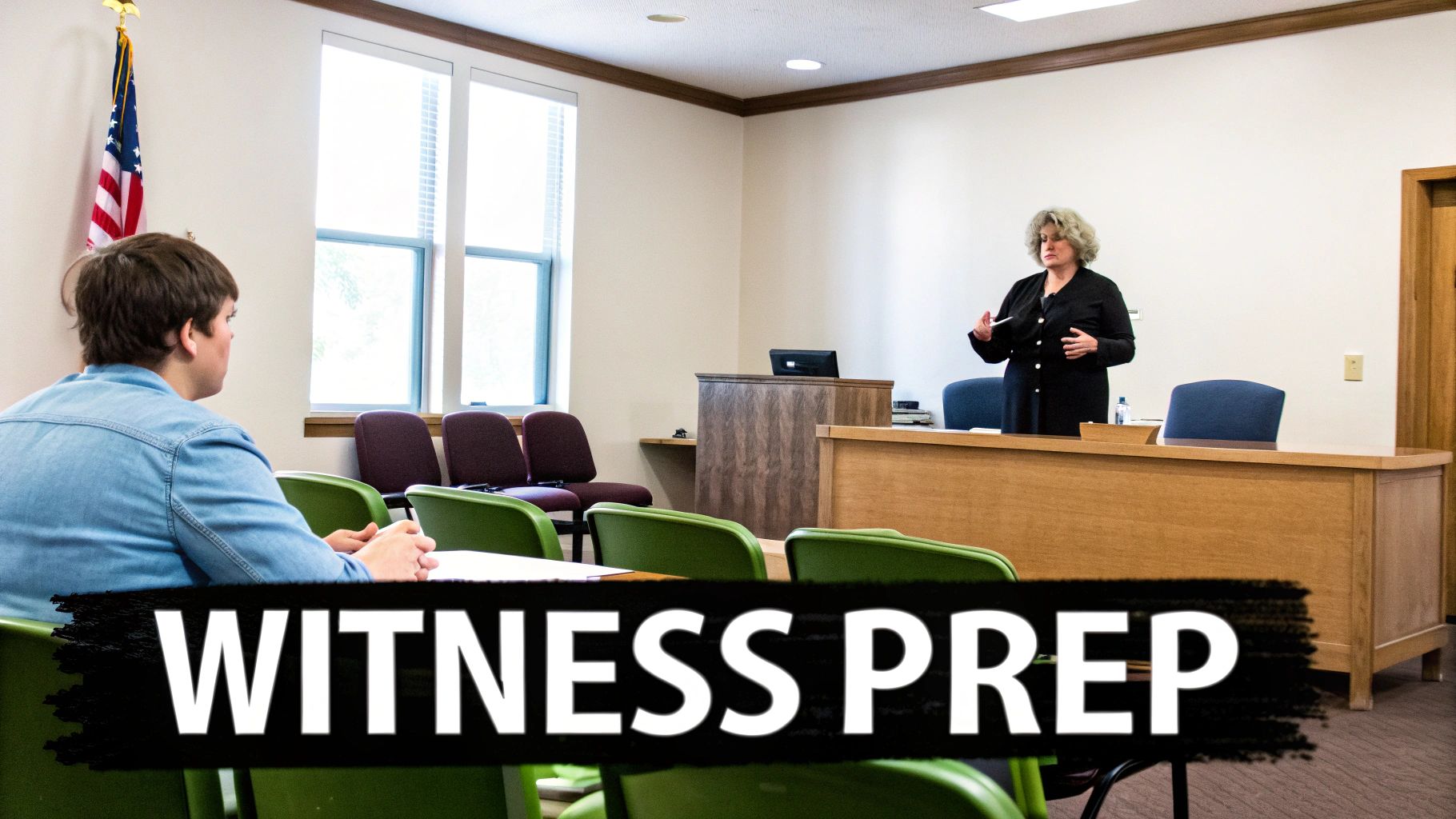
For your own witnesses, the goal is to build resilience. A proper preparation session is like a dress rehearsal for the real event. We walk them through what to expect in a Harris County courtroom—where to sit, who to look at, and the types of questions they will face from both sides.
We concentrate on a few core principles:
- Answer only the question asked. It is natural to want to explain or add context, but rambling provides a prosecutor with more ammunition. Stick to the question.
- Stay calm under fire. Cross-examination is designed to be confrontational. We conduct mock cross-examinations to prepare witnesses for aggressive questioning so they can respond without becoming defensive or flustered.
- Stick to what you know. Witnesses testify about what they personally saw, heard, or did—not what they speculate happened or what someone else told them.
This process is critical. In many complex fields, merely going through the motions is insufficient. True preparation builds the confidence needed to withstand pressure.
The Monumental Decision: Should You Testify?
The most significant witness in any trial is often the defendant. The Fifth Amendment grants you the absolute right to remain silent, meaning you can never be compelled to testify against yourself. Deciding whether to waive that right and take the stand is easily one of the most critical decisions in your entire case.
There is no simple answer. It is a purely strategic decision, weighing the potential benefits against immense risks.
On one hand, taking the stand allows you to tell your side of the story directly to the jury. It personalizes the defense and enables you to explain your actions or intent in your own words. On the other hand, it opens you up to a blistering cross-examination from a prosecutor whose sole objective is to portray you as a liar.
Deciding to testify is a strategic gamble. It requires an honest assessment of how you’ll hold up under extreme pressure and whether your testimony will clarify the facts or just create more doubt.
Your attorney will help you weigh several factors:
- Your Demeanor: How will you come across to a jury? Are you calm, credible, and likable? Or will you appear defensive or nervous?
- The State’s Case: How strong is the evidence against you? If it’s weak, there might be no need to risk testifying. If it’s strong, your testimony might be the only thing that can create reasonable doubt.
- Your Criminal History: If you have prior convictions, the prosecutor may be able to introduce them to attack your credibility, which can be devastating.
To make these high-stakes decisions, you need perfect recall of every detail. Using professional legal court transcription services to get accurate transcripts of depositions, hearings, and prior statements is a must. It ensures your legal team can review every word to find inconsistencies and prepare you for any question.
Ultimately, the choice to testify is yours and yours alone. But it is a decision that must be made after a frank, in-depth conversation with your lawyer about every possible outcome.
Mastering Courtroom Strategy And Procedure
Dramatization
Walking into a courtroom for trial is like stepping onto a stage where every word, action, and even silence is scripted. But this is not Hollywood. Real success in the courtroom does not come from dramatic, last-minute outbursts; it is the result of a disciplined, well-rehearsed strategy executed from beginning to end.
Understanding the distinct phases of a trial is critical. It allows your legal team to control the narrative, anticipate the prosecution’s next move, and put you in the best possible position to win. The jury watches everything, and an experienced attorney knows how to use both the formal rules and the unwritten customs of the court to your advantage.
Setting the Stage with Voir Dire
The very first battle is fought before a single piece of evidence is even mentioned. This is voir dire, the jury selection process. It’s a common misconception that the goal is to find jurors who will like you. It’s not.
The real objective is to identify and remove potential jurors who hold biases that would make it impossible for them to be fair.
A skilled defense lawyer uses this opportunity to ask targeted, strategic questions that uncover hidden prejudices. For instance, in a Harris County theft case, an attorney might probe a potential juror’s feelings about property crime or their own past experiences with being stolen from. The answers help build a profile of each person, giving the defense the insight needed to strike those most likely to be predisposed to a guilty verdict.
This is your first—and arguably best—chance to shape the group of people who will decide your future.
Delivering a Compelling Opening Statement
Once the jury is sworn in, the trial officially kicks off with opening statements. This is our chance to give the jury a roadmap of the case from our perspective. Think of it less as an argument and more as a story—a concise preview of the evidence we’ll present and the holes we plan to poke in the prosecution’s case.
A powerful opening statement frames the entire trial. It provides the jury with a lens through which to view every piece of testimony and evidence that follows. We might introduce a central theme, like “this is a simple case of mistaken identity,” and then promise to show the jury exactly how the evidence proves it. This sets expectations and gives them a clear counter-narrative to the one the prosecutor is selling.
The Art of Cross-Examination
This is where the defense goes on the offensive. After the prosecutor questions their own witnesses (direct examination), your attorney gets to stand up and challenge their testimony. The goal isn’t always a dramatic “Aha!” moment you see in movies. It’s about strategically chipping away at a witness’s credibility or, even better, getting them to admit facts that actually help our case.
This is done through precise, leading questions designed to control the witness and prevent them from explaining away their inconsistencies.
Effective cross-examination can:
- Expose contradictions between what a witness says on the stand and what they told the police initially.
- Highlight a witness’s motive to lie or their bias against you.
- Show that a witness had a poor vantage point or was otherwise in no position to see what they claim they saw.
Every question has a purpose, methodically dismantling the foundation of the prosecution’s story. For a more detailed look at what this preparation entails, check out our step-by-step guide on preparing for court.
Weaving the Facts into a Powerful Closing Argument
The closing argument is our final pitch to the jury. After all the witnesses have testified and all the evidence is in, this is the time to connect the dots. It’s our last chance to argue, forcefully and persuasively, why the state has failed to prove its case beyond a reasonable doubt.
A strong closing argument weaves together the key pieces of witness testimony, the physical evidence (or lack thereof), and the defense’s central theme into one cohesive story. It reminds the jury of the promises the prosecutor made in their opening statement and points out exactly where the evidence fell short.
Courtroom procedure is a strategic chess match. From selecting the jury to the final closing argument, every move is calculated to build reasonable doubt and protect your freedom. An unprepared defendant is simply a pawn in the prosecution’s game.
Finally, remember that your own conduct in court speaks volumes. Dressing professionally and showing genuine respect for the judge, the jury, and the court staff creates an impression of seriousness and credibility. It’s a subtle but powerful factor that your attorney will guide you on every step of the way.
Common Questions About Texas Criminal Trials
When you’re facing a criminal trial, your mind is probably racing with urgent questions. The uncertainty can be completely overwhelming, but getting straight answers is the first step toward getting some control back. Here are a few of the most common concerns I hear from people preparing for a trial in the Houston area.
How Long Does It Take to Prepare for a Trial in Houston?
There is no standard timeline. A straightforward misdemeanor case in a Harris County court might take a few months to prepare for trial. Conversely, a complex felony case with voluminous evidence could easily require over a year of dedicated preparation.
It is crucial to remember that the prosecution has a significant head start—they have often been building their case for weeks or months before you were even charged. This is why it is imperative for your defense to begin immediately.
The timeline ultimately depends on several key factors:
- The volume of evidence: How many police reports, videos, and lab results must be analyzed?
- The number of witnesses: Every witness must be located, interviewed, and prepared for testimony.
- Expert testimony needs: In complex cases, it may be necessary to retain independent experts to challenge the state’s theories, which takes time.
- The court’s own schedule: Sometimes, the most significant delay is simply waiting for an available slot on the court’s docket.
Every day that passes without a proactive defense is another day the prosecution has to strengthen its position. An experienced defense team starts working to close that gap from day one.
Is It a Good Idea to Represent Myself in Court?
While you have a constitutional right to represent yourself (known as pro se representation), it is an exceptionally dangerous path in a criminal trial. I cannot stress this enough.
The Texas legal system is a complex maze of intricate rules of evidence and procedure that lawyers spend their entire careers mastering. The prosecutor will not “go easy” on you simply because you are not an attorney. Their objective is to win.
A single procedural mistake can irreparably harm your case. For example, failing to object correctly could allow the jury to hear inadmissible, damaging evidence. Alternatively, you might be prevented from presenting a crucial piece of your own evidence because you did not follow the proper procedural steps.
The long-term costs of a conviction—loss of freedom, devastating fines, and a permanent criminal record—are infinitely higher than the expense of hiring a skilled defense attorney to protect your future from the very beginning.
What Should I Consider Before Accepting a Plea Bargain?
A plea bargain is a formal agreement where you plead guilty or “no contest” in exchange for a specific sentence or a reduced charge. This is a monumental decision because it permanently forfeits your right to a trial. You should never accept a plea offer without having an experienced defense lawyer thoroughly analyze it first.
Your attorney’s role is to evaluate that offer against the actual strength of the state’s case. They will search for weaknesses, realistically assess your chances of winning at trial, and determine if the plea is genuinely in your best interest.
More often than one might think, a skilled lawyer can negotiate for significantly better terms or may advise that fighting the charges in court provides a realistic opportunity for a full acquittal. This is a strategic determination that is nearly impossible to make on your own.
Should I Explain My Side of the Story to the Police?
Absolutely not. You must invoke your constitutional right to remain silent and your right to an attorney. It is incredibly tempting to believe you can “clear things up” by talking, but this strategy almost always backfires.
Investigators are trained to elicit statements. Anything you say, no matter how innocent you believe it to be, can be twisted, taken out of context, and used to help convict you.
Even seemingly harmless details can inadvertently fill in the missing pieces of the prosecution’s puzzle. The only person you should ever discuss the facts of your case with is your criminal defense lawyer. Your attorney will then strategically manage all communication with law enforcement and the District Attorney’s office.
The complexities of trial preparation demand professional expertise from start to finish. Protecting your rights and building a powerful defense requires a deep understanding of Texas law and courtroom procedure. For a zealous defense dedicated to fighting for your freedom, consider the experience of a Board Certified expert in criminal law. The team at David Smith Law Firm, PLLC is committed to providing the aggressive and knowledgeable representation you need.
Discover more from David Smith Law Firm, PLLC
Subscribe to get the latest posts sent to your email.