

Facing a judge in a Houston courtroom can be one of the most nerve-wracking experiences of your life. How you conduct yourself, from your words to your attire, sends a powerful message. When your freedom is at stake, understanding how to address a judge boils down to one critical principle: respect. You demonstrate this through your language, your actions, and your appearance. It begins with the fundamentals: always address the judge as “Your Honor,” stand when they enter or when you speak to them, and dress in conservative, business-formal attire. These actions are not merely formalities; they signal that you take the proceedings, and your future, seriously.
The Unwritten Rules of Courtroom Respect
Walking into a Harris County courtroom for the first time can feel incredibly intimidating. Before you utter a single word, the judge is forming an impression of you, and that first impression can set the tone for your entire criminal case. This isn’t just about being polite. It’s about showing genuine respect for the authority of the court and the entire judicial process.
Understanding this dynamic is the first step toward protecting yourself. A simple mistake—like showing up in casual clothes or using a disrespectful tone—can create an immediate, unspoken bias against you. Even an unintentional misstep can damage your credibility before a skilled defense attorney has a chance to build it. For anyone facing criminal charges in Texas, getting a handle on the general litigation process is crucial for navigating this environment without making a critical error that could jeopardize your case.
Why Your Conduct Is So Important
Judges are held to a strict code of conduct designed to ensure they remain impartial, and they expect that same level of seriousness from every single person in their courtroom.
Your conduct creates a ripple effect. How you act shapes the judge’s perception of you, which in turn influences how credible they find you to be.
As the infographic shows, proper decorum isn’t just a formality. It’s a strategic part of your defense that directly impacts how the judge sees you and, ultimately, the outcome of your case.
This isn’t just a suggestion; it’s codified. The Texas Code of Judicial Conduct actually requires judges to maintain a dignified and respectful courtroom. This standard has teeth.
A courtroom is a formal environment where every detail matters. A defendant’s conduct, from their posture to their tone of voice, contributes to the overall perception of their character and trustworthiness.
Trying to navigate this high-stakes environment on your own is incredibly risky. One small slip-up could have major consequences for your case, which is why having professional guidance is so important. A seasoned Houston criminal defense lawyer helps you avoid the kind of mistakes that could sink your entire defense.
What to Say When Speaking to a Judge

When it’s your turn to speak in a Texas courtroom, the words you choose can have a massive impact on how the judge sees you. If you remember nothing else, remember this one critical rule: always, without exception, address the judge as “Your Honor.”
This isn’t just a friendly suggestion. Using informal language like ‘Sir,’ ‘Ma’am,’ or even ‘Judge’ comes across as disrespectful. It’s a simple mistake that can instantly put you on the wrong side of the one person whose opinion matters most in that room.
The Ground Rules for Speaking in Court
Beyond the title, a few other key protocols will serve you well. First, you must stand whenever the judge enters or leaves the room, and also any time you are speaking directly to them. It’s a physical act of respect that sends a powerful non-verbal message.
When you do speak, make sure you are clear and loud enough for everyone to hear. Mumbling or speaking too softly only frustrates the judge and the court reporter, slowing everything down.
And most importantly, never, ever interrupt the judge. Let them finish their entire thought before you even think about responding. Cutting off a judge is one of the fastest ways to damage your credibility.
Answering Questions the Right Way
There’s a real skill to answering questions in court. Your responses should always be direct, honest, and to the point. Only answer the specific question you were asked—don’t volunteer extra information.
Think about these common scenarios you might face in a Houston criminal court:
- When asked a “Yes” or “No” question: The correct response is simply, “Yes, Your Honor” or “No, Your Honor.” Resist the urge to launch into a long story unless the judge specifically asks you to explain further.
- If you don’t understand the question: It is perfectly fine—and actually very smart—to say, “Your Honor, I’m sorry, but I don’t understand the question.” It is far better to ask for clarification than to guess and give a wrong or damaging answer.
The line between saying too much and not saying enough is razor-thin. One wrong word at a critical moment can completely derail your defense. The pressure is immense, especially during crucial early stages like an arraignment hearing.
This is precisely why having an experienced criminal defense attorney is so important. They know the unwritten rules of the courtroom and can advocate for you without making a costly verbal slip-up.
Quick Guide to Addressing a Judge
Here’s a quick cheat sheet to help you navigate verbal communication in a Texas courtroom and make the right impression every time.
| Situation | What to Say or Do | What to Avoid |
|---|---|---|
| When the judge enters/leaves | Stand silently and respectfully. | Remaining seated or talking. |
| When speaking to the judge | Stand up straight and make eye contact. | Slouching, mumbling, or looking away. |
| Addressing the judge | “Your Honor” or “Judge” | using the first or last name of the judge |
| Answering yes/no questions | “Yes, Your Honor” or “No, Your Honor” | “Yeah,” “Nope,” or adding a long story. |
| When the judge is talking | Listen without interrupting. | Interrupting or talking over them. |
| If you don’t understand | “Your Honor, I don’t understand the question.” | Guessing or making up an answer. |
Following these simple rules shows the court you take the process seriously, which can only help your case in the long run.
Your Appearance and Body Language in Court

Long before you say a single word, your appearance sends a powerful message to the judge. The way you present yourself in a Texas courthouse can either build your credibility or completely undermine it. This isn’t about fashion; it’s about signaling that you take the legal proceedings seriously.
Dress for Respect
Think business formal. For men, this means a suit or, at the very least, a button-down shirt, slacks, and a tie. For women, a conservative dress, pantsuit, or a simple blouse and skirt is always a safe bet.
You need to avoid anything that could be distracting or seen as casual. That means no:
- Jeans with holes/jewels, or shorts
- T-shirts with logos or graphics
- Hats or sunglasses inside the courtroom
- Flashy jewelry
- Revealing clothing of any kind
Choosing conservative, clean attire shows the court you respect its authority. It might seem superficial, but it’s a huge part of the overall picture you present. A professional appearance suggests a serious defense. For more tips, check out our detailed guide on preparing for court step-by-step.
How Your Actions Speak Louder Than Words
Your body language is just as critical as your clothing. When you’re under the immense stress of a court hearing, it’s incredibly easy to send the wrong non-verbal signals without even realizing it.
Actions like slouching in your chair, crossing your arms, or fidgeting can be interpreted by the judge as disinterest, disrespect, or even defiance. Even a subtle eye-roll or an audible sigh can be seen as contempt of court, which carries its own serious consequences.
Controlling these subconscious reactions is tough when your future is on the line. This is another area where a skilled attorney provides a critical advantage—they act as your composed, steady advocate when your own emotions could betray you.
A lawyer ensures that your case is presented professionally from every angle, managing both the spoken and unspoken communication that happens in a courtroom.
Addressing a Judge in Written Documents
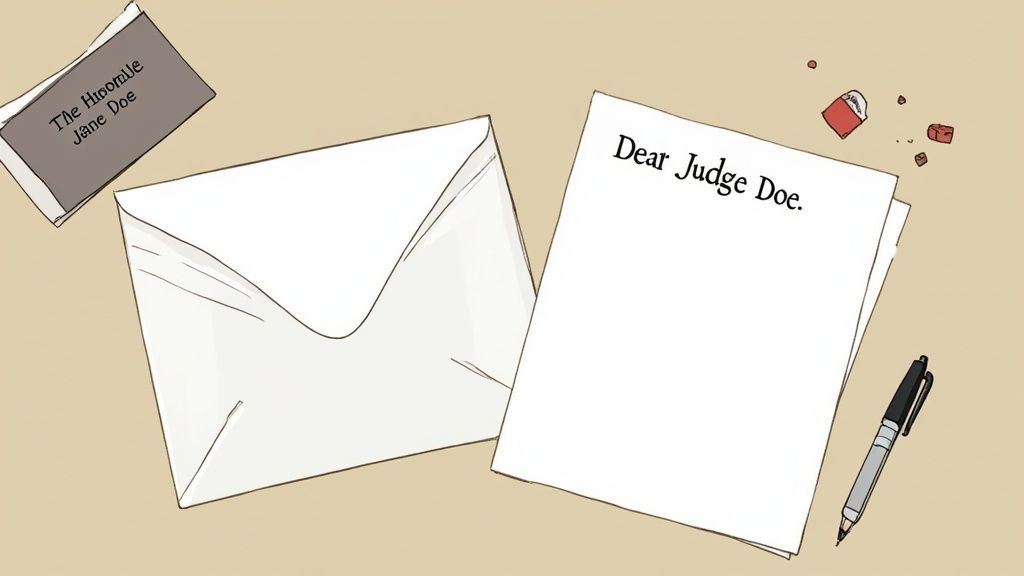
Your case doesn’t just happen inside the courtroom. The written motions, filings, and letters submitted on your behalf are just as critical, and they require a completely different level of formality than an email or a business letter.
How you address a judge in writing is dictated by long-standing rules of legal procedure. A simple mistake here can signal disrespect or ignorance, which is the last thing you want when facing serious charges like a DWI or assault in the Houston area.
Salutations and Formal Address
When it comes to official correspondence, getting the format right is non-negotiable. It shows the court you understand and respect the process.
- On the Envelope: The address line should always read, “The Honorable [Judge’s Full Name].” This title is specifically reserved for judges and other high-ranking officials, and using it correctly is step one.
- In the Document: The salutation inside a letter or motion should be “Dear Judge [Last Name].” This strikes the right balance between respect and directness for legal communication.
These aren’t just tiny details—they’re the required standard. Getting them wrong can make your entire document look unprofessional right from the start. Do not write a letter to a judge or prosecutor without consulting with your attorney FIRST!
The Most Critical Rule of All
Here’s the single most important rule, and it’s one that catches many people by surprise: you must never send a letter or any document directly to a judge’s chambers. This is called ex parte communication, and it’s strictly forbidden.
All written communication has to be filed through official channels, usually with the Clerk of Court. Crucially, a copy must also be sent to the prosecutor (the opposing counsel). This process ensures total transparency, preventing one side from trying to influence the judge in private.
Any attempt to sidestep this will get your letter rejected and can seriously damage your credibility with the court. This is especially true when submitting documents like the ones detailed in our guide on sample character letters to the judge.
A mistake in a legal filing can cause the clerk to reject it outright, leading to critical delays that can weaken your entire defense. It’s a perfect example of why all official court correspondence must be handled by an experienced defense attorney.
Why Your Conduct Matters, Even with an Impartial Judge
To really get a handle on courtroom etiquette, you have to understand the judge’s role. Every judge in Texas takes an oath to be impartial. Their job is to make decisions based only on the law and the facts presented in your case. The entire justice system is built on this foundation of judicial independence.
But here’s the thing you can’t forget: judges are still human. They work incredibly hard to stay objective, but subconscious factors can creep into their perceptions. A defendant who comes across as disrespectful or uncooperative might find themselves on the losing end of discretionary rulings, like when a judge is setting bail or deciding a sentence.
The Human Element in the Justice System
The system is designed for fairness, but your own behavior can absolutely influence how you are seen within that system. This is where the subtle dynamics of the courtroom become so important.
Judges pride themselves on their fairness. In fact, one study found that a staggering 97% of judges believe they are above average in their ability to avoid racial prejudice. You can learn more about the complexities of judicial impartiality from this Judicature article.
Despite this deep commitment, other research shows that factors like a person’s background can subtly influence outcomes. This doesn’t mean judges are intentionally biased, but it does show that human perception is complicated. Knowing how to address a judge is about more than just following rules; it’s about showing you respect the seriousness of the situation.
An experienced attorney gets these subtle dynamics. They know how to frame your case in a way that not only meets the legal standard but also shows deep respect for the court—making sure you get a truly fair hearing from start to finish.
Trying to navigate these nuances on your own is a huge risk. Your lawyer is your advocate, making sure every word, action, and document is presented in a way that respects the court’s dignity and protects your rights. It’s how you get the fair shake you deserve.
Why You Need a Lawyer to Speak on Your Behalf
Knowing the proper way to address a judge is a good first step, but the single most effective strategy you can employ is to have a skilled criminal defense attorney do the talking for you.
Frankly, legal representation isn’t just an advantage in a Texas courtroom—it’s an absolute necessity. The stakes are simply too high to risk a procedural mistake or a simple misunderstanding that could derail your entire case.
The Critical Role of Legal Counsel
Think of your attorney as your translator and your filter. They are fluent in the complex language of the law and, just as importantly, the unwritten rules of the courthouse. An experienced Houston lawyer often has professional relationships with the judges and prosecutors, giving them an insider’s understanding of the local legal culture that you just can’t get from a book.
Your lawyer’s job is to take your side of the story and shape it into a precise, compelling legal argument. They keep the raw emotion of the situation from damaging your credibility and know what to say—and, crucially, what not to say.
The court system is designed to be fair and impartial, interpreting the law based on established standards. But the reality is that courts are under immense pressure with limited resources, making it even more vital that your case is presented perfectly. A good lawyer ensures your case meets those rigorous expectations, even when the system is strained.
Trying to represent yourself in a criminal case is a dangerous gamble. Every single word you utter can be twisted and used against you. A lack of procedural knowledge can lead to devastating, irreversible consequences.
An experienced attorney also knows how to communicate effectively with the prosecution long before you ever see the inside of a courtroom. They understand the right channels and can often start negotiating on your behalf from day one. To learn more about this vital process, check out our guide on how a lawyer can help get charges dropped or reduced.
Ultimately, hiring the right legal counsel is the most important decision you’ll make. It’s the best way to protect your rights and fight for the best possible outcome in your case.
When your freedom is on the line, you need an advocate with proven experience in Houston’s criminal courts. The team at David Smith Law Firm, PLLC is dedicated to providing a powerful defense. Protect your future today.
Discover more from David Smith Law Firm, PLLC
Subscribe to get the latest posts sent to your email.