A well-written character letter offers a judge in a Texas courtroom something legal documents just can’t: a glimpse of the real person behind the criminal charges. It humanizes the defendant, showing them as a whole person, not just the subject of an alleged offense. In the high-stakes environment of a Harris County courthouse, a powerful, sincere letter can significantly influence sentencing by highlighting positive traits, community ties, and a genuine capacity for rehabilitation. The outcome of a criminal case can depend on these crucial details, and navigating this process without legal guidance is a serious risk.
Why a Character Letter Can Influence a Judge in a Texas Court
When a judge in a Harris County courtroom considers a sentence, they are weighing more than just the black-and-white facts of the case. Their job is to understand the individual standing before them. A criminal charge presents one side of the story, often reducing a person to a case file number and a list of accusations. This one-dimensional view can be devastating at sentencing.
A character letter provides the necessary counterbalance. It’s a critical opportunity to offer the court a more complete, three-dimensional picture. Think about it: a judge sees countless cases, but a heartfelt letter from a respected community member, a long-time employer, or a mentor can cut through the stiff formality of the legal proceedings. It adds a layer of personal context that is otherwise completely missing from the courtroom—context that could mean the difference between jail time and a more favorable outcome.
Humanizing the Defendant Beyond the Courtroom
The prosecution’s job is to present evidence of an alleged crime. The role of a character letter is to present evidence of a person’s life and character. This isn’t about arguing innocence or making excuses for behavior. It’s about providing a much broader perspective that a skilled legal team can strategically integrate into the defense.
For anyone facing criminal charges in the Houston area, understanding the various strategies for criminal defense can shed light on how these letters fit into the bigger picture.
An effective letter can accomplish several key things:
- Demonstrate Positive Traits: It can highlight qualities like integrity, kindness, and reliability, backed up with specific, real-world examples.
- Show Community Ties: Letters can illustrate the defendant’s role as a valued employee, a dedicated volunteer, or a supportive family member who people depend on.
- Highlight Potential for Rehabilitation: They can speak to a person’s capacity for growth and their commitment to making things right.
A judge’s final decision is based on the law, but their discretion is often influenced by their perception of the person. A sincere, credible character letter provides invaluable insight into who that person truly is, separate from the charges they face.
Submitting a collection of thoughtful letters from credible sources is a smart, strategic move. It shows the court that the defendant has a strong support system and is seen as a valuable member of society—someone worth giving a second chance. This narrative can be pivotal, especially during sentencing, and can potentially lead to more favorable outcomes. But this process needs careful guidance. To be truly impactful, each letter must be structured correctly and follow court protocols. Without professional oversight, even the most well-intentioned letters can fall flat or, even worse, accidentally harm the case.
Choosing the Right Person to Write Your Letter

The single biggest factor in a powerful character letter is who writes it. It’s a common mistake to think a letter from a high-profile person or a relative with a fancy job title will automatically impress a judge. It won’t.
Judges are moved by sincerity and specifics, not status. They’ve seen it all. A vague, generic letter from a city council member who barely knows the defendant is far less persuasive than a heartfelt letter from a manager who has supervised them for the last five years. The manager can speak to real-world examples of work ethic, reliability, and character. Selecting the right authors is a matter of legal strategy, not just a simple request for a favor.
The key is choosing someone who knows you well enough to provide concrete examples of your character.
This isn’t just a theory; it’s a core part of legal strategy. A set of well-chosen letters from credible people can humanize you in a way nothing else can, potentially tipping the scales toward a more lenient sentence. Research even shows that judges find letters from non-family members more persuasive. Y
Identifying Your Strongest Advocates
So, who should you ask? The goal is to gather a small group of people who can paint a consistent, well-rounded picture of who you are outside of this legal issue. Forget about their job titles for a moment and focus on the substance of what they can share.
Think about people from different corners of your life:
- Employers or Supervisors: They can speak to your professionalism, punctuality, and responsibility. A letter that details your value to the company is incredibly powerful.
- Mentors or Teachers: These individuals can talk about your drive, your willingness to learn, and your commitment to improving yourself.
- Community or Religious Leaders: A pastor, volunteer coordinator, or coach can highlight your moral compass and dedication to something bigger than yourself.
- Long-Term Friends or Colleagues: People who have known you for years can offer personal stories that demonstrate your loyalty, integrity, and how you show up for others.
A common pitfall is leaning too heavily on immediate family. While their support is crucial, a judge expects family to be biased. Letters from objective, outside sources will almost always carry more weight and offer a more credible perspective.
Figuring out who to ask can be tough, especially when you’re already stressed about a court date in a place like Harris County. An experienced criminal defense attorney can be a huge help here. They can review your list of potential writers and offer strategic advice on who can provide the most compelling testimony, ensuring every letter adds real value to your case. This is not a step to handle alone.
How to Structure a Persuasive Letter for Court
A powerful character letter isn’t just about what you say; it’s about how you say it. To be effective in a Houston courtroom, your letter needs a clear, professional structure that makes it easy for a judge to read, absorb, and trust. A jumbled or poorly organized letter can lose its impact, no matter how sincere the writer is.
The goal is to present a logical, compelling story about the defendant’s character. This starts with a proper format that shows respect for the court and the entire legal process. Every part, from the greeting to the signature, plays a role in building the writer’s credibility.
Crafting the Introduction
Your first paragraph is critical. It immediately establishes who you are and your relationship to the defendant. A judge needs to know why your opinion matters.
Start by clearly stating your full name, address, and occupation. Then, explain how you know the defendant and—most importantly—specify the length of time you have known them. A statement like, “I have been John Doe’s direct supervisor at XYZ Company in Houston for the past seven years,” is far more compelling than a vague “I’m John’s friend.”
This introduction lays the groundwork for your credibility. It tells the judge your perspective is based on long-term, direct observation, not just a casual acquaintance.
The infographic below shows how a well-structured letter moves through the court’s evaluation process.
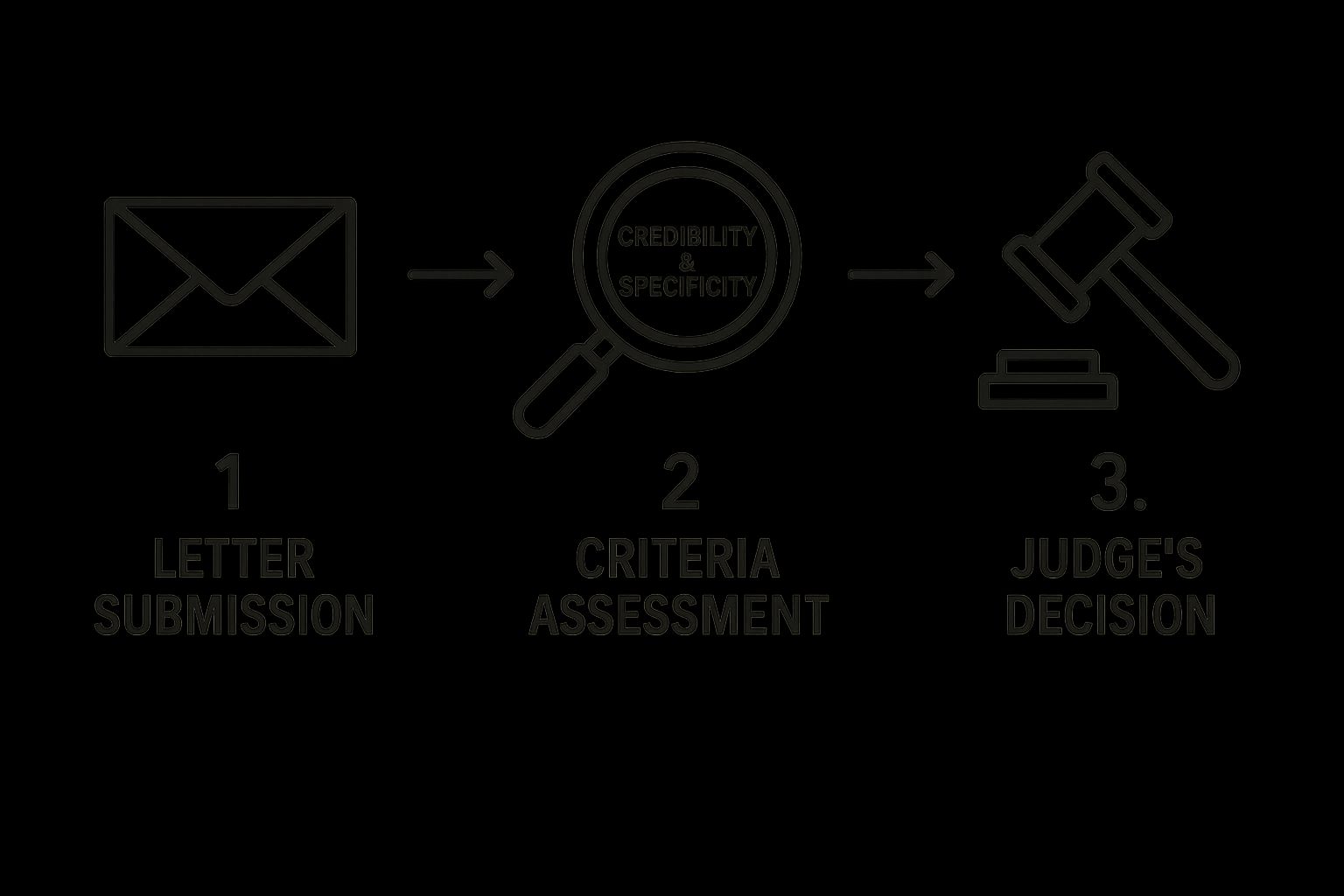
As you can see, once a letter is submitted, it’s assessed for key criteria like credibility and specificity before it can influence a judge’s decision.
Building the Body with Specific Examples
This is where your letter truly comes to life. The body paragraphs are your chance to move beyond generic praise and give concrete, real-world examples of the defendant’s positive character. Vague statements like “He is a good person” or “She is very responsible” carry almost no weight in court.
You need to show, not just tell.
- Instead of: “He is a dedicated father.”
- Try: “For the last three years, I have seen him coach his son’s little league team every weekend, teaching the kids about sportsmanship and respect, rain or shine.”
- Instead of: “She is a hard worker.”
- Try: “During a major project last year, she voluntarily stayed late every night for two weeks to ensure our team met a critical deadline, demonstrating a level of commitment that inspired everyone.”
These specific stories paint a vivid picture and provide tangible evidence of character. It takes some effort to frame these anecdotes effectively, but you can always find ways to improve your overall writing ability.
A single, powerful story that illustrates honesty or compassion is worth more than a dozen generic platitudes. The details are what make a letter believable and memorable.
To help you get this right, here’s a simple framework breaking down the key components of an effective letter.
Key Elements of a Character Letter
Follow this framework to ensure your letter is professional, clear, and effective in a court setting.
| Section | Purpose | Example Content |
|---|---|---|
| Salutation | To formally address the judge with respect. | “The Honorable Judge [Last Name]:” |
| Introduction | To establish your identity, relationship to the defendant, and credibility. | “My name is Jane Smith, and I have been John Doe’s neighbor for the past 12 years.” |
| Body Paragraphs | To provide 1-2 specific anecdotes that showcase positive character traits. | “I witnessed him organize a neighborhood fundraiser for a family who lost their home…” |
| Acknowledgement | To show you understand the seriousness of the situation without arguing the case. | “I am aware of the charges John is facing and write this letter to speak only to his character.” |
| Conclusion | To summarize the key traits and offer verification of your identity. | “In my experience, John is a compassionate and reliable individual. Please feel free to contact me.” |
| Closing | To end the letter professionally. | “Respectfully,” or “Sincerely,” followed by your signature, typed name, and contact information. |
Sticking to this structure helps ensure your message is heard loud and clear.
Concluding with Respect and Professionalism
Your conclusion should be brief, respectful, and direct. Briefly summarize the key character traits you’ve discussed. It’s also important to acknowledge that you are aware of the seriousness of the charges without making excuses or trying to argue the case.
End with a polite closing, like “Sincerely” or “Respectfully,” followed by your typed name and signature. Crucially, include your phone number and email address below your name so the court can verify your identity if needed. This final detail reinforces your credibility.
Navigating the nuances of what to include takes careful thought, and a mistake could be costly. An experienced criminal defense attorney must review every letter to ensure it’s structured for maximum impact and follows all local court protocols before it is submitted.
What to Include and Common Mistakes to Avoid

A well-written character letter can genuinely make a difference in court, but only if it’s credible and follows a few unwritten rules. One wrong move can completely undermine the letter’s purpose, or worse, actually hurt the defense.
Understanding what to put in—and what to leave out—isn’t just helpful; it’s essential. The goal is to strike a delicate balance: you need to strongly endorse the person’s good qualities while still showing complete respect for the court and the gravity of the situation. This is exactly where so many well-meaning letters go sideways. Having legal counsel is vital to avoid these pitfalls.
Essential Elements for an Impactful Letter
For your letter to be taken seriously by a judge, it has to contain a few key components. These elements are what build your credibility and make your perspective valuable. Think of it less like a casual note and more like a formal, supportive statement.
Your letter should always:
- Be Honest and Truthful: Never stretch the truth or make things up. Authenticity is everything, and even a hint of dishonesty will get your letter tossed in the mental trash bin.
- Provide Specific, Positive Examples: Don’t just say the defendant is “a good person.” That’s meaningless. Instead, describe a specific time you saw them help a neighbor move, volunteer on a weekend, or show compassion when no one was watching. Concrete stories are far more powerful than vague praise.
- Acknowledge Awareness of the Charges: A simple sentence like, “I am aware that [Defendant’s Name] is facing charges for…” shows you’re writing with the full picture in mind. This adds significant weight to your continued support for them as a person.
While every letter is unique, you can find general guidance on the basic structure of what to include in a formal letter. This kind of framework helps make sure you don’t miss anything critical.
Critical Mistakes That Can Hurt the Case
Just as important as what you say is what you don’t say. Certain statements can backfire spectacularly, doing more harm than good. Navigating these legal landmines is where having a lawyer review your letter becomes so important.
A survey of over 900 federal judges found that character references are a valuable resource, but their impact hinges on authenticity and credibility. A single mistake can erase that credibility in an instant.
Here are the most common—and damaging—mistakes to avoid at all costs:
- Proclaiming the Defendant’s Innocence: This is the big one. Your letter is about their character, not their guilt or innocence. Arguing the facts of the case is the attorney’s job, and trying to do it for them will only annoy the judge.
- Criticizing the Justice System: Never, ever question the police, the prosecutor, or the court process. It comes across as disrespectful and will immediately put the judge on the defensive.
- Suggesting a Specific Sentence: Do not tell the judge how to do their job. Phrases like, “He doesn’t deserve jail time,” are completely inappropriate and counterproductive.
- Making Excuses for the Behavior: While you need to acknowledge the charges, trying to minimize or justify the alleged actions is a serious error. It shows a lack of respect for the process.
Avoiding these pitfalls is a crucial part of an effective defense strategy. A poorly written letter really can do more harm than no letter at all, which is why an experienced attorney should review every single one to ensure it helps the defense, rather than hurts it.
Seeing a Great Character Letter in Action
Theory is one thing, but seeing how these letters work in the real world is where it all clicks. The best way to understand the impact of a strong character letter is to see one in action.
Below are two sample letters for common scenarios we see in Texas criminal courts. The first comes from an employer, and the second is from a community leader. Think of these as guides, not rigid templates. The letters that truly resonate with a judge are always genuine, personal, and written from the heart.
A skilled attorney can help you and your supporters tailor these ideas to fit the specifics of your case, making sure every word counts.
Sample Letter from an Employer
This example is a masterclass in how an employer can vouch for someone. It focuses on professional value, work ethic, and reliability—exactly the kind of stabilizing qualities a judge wants to see in a defendant.
[Your Name]
[Your Address]
[City, State, Zip Code]
[Your Phone Number]
[Your Email Address]
[Date]
The Honorable Judge [Judge’s Last Name]
[Court Name and Address]
[City, State, Zip Code]
Re: Character Reference for [Defendant’s Full Name]
Dear Judge [Last Name]:
My name is Sarah Jenkins, and I am the General Manager at [Company Name] here in Houston. I’m writing to you today about Mr. John Doe, who has worked under my direct supervision for the past seven years.
In my position, I’ve had a front-row seat to John’s integrity and work ethic. He’s one of the most dependable people on my team, always going above and beyond what’s asked of him. To give you an example, during the big winter storm last year, our facility lost power. On his own initiative, John organized a small team to go in and secure our sensitive equipment, preventing what would have been thousands of dollars in damages. That’s just the kind of proactive, responsible person he is.
I am aware of the charges he is facing. My letter isn’t about that—it’s about the man I’ve worked alongside for nearly a decade. The John Doe I know is honest, responsible, and deeply respected by his colleagues. He is a vital part of our operation, and his absence would leave a significant hole in our team.
Thank you for your time and for considering my perspective. Please don’t hesitate to contact me if you need any further information.
Respectfully,
(Signature)
Sarah Jenkins
General Manager, [Company Name]
Here’s what makes this letter work: Notice how Sarah Jenkins immediately establishes her credibility (a 7-year supervisory relationship is powerful). She doesn’t just say John is a good guy; she provides a specific, compelling story (the winter storm) that proves it. She wisely acknowledges the charges without arguing them, keeping the focus entirely on positive, verifiable character traits.
Sample Letter from a Community Leader
This next example shows how to paint a picture of personal growth and positive community impact. This can be incredibly persuasive, as it demonstrates that the person is more than just their alleged mistake.
[Your Name]
[Your Address]
[City, State, Zip Code]
[Your Phone Number]
[Your Email Address]
[Date]
The Honorable Judge [Judge’s Last Name]
[Court Name and Address]
[City, State, Zip Code]
Re: Character Reference for [Defendant’s Full Name]
Dear Judge [Last Name]:
My name is Robert Williams, and I run the volunteer program at the [Community Center Name] in Harris County. I’ve had the pleasure of knowing Jane Smith for the last four years, during which she has been one of our most dedicated volunteers.
When Jane first started with us, she was quiet and a bit reserved. Over these past few years, I’ve watched her blossom into a compassionate and confident leader. She now runs our entire weekly youth mentorship program, giving up every Saturday morning to guide at-risk teenagers. Her patience and genuine care have made a huge difference in their lives. In fact, several of the kids have told me directly that Jane is the reason they’ve managed to stay in school.
I know about the legal trouble Jane is in, and it just doesn’t square with the person I’ve seen week in and week out. The Jane I know is a kind-hearted and selfless individual. Her contributions to our community are invaluable, and there are a lot of young people who depend on her.
Thank you for taking the time to consider my thoughts on Jane’s character. I can be reached at the number above if you need to verify anything.
Sincerely,
(Signature)
Robert Williams
Volunteer Coordinator, [Community Center Name]
Common Questions About Character Letters
When you’re asked to write a character letter for a court case, a lot of practical questions pop up right away. It’s a task that feels simple on the surface, but the details really matter. Getting them wrong can mean the letter has no impact—or worse, gets ignored entirely.
Let’s walk through some of the most common questions people ask.
How Many Letters Should We Submit?
This is a classic case of quality over quantity. There’s no magic number, but most experienced Texas attorneys will recommend aiming for 5 to 10 strong letters. You want a diverse group of people who can offer unique, credible perspectives.
Sending in a huge stack of generic, repetitive letters can actually backfire. It dilutes the impact and can frustrate a busy judge. The real goal is to paint a consistent, well-rounded picture of the defendant’s character, and a handful of powerful, personal stories does that far better than a mountain of vague praise. A criminal defense lawyer is crucial here to help strategize which letters are the most compelling and package them for the court.
Should the Letter Mention the Criminal Charge?
Yes, it absolutely should. The writer needs to briefly acknowledge that they know what the defendant is being accused of.
This is a critical step. It shows the judge that the writer isn’t in the dark and is offering their support with full awareness of the situation. That simple acknowledgment adds a ton of credibility to their words.
But—and this is important—the letter is not the place to argue the case, make excuses, or question the facts.
A simple sentence like, “I am aware that [Defendant’s Name] is facing charges for…” is all you need. Right after that, the focus must pivot back to positive character traits, backed up by specific, personal examples.
How Do the Letters Actually Get to the Judge?
This is one of the most important procedural details, and it’s where many people make a critical mistake. Writers should never, ever send a letter directly to the judge’s office or the courthouse. This is a serious violation of legal protocol and pretty much guarantees the letter will be thrown out.
All letters must be collected and given to the defendant’s criminal defense attorney. The attorney will then:
- Review each letter to ensure it’s helpful, appropriate, and follows the right format.
- Organize the letters as part of the official legal filings for the case.
- Submit everything to the court and the prosecution according to strict legal deadlines and rules.
Trying to bypass the attorney can undermine the whole effort. For more answers on how the legal system works, you can explore our criminal defense FAQs and Blog to get a better handle on the process. Having an experienced legal team manage these documents ensures every piece of support is presented correctly, giving it the best possible chance to make a real difference.
Discover more from David Smith Law Firm, PLLC
Subscribe to get the latest posts sent to your email.