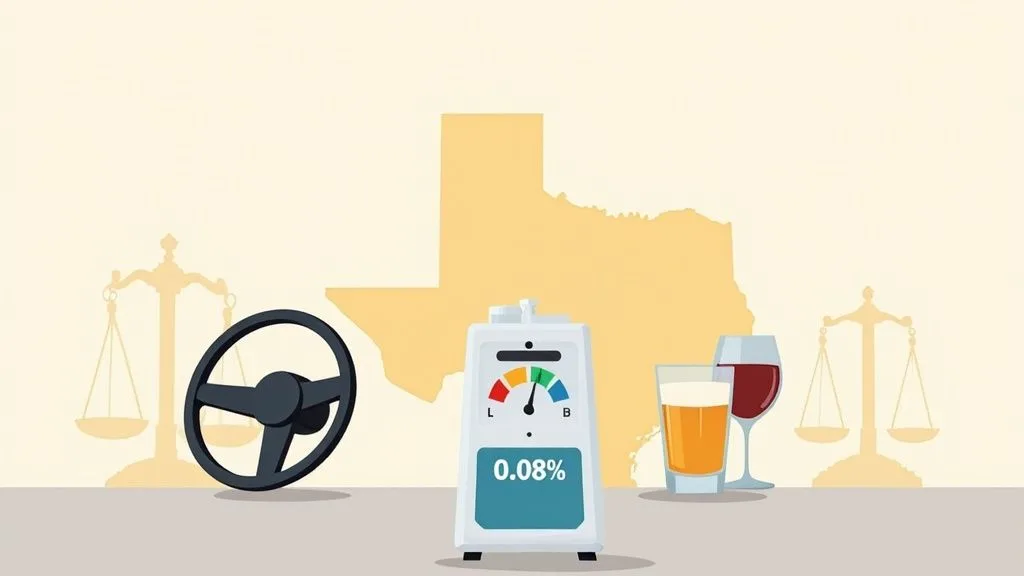
In Texas, the number that matters most in any DWI stop is 0.08%. That’s the legal Blood Alcohol Concentration (BAC) limit for most drivers over 21, and it’s far more than just a number—it’s a strict legal boundary. Crossing that line, even by a little, can trigger severe and life-altering consequences, making urgent legal counsel a necessity, not a choice.
What Is the Legal BAC Limit
If you’ve been pulled over anywhere in the Greater Houston area, the first question racing through your mind is probably, “Am I over the limit?” The answer to that question draws the line between a stressful traffic stop and a potential Driving While Intoxicated (DWI) charge that can derail your life.
Blood Alcohol Concentration, or BAC, is a scientific measurement of the percentage of alcohol in your bloodstream. It is not an estimate based on how you feel or how many drinks you’ve had. In Harris County and throughout Texas, law enforcement uses BAC to measure impairment with what they present as scientific precision.
A BAC of 0.08% means that for every 1,000 parts of blood in your system, one part is alcohol. That might sound tiny, but it’s enough for the state of Texas to consider you legally intoxicated and unfit to drive.
Understanding the Numbers Game
It is a profound mistake to believe you can accurately guess your own BAC. The truth is, that number is the result of a complex cocktail of biological factors, making any self-assessment a dangerous gamble. Several key variables can dramatically change how your body processes alcohol, which directly impacts your final BAC reading.
These factors include:
- Body Weight and Composition: A smaller person will almost always have a higher BAC than a larger person after drinking the same amount of alcohol.
- Gender: Biological differences in body water and enzymes mean women often metabolize alcohol differently than men, which can lead to a higher BAC from the same number of drinks.
- Food Consumption: A full stomach slows down how quickly alcohol is absorbed into your bloodstream. This doesn’t stop you from becoming intoxicated, but it can affect the rate at which your BAC rises.
- Time: How long you take to consume your drinks is critical. Your body needs time to metabolize alcohol, and drinking too quickly will cause your BAC to spike.
Because of these variables, two people can drink the exact same thing over the same period and end up with wildly different BAC levels. That’s why relying on how “sober” you feel is legally perilous. The stakes are just too high for guesswork. A DWI charge isn’t a minor ticket; it carries penalties that demand an immediate and strategic legal defense from a qualified Houston criminal defense attorney.
How Blood Alcohol Concentration Is Measured
When Houston-area law enforcement suspects a driver is intoxicated, they don’t rely on guesswork. They turn to scientific testing to determine a driver’s Blood Alcohol Concentration—a process that is both precise and, at times, surprisingly fallible.
Knowing the legal BAC limit is only half the story; understanding how that number gets calculated is where a strong DWI defense begins. Your BAC isn’t a fixed number. It’s a moving target, influenced by a huge range of personal factors that can dramatically change how your body processes alcohol. These physiological variables mean two people can have the exact same number of drinks and end up with completely different BAC results. This simple fact is one of the first things a skilled Houston DWI lawyer will investigate when reviewing the details of an arrest.
Common BAC Testing Methods
In Texas, police primarily use three methods to measure the amount of alcohol in your system. Each test comes with its own procedures, technology, and potential for error.
- Breath Tests (Breathalyzers): This is the least-time consuming option for the officer. The device measures the alcohol vapor in your exhaled breath and then uses a scientific formula to estimate the alcohol concentration in your blood. It’s an indirect measurement, not a direct one.
- Blood Tests: Widely considered the most accurate method available currently, a blood test directly measures the alcohol content from a blood sample. To be valid, this test must be done in a sterile, medical setting and follow strict clinical protocols to prevent contamination.
- Urine Tests: While less common for DWI stops, a urine test can also detect the presence of alcohol. It’s generally seen as less reliable for determining a person’s exact level of impairment at the time they were driving.
Even though these tests are based on science, they are far from perfect. The results they produce are only as good as the machines used to run them and the people who administer them. A deeper look into how to understand blood alcohol concentration (BAC) measurement reveals just how many things can go wrong.
The Vulnerability of Scientific Evidence
Every single step of the BAC testing process is an opportunity for error. An experienced attorney knows exactly where to look for weaknesses in the prosecution’s case, and it often starts with the test itself.
The accuracy of a BAC test result is not a guarantee. It is a piece of evidence that can, and should be, scrutinized for procedural errors, machine malfunctions, and human mistakes.
Think about it. Breathalyzer devices need constant maintenance and precise calibration to work correctly. If a department’s maintenance logs are sloppy or show a history of device errors, the results from that machine can be successfully challenged in court.
Blood tests are just as vulnerable. An improperly stored sample, a mix-up in the lab, or a break in the “chain of custody”—the official log of who handled the evidence and when—can get a blood test result thrown out completely.
This is a critical point to remember: an arrest based on a high BAC reading is not the end of the story. It’s the beginning of a legal fight where the so-called “scientific evidence” is put on trial. An experienced Houston legal advocate knows how to dissect the state’s evidence and build a powerful defense based on the facts of your specific case.
Special BAC Limits for Commercial and Young Drivers
Most people know the number 0.08%. It’s the BAC limit we’ve all heard about. But in Texas, that number isn’t a one-size-fits-all rule. The law carves out much stricter standards for certain drivers, and not knowing where you fall can have devastating consequences.
Two groups, in particular, face a dramatically lower threshold for a DWI charge: commercial drivers and anyone under the age of 21. For them, the margin for error is razor-thin. A BAC that’s perfectly legal for a regular driver could end a trucker’s career or saddle a young person with a life-altering criminal record.
The Higher Standard for Commercial Drivers
Holding a commercial driver’s license (CDL) comes with immense responsibility, and Texas law reflects that. When behind the wheel of a commercial vehicle, the legal BAC limit is just 0.04%—exactly half the limit for other adult drivers.
A DWI conviction at this lower level can trigger a suspension or even a permanent revocation of their CDL, effectively ending their livelihood. It’s critical for anyone in this line of work to understand the stringent CDL requirements, which go far beyond just passing a driving test. The professional stakes are incredibly high, and the legal system offers very little leniency.
This infographic breaks down some of the key biological factors that can swing a BAC reading one way or another.
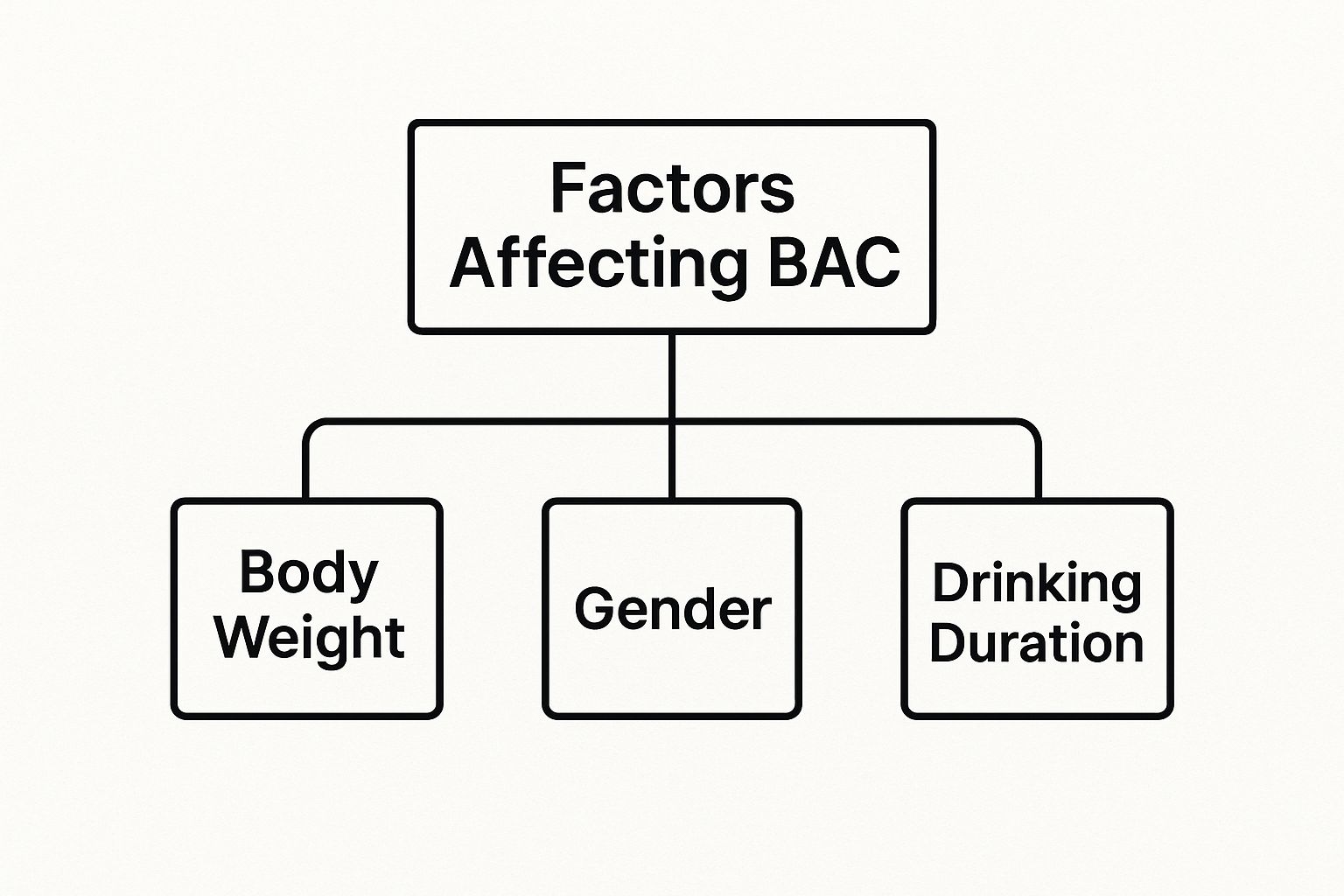
As you can see, things like body weight, gender, and how quickly you drink can dramatically change the final number.
Texas Zero Tolerance for Young Drivers
When it comes to drivers under the age of 21, Texas has an absolute zero-tolerance policy. This means if a minor gets pulled over and has any detectable amount of alcohol in their system, they can be charged with Driving Under the Influence (DUI).
This is a completely different standard from an adult DWI.
For drivers under 21, the legal limit isn’t 0.08% or 0.04%. It’s effectively 0.00%. Even a trace amount from mouthwash or a single sip of a beer could be enough to trigger a charge that brings its own set of serious penalties, including license suspension and a lasting criminal record.
A DUI charge can throw a young person’s future off track, creating roadblocks for everything from college applications to job opportunities. The law is designed to be tough, and fighting it requires a smart legal strategy that addresses the unique facts of the case.
Consequences of a DWI Conviction in Houston
A DWI charge in Harris County isn’t just another traffic ticket. It’s a life-altering event with consequences that get dramatically worse with each offense. The penalties are designed to be harsh, creating a legal minefield for anyone facing a second or third charge.
The stakes are incredibly high from the very start. Understanding the penalties that follow a conviction reveals just how serious this is, making experienced legal representation an absolute necessity from day one.
First DWI Offense Penalties
Even for a first-time offense, the penalties are built to make a lasting impact. A conviction is classified as a Class B Misdemeanor and carries a heavy burden that can disrupt your career, strain your finances, and complicate your daily life.
- Jail Time: You could face anywhere from 3 to 180 days in county jail.
- Fines: Financial penalties can climb as high as $2,000, and that doesn’t even include court costs and other administrative fees that pile on top.
- License Suspension: Expect a mandatory driver’s license suspension lasting from 90 days to one full year.
These immediate penalties are just the beginning. Our guide on the consequences and penalties of a DWI conviction provides a more detailed look into what you can expect.
Escalating Consequences for Repeat Offenses
If you have a prior DWI conviction on your record, the state of Texas raises the stakes dramatically. A second offense is elevated to a Class A Misdemeanor, which means the potential fines double to $4,000 and the possible jail time increases to a full year.
A third DWI offense is charged as a third-degree felony. This leap from misdemeanor to felony is a critical turning point, carrying the threat of 2 to 10 years in a state prison and a fine of up to $10,000.
Once you have a felony conviction, it creates a “mark” that follows you for life. This can impact your right to vote, own a firearm, and secure employment or housing for years to come.
When Penalties Get Even Worse
Certain circumstances, known as “enhancements,” can ratchet up the penalties for a DWI, even if it’s your first offense. These factors signal to the court that the incident was particularly dangerous.
Key enhancements include:
- High BAC: If your BAC is 0.15% or higher, a first-time DWI can be bumped from a Class B to a Class A Misdemeanor.
- Child Passenger: Driving while intoxicated with a child under 15 years old in the vehicle isn’t a misdemeanor at all—it’s a state jail felony, punishable by up to two years in a state jail facility.
For some folks, a DWI conviction can also be a catalyst for people to step back and re-evaluate their relationship with alcohol. For those looking to make positive life changes after a difficult legal battle, understanding the benefits of getting sober can offer a constructive path forward. The consequences are severe, and navigating them requires a robust and immediate defense.
Understanding Your Rights and Implied Consent
When you’re pulled over for a suspected DWI in Houston, you’re immediately faced with a choice that can change the entire direction of your case. This decision hinges on a legal concept called Implied Consent, and understanding what it means before you’re on the side of the road is critical. The choice you make in a few stressful seconds can have consequences that last for years.
The law itself sounds straightforward. By getting and using a Texas driver’s license, you’ve already given your consent to provide a breath or blood sample if you are lawfully arrested for driving while intoxicated. This isn’t something you agree to during the stop; it’s a condition you accepted when the state gave you the privilege to drive. But that doesn’t mean you have to consent!
The Two Roads: Test Refusal vs. Submission
When an officer asks you to take a chemical test, you’re at a fork in the road. One path is to refuse, the other is to submit. Neither option is perfect, and the “right” answer is rarely clear in the heat of the moment.
Refusing the test is your right, but it comes with an immediate, automatic penalty. A refusal triggers the potential for license suspension per the Administrative License Revocation (ALR) process. This isn’t a criminal punishment; it’s an administrative action that suspends your license for 180 days for a first-time refusal. This happens whether you are ever found guilty of the DWI or not, IF you don’t request a hearing within 15 days of your arrest. Requesting the hearing puts the suspension on hold pending the outcome of the ALR hearing.
On the other hand, if you submit to the test, you’re giving the prosecutor a powerful piece of evidence—your BAC number. If that number is over the legal limit, you’ve essentially handed them what they need to build their case and secure a conviction. If you have had any alcohol, it may be better to refuse to preserve your Constitutional rights and speak with an attorney as soon as you can.
This puts you in a tough spot. Refusing the test means a potential 180 day license suspension, right away. Submitting to the test could give the state the evidence they need to convict you, which also leads to a license suspension on top of criminal penalties.
Walking the Legal Tightrope of a DWI Stop
The moments after seeing flashing lights in your rearview mirror are confusing and packed with stress. You’re expected to navigate a legal minefield, knowing one wrong step could seriously impact your future. Police officers are trained to investigate, and every question they ask and test they administer is designed to build a case against you.
This is why protecting your rights from the very beginning is so important. Your decisions about field sobriety tests and chemical tests are pivotal. Our firm offers a detailed look at what implied consent laws mean for you that explains this complex situation further. A single decision can dramatically affect your future, which is why having an experienced legal advocate on your side isn’t a luxury—it’s a necessity.
How a Strong DWI Defense Can Be Built
Getting arrested for a DWI in Houston can feel like your world is crumbling. But it’s critical to remember one simple fact: an arrest is not a conviction. The state carries the entire burden of proving its case beyond a reasonable doubt, and the evidence they bring to the table is often far from perfect.
Building a strong defense starts with a deep dive into every single detail of your case—from the moment you saw flashing lights in your rearview mirror to the final blood or breath test result. The prosecution’s case might look solid on the surface, but it’s often built on a shaky foundation of procedures that must be followed to the letter. Any misstep by law enforcement can open the door to challenge their evidence and protect your rights.
Questioning the Initial Traffic Stop
The entire DWI case stands on one single event: the traffic stop. An officer can’t just pull you over on a hunch. They must have reasonable suspicion that you’ve actually violated a traffic law—anything from speeding and running a stop sign to swerving out of your lane.
If the officer can’t provide a legitimate, clear reason for pulling you over, any evidence they collected afterward—field sobriety tests, breath samples, blood draws—could be thrown out of court. This is often the first, and most powerful, line of defense.
A DWI charge can be dismissed entirely if the initial traffic stop was unlawful. The legality of the stop is the cornerstone upon which the entire prosecution case rests. If that foundation is weak, the case can crumble.
Scrutinizing Field Sobriety and BAC Tests
The tests used to measure impairment are another area ripe for a strong defense. Standardized Field Sobriety Tests (SFSTs) are notoriously subjective. An officer’s opinion can be swayed by anything from your medical conditions and fatigue to simple nervousness or even bad weather. An experienced attorney knows exactly how to expose these factors and cast doubt on the officer’s conclusions.
Likewise, the scientific evidence from breath and blood tests isn’t nearly as foolproof as the state wants you to believe.
- Breathalyzer Maintenance: These machines need constant calibration and meticulous maintenance to give accurate readings. If the police department’s records show a device wasn’t properly serviced, its results can be successfully challenged.
- Blood Test Protocols: A blood sample must follow a strict chain of custody. Any break in that documented trail—from improper storage at the hospital to potential contamination in the lab—can make the results unreliable and inadmissible in court.
These are just a couple of examples of how a defense is put together. For a closer look at effective approaches, you can explore some of the 10 common DWI defense strategies in Texas.
Ultimately, an arrest is just the beginning. The state’s case is rarely airtight, and a skilled Houston DWI lawyer can find the details that make all the difference.
Common Questions After a Texas DWI Arrest
Getting pulled over for a DWI in the Greater Houston area is confusing and stressful. Most people have a million questions running through their minds. Here are some straightforward answers to the questions we hear most often from people facing the Texas legal system for the first time.
Can I Be Charged With a DWI if My BAC Is Under 0.08%?
Yes, absolutely. This is a critical point that trips a lot of people up. While 0.08% is the per se legal limit—meaning you are automatically considered intoxicated by the law at that level—it’s not the only way to get a DWI.
Texas law has another definition of intoxication: not having the “normal use of mental or physical faculties” because of alcohol or drugs. If a police officer claims you were impaired and can point to evidence like a poor performance on field sobriety tests, you can be arrested and charged. It doesn’t matter what the chemical test says.
How Long Will My License Be Suspended for a First DWI?
If you’re convicted of a first-time DWI, a judge can order your driver’s license suspended for anywhere from 90 days to a full year.
But that’s not the whole story. Refusing a breath or blood test comes with its own potential penalty. Under Texas’s “Implied Consent” law, that refusal can trigger a 180-day administrative license suspension. This suspension happens on its own, completely separate from the criminal case, and it kicks in even if you are never found guilty of the DWI.
Is It Possible to Get an Occupational License After a Suspension?
Yes, in many cases, you can get what’s called an occupational driver’s license (ODL), or an “essential needs” license. This is a special, restricted license that lets you drive to and from necessary places like work, school, or your kid’s daycare while your main license is suspended.
An occupational license isn’t just handed to you. You have to formally petition the court, prove you have a real, essential need to drive, and often attend a hearing. It’s a complex legal process where having a lawyer to guide you is crucial for getting back on the road.
Without an ODL, you risk losing your job and facing serious personal setbacks. The process is time-sensitive, so it’s something you need to act on right away after an arrest.
Facing a DWI charge is a serious matter with complex rules and procedures. You do not have to navigate it alone.
Discover more from David Smith Law Firm, PLLC
Subscribe to get the latest posts sent to your email.