
Facing a Class A misdemeanor charge in Texas is a serious legal crisis. Many people hear the word “misdemeanor” and mistakenly think of a minor issue, like a simple traffic ticket. This is a dangerous assumption.
A Class A misdemeanor is not a slap on the wrist. It is the most severe non-felony criminal offense in the state. A conviction carries the threat of up to one year in county jail, a fine reaching $4,000, and a permanent criminal record that can profoundly damage your future. If you are facing this charge, the time to act is now.
Understanding the Stakes of a Class A Charge
Imagine the Texas criminal justice system as a ladder. At the very top are the most severe felonies. Just one step below them, you find Class A misdemeanors. This is a grave charge with consequences that can derail your entire life—impacting your job, your finances, and your fundamental freedom.
A conviction follows you long after any sentence is served. It appears on background checks, creating significant obstacles when you try to secure a job, rent an apartment in a good neighborhood, or obtain a professional license. This is not a problem that you can afford to ignore or hope will simply disappear. Taking immediate and decisive action with the guidance of a legal professional is critical.
The Official Penalties
The punishments for a Class A misdemeanor are defined by the Texas Penal Code, and they are severe. These are not just abstract possibilities; they are the real-world consequences a judge can impose.
Here is what you are facing:
- Jail Time: Up to a full one year in county jail.
- Fines: A financial penalty as high as $4,000, plus court costs and other fees.
- A Permanent Criminal Record: A conviction becomes a public record, creating a lasting barrier to future opportunities.
These potential outcomes make it undeniably clear why a Class A misdemeanor charge demands an urgent and aggressive defense from the very beginning.
To give you a quick reference, here’s a simple breakdown of the maximum statutory penalties you could be facing.
Class A Misdemeanor Penalties at a Glance
This table summarizes the maximum penalties for a Class A misdemeanor conviction in Texas.
| Penalty Type | Maximum Consequence |
|---|---|
| Incarceration | Up to 1 Year in County Jail |
| Financial Penalty | Up to a $4,000 Fine |
| Community Supervision | Initially Up to 2 Years of Probation |
Remember, these are the maximums. The primary objective of a skilled criminal defense attorney is to fight for a much better result, whether that is a complete dismissal of the charges, a reduction to a lesser offense, or a sentence that protects your freedom and future.
How Common Situations Become Serious Charges
It’s a mistake to think a Class A misdemeanor is a charge reserved for career criminals. The truth is, these serious charges often spring from everyday situations that just go wrong. A bad day, a heated argument, or one poor decision can spiral, leaving an ordinary person shocked to find themselves facing life-altering legal trouble.
Many people get caught up in difficult circumstances where a line is crossed, sometimes without even realizing the legal jeopardy they’re in until it’s far too late. Understanding how a seemingly minor event can escalate is the first step toward appreciating the gravity of the accusation you’re facing.
Real-World Examples of Class A Charges
To make this less abstract, let’s look at some common scenarios that happen daily across Houston and Harris County that can land you a Class A misdemeanor charge.
- A Second DWI Offense: Your first DWI is typically a Class B misdemeanor. But if you’re arrested a second time for DWI, the charge is automatically bumped up. It’s a perfect example of how past mistakes can dramatically raise the stakes.
- Assault Causing Bodily Injury: Things get heated. An argument turns into a shove. Even if the resulting injury is something minor like a bruise or a scratch, it can easily lead to a serious assault charge. The legal definition of “bodily injury” is much broader than most people think.
- Burglary of a Motor Vehicle (BMV): You don’t have to successfully steal anything. Just breaking into someone’s car with the intent to take something is enough to be charged with a Class A misdemeanor.
- Theft of Property or Services: If you’re accused of stealing property or services valued between $750 and $2,500, you’re squarely in Class A territory.
These examples show just how fast a situation can get out of control. A second drink before getting behind the wheel, a moment of anger, or an act of desperation can lead directly to an arrest, a night in jail, and a court date where your entire future is on the line.
The threshold for a Class A misdemeanor is lower than many realize. It’s crucial to understand that the prosecution’s view of an event, not just your intent, is what initiates the legal battle.
Every one of these charges carries the potential for up to a year in county jail and a $4,000 fine. Because the facts of every case are unique, fighting back requires a deep understanding of the law and a defense strategy built specifically for your situation.
The Hidden Consequences of a Conviction
When you hear about penalties for a Class A misdemeanor, the conversation usually stops at jail time and fines. But those are just the official punishments—the tip of the iceberg, really. The real damage often comes from the ripple effect a conviction sends through every corner of your life, long after you’ve paid the court.
These are the collateral consequences, the ones the judge might not lay out for you. And honestly, they can be just as devastating as the sentence itself.

Suddenly, you have a permanent mark on your public record. It becomes a massive roadblock, creating a future filled with unexpected hurdles that can threaten your financial stability, your career, and even your fundamental rights.
Beyond the Courtroom Walls
The fallout from a conviction doesn’t end when you walk out of the jail or courthouse. That criminal record follows you, creating a series of lifelong challenges that are incredibly difficult to shake.
Here’s a look at some of the most significant long-term effects you could be up against:
- Employment Barriers: Most employers run background checks. It’s just standard practice. A conviction for assault, theft, or a second DWI can instantly make you look like a risky hire, getting your application tossed in the “no” pile before you even get an interview.
- Housing Difficulties: Landlords and apartment complexes screen applicants, too. Seeing a criminal record can be all it takes for them to deny your rental application, which seriously limits where you can live.
- Loss of Professional Licenses: If you’re a nurse, teacher, real estate agent, or hold any other professional license, a conviction could trigger a review by your state licensing board. This can lead to suspension or, in some cases, having your license revoked entirely.
- Restrictions on Firearm Rights: Under federal law, some misdemeanor convictions, such as Assault Causing Bodily Injury-Family Violence, can lead to a lifetime ban on owning or possessing a firearm. Just like that, your Second Amendment rights can be gone for good.
A conviction isn’t just a one-time punishment. It’s a permanent stain that forces you to explain a past mistake over and over again. This recurring burden is why a proactive, aggressive defense from the very beginning is so critical.
This is exactly why getting a dismissal or an acquittal is the number one goal. While you might be able to explore cleaning up your record later on, you can see just how complex that process is if you learn about how to expunge criminal records.
Without a doubt, the best strategy is always to prevent the conviction from happening in the first place.
Your Case and the Texas Justice System
When you’re charged with a Class A misdemeanor, you aren’t just facing a single prosecutor. You’re up against the entire Texas justice system—a massive machine with immense pressure to secure convictions and keep cases moving.
Understanding this bigger picture is absolutely critical. Your individual case doesn’t exist in a vacuum; it’s part of a much larger enforcement strategy.
The state’s tough-on-crime approach to serious misdemeanors directly contributes to rising jail populations and puts a serious strain on local resources. This isn’t just some abstract trend; it has a real-world impact on how your case is handled from day one.
The Systemic Pressure to Prosecute
The simple fact is that Texas classifies a huge number of offenses as Class A misdemeanors, and that decision has noticeably burdened the state’s criminal justice system. Official projections show that Texas expects its incarceration numbers to jump by 10.2%, hitting over 151,000 inmates by 2027. This figure includes both misdemeanors and felonies, but Class A offenses are a major contributor to local jail populations.
What this systemic pressure means for you is that prosecutors are often more focused on conviction rates and clearing dockets than on the specific details of your situation. Your case becomes just another number in a system built for volume, which makes trying to navigate it alone incredibly risky.
You are not just a defendant; you are a statistic in a statewide enforcement initiative. This reality underscores the urgent need for a skilled legal professional to ensure your individual rights are fiercely protected.
As the legal world changes, knowing the essential guidelines on remote legal proceedings can also give you valuable context.
On top of that, certain charges like DWI have their own separate, parallel administrative processes that can suspend your driver’s license long before a criminal conviction ever happens. An experienced legal advocate knows how to challenge the state’s case from every possible angle—criminal and administrative.
What Happens After a Class A Misdemeanor Arrest
Getting arrested for a Class A misdemeanor in Texas kicks off a legal process that feels confusing, fast, and overwhelming. If you don’t know what’s coming, it’s easy to make a mistake.
Understanding the timeline is critical. The system moves quickly, and every single step—from the moment of arrest to the final court date—is an opportunity for a skilled defense attorney to challenge the prosecutor’s case and protect your rights.
The Initial Legal Proceedings
Right after an arrest, you’ll be taken to a local jail for booking. This is the administrative part: they’ll take your fingerprints, snap a mugshot, and officially log the alleged crime into the system. It’s the formal entry point into the court process.
From there, the clock starts ticking. By law, you must be brought before a magistrate for an arraignment hearing within 48 hours. This is your first time in front of a judge. They will read the official charges, explain your rights, and make crucial decisions about bail and your legal representation. This hearing sets the tone for everything that follows.
This diagram shows the basic flow from the initial arrest to a potential sentence.
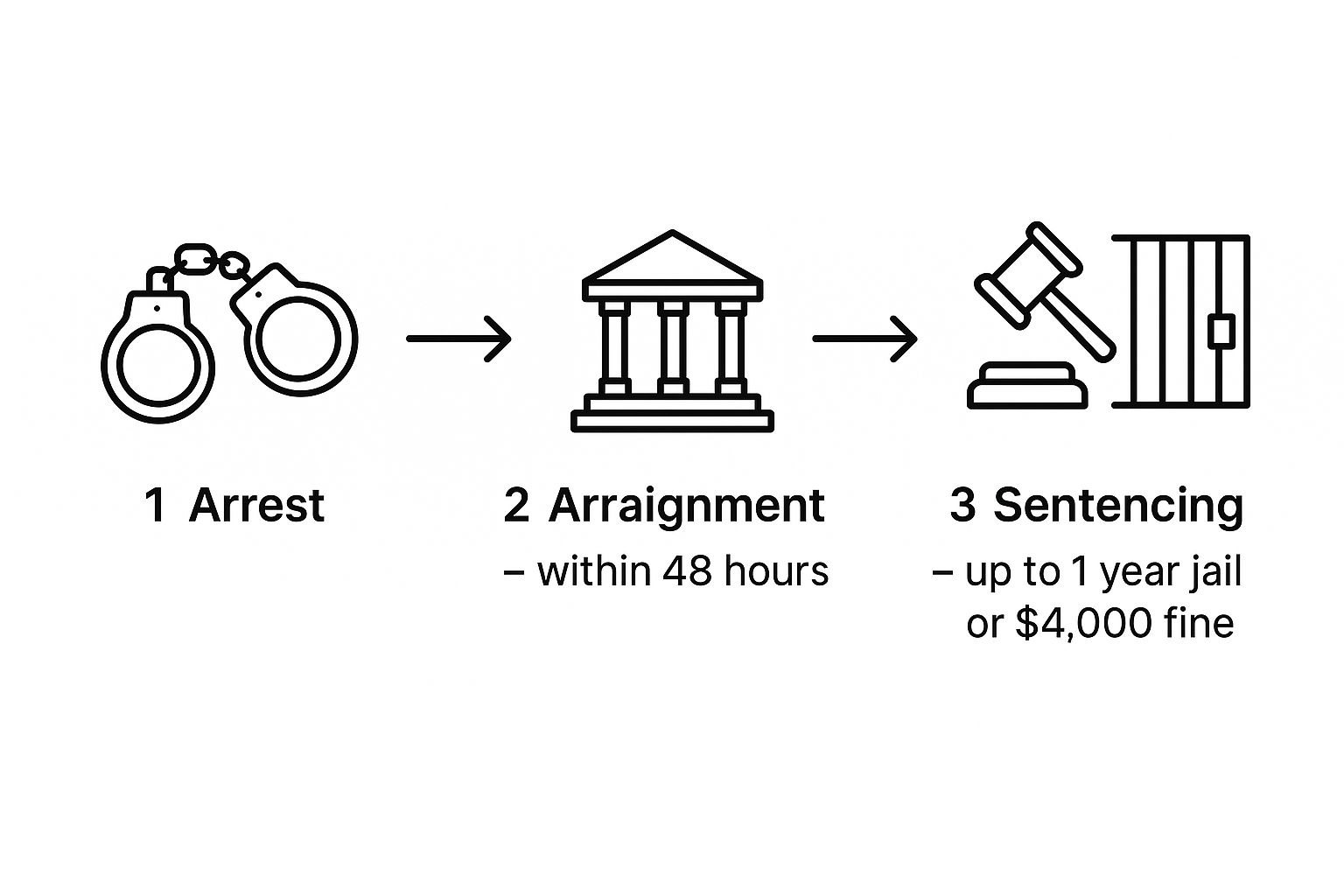
As you can see, the arraignment is the first major legal hurdle. It determines whether you’ll be released while the case moves forward. You can learn more about this critical first appearance in our detailed guide on what happens at an arraignment hearing.
From Pre-Trial to Potential Trial
After the arraignment, your case moves into the pre-trial phase. This is where the real legal work begins. Your defense attorney will be busy filing motions, demanding evidence from the prosecution (a process called “discovery”), and investigating every detail to find weaknesses in the state’s case.
This is also when negotiations often happen. A good lawyer might be able to negotiate with the prosecutor to get the charges reduced, dismissed entirely, or secure a favorable plea deal that keeps you out of the courtroom.
The pre-trial phase isn’t just a waiting period; it’s a battleground. This is where many cases are won or lost long before a jury is ever selected.
If you can’t reach a plea agreement, your case will be scheduled for trial. Here, the prosecutor has the heavy burden of proving your guilt beyond a reasonable doubt to a judge or jury. This is the ultimate showdown, and having a powerful advocate in your corner is absolutely essential.
Why an Experienced Attorney Isn’t a Luxury—It’s a Necessity
Trying to handle a Class A misdemeanor charge on your own is a huge gamble. The stakes are incredibly high. We’re talking about your freedom, your finances, and your reputation being on the line. With jail time and heavy fines on the table, going it alone is one of the most dangerous risks you can take.
The single most important decision you can make right now is to hire a skilled criminal defense attorney. This isn’t a luxury; it’s an absolute necessity. A good lawyer does so much more than just stand next to you in court—their job is to start taking the prosecutor’s case apart, piece by piece, from day one.
The Role of a Strategic Defender
A proactive attorney doesn’t wait around for the court date. They get to work immediately, taking control of the situation before the state builds an airtight case against you. Think of them as your investigator, your negotiator, and your advocate, all rolled into one.
Here’s what they actually do:
- Dig Into the Evidence: They’ll comb through every document—from the police report to witness statements—looking for mistakes, inconsistencies, or any violation of your rights.
- Find the Weak Spots: An experienced lawyer knows exactly where to look for weaknesses. Was the traffic stop that started it all even legal? Was the evidence handled properly? Does a key witness have a credibility problem?
- Negotiate from a Position of Strength: Armed with these weaknesses, your attorney can negotiate with the prosecutor to get the case dismissed entirely, have the charges reduced, or work out a deal that keeps your record as clean as possible.
- Build a Powerful Defense: If the case has to go to trial, they will build a defense strategy designed to tell your side of the story and protect your future.
Securing professional legal help is the single most effective step you can take to protect your freedom and your good name. It’s an investment in making sure one bad day doesn’t ruin the rest of your life.
Ultimately, knowing what to look for in a lawyer is key. You can find more detailed advice on the factors to consider when hiring a criminal defense attorney to make sure you find the right fit for your case. Don’t just wait and see what happens—take action now to protect yourself.
Questions People Often Ask About Class A Misdemeanors
When you’re trying to figure out what a Class A misdemeanor in Texas means for your life, it’s completely normal to have questions swirling in your head. Here are some straightforward answers to the things people worry about most when they’re facing these serious charges.
Can I Ever Get a Class A Misdemeanor Off My Record in Texas?
Yes, in some cases, you absolutely can. The legal system provides a couple of paths for this, depending on how your case turns out. You might be eligible for an expunction, which completely destroys the record of the arrest, or an order of non-disclosure, which seals it from the general public.
But it’s not automatic. Getting your record cleared hinges on specific factors, like whether your case was ultimately dismissed or if you successfully finished a deferred adjudication program. Figuring out if you qualify requires a lawyer to dig into the specific details of your case.
If I’m Convicted, Am I Definitely Going to Jail?
While the law allows for up to a year in county jail, it’s not a foregone conclusion. A judge has a lot of leeway and can decide on other penalties instead, such as probation (also called community supervision), hefty fines, or a mix of different consequences.
A strong defense strategy is always aimed at preventing a conviction entirely. But if that’s not possible, the goal immediately shifts to persuading the judge that alternatives to jail time are the right and fair way to resolve the case.
How Is a Class A Misdemeanor Different From a State Jail Felony?
The main difference comes down to severity and the long-term impact on your life. A Class A misdemeanor is the highest-level misdemeanor, with the maximum punishment being a year in a county jail.
A state jail felony is the next step up the ladder. It’s the least serious felony, but the penalties are much tougher, including 180 days to two years in a state jail facility—not a county jail. More importantly, a felony conviction comes with what are called “collateral consequences,” like permanently losing your right to own a gun, which a misdemeanor conviction typically does not.
Discover more from David Smith Law Firm, PLLC
Subscribe to get the latest posts sent to your email.