
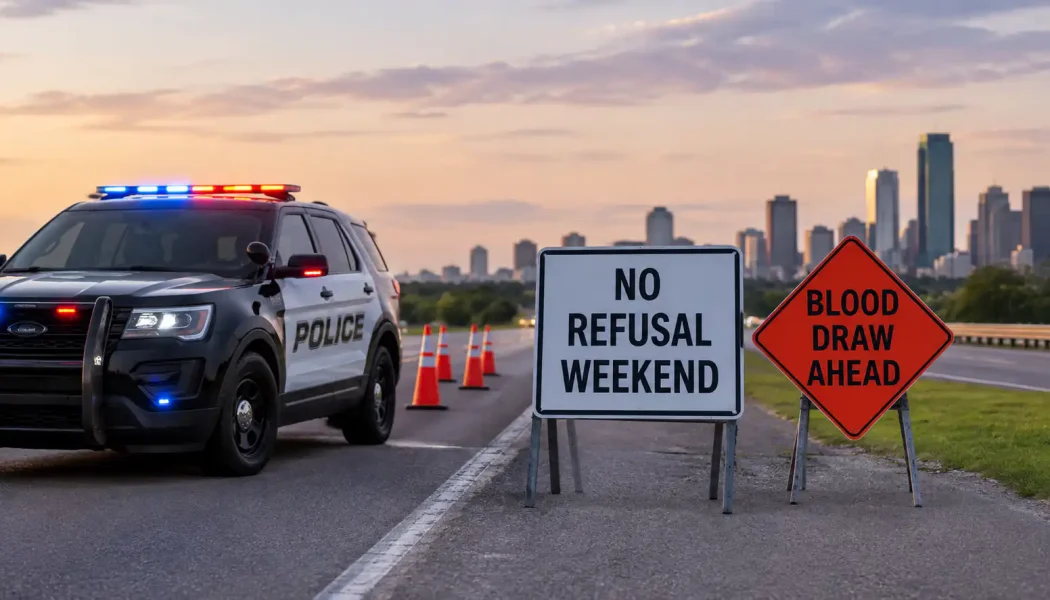
A “No Refusal Weekend” does not mean Texas drivers lose the right to refuse a voluntary breath or blood test.
Instead, it means law enforcement is prepared to move quickly if someone refuses. Officers may have prosecutors, judges, and qualified medical personnel available so they can seek and execute a blood-draw warrant without the delays that might happen during a normal shift.
The most important point is simple: you may still refuse the initial request, but refusal does not necessarily prevent police from obtaining a blood sample.
Key Takeaways
- A No Refusal Weekend does not eliminate a driver’s constitutional rights.
- You can still refuse an officer’s initial request for a voluntary breath or blood test.
- If you refuse, police may ask a judge for a warrant authorizing a blood draw.
- No Refusal programs are designed to make that warrant process faster.
- Once a valid warrant is issued, the blood draw may become compulsory.
- Refusing a chemical test can also trigger separate driver’s-license consequences.
- A warrant does not automatically make the blood evidence unquestionable. The warrant, collection process, and test results may still be challenged.
What Is a No Refusal Weekend in Texas?
A No Refusal Weekend is an enforcement strategy, not a special law that removes a driver’s rights.
Texas law does not create a separate legal status where constitutional protections disappear during holidays or high-visibility DWI enforcement periods. Instead, law-enforcement agencies coordinate additional resources so officers can respond more quickly when a driver refuses chemical testing. These operations are commonly used around holidays, festivals, and other periods associated with increased impaired driving.
The main difference is logistical.
During a typical DWI arrest, an officer may need time to prepare a warrant affidavit, locate an available judge, and arrange for a blood draw. During a No Refusal operation, those resources may already be on standby.
Can You Refuse a Breath or Blood Test During a No Refusal Weekend?
Yes. A driver can still refuse the officer’s initial request for a voluntary chemical test. Texas has an implied consent law, which generally means that people who drive on public roads are considered to have agreed to chemical testing under certain DWI arrest circumstances. However, that does not mean consent can never be withdrawn. If you refuse, the officer generally cannot simply decide to force a blood draw based only on that refusal. Instead, police may move to the next step: asking a judge for a search warrant. That is why the phrase “No Refusal” can be misleading. It does not mean you cannot refuse. It means police are prepared to seek another legal way to obtain the sample.
What Happens After You Refuse?
If a driver refuses chemical testing during a DWI investigation, the process may look like this:
- The officer documents the refusal.
- The officer prepares an affidavit explaining the facts supporting probable cause.
- The affidavit is submitted to a judge.
- The judge reviews the information.
- If the judge finds probable cause, a blood-draw warrant may be issued.
- The driver can then be taken for the blood draw.
During No Refusal operations, this process may move quickly because officers can use electronic warrant procedures and judges may already be available to review applications.
What Does a Judge Need to Issue a Blood-Draw Warrant?
Police generally need to show probable cause that the person was driving while intoxicated and that evidence of intoxication may be found in the person’s blood.
The facts supporting that request may include things described by the police such as:
- Driving behavior
- The odor of alcohol
- Slurred speech
- Bloodshot or watery eyes (not really a clue of intoxication!)
- Balance or coordination problems
- Statements made by the driver
- Field sobriety test observations
- Other facts surrounding the traffic stop
The key point is that the officer must present facts to a judge. The officer does not simply get to declare that a blood draw should happen.
Can Police Force a Blood Draw After Getting a Warrant?
Once a valid warrant is issued, the situation changes. Before the warrant, the officer is generally asking for voluntary cooperation. After the warrant is issued, the blood draw becomes a court-authorized search. Texas courts have recognized that officers may use reasonable physical restraint if a person actively resists a valid warranted blood draw. That does not mean police have unlimited authority to use force. The way the blood draw is carried out must still be reasonable. Physically resisting a valid warrant can also create additional legal problems, such as a potential charge of resisting a search, which is a class A misdemeanor. The better place to challenge whether the warrant was lawful is generally in court.
Do Police Always Need a Warrant for a Forced Blood Draw?
Not always, but a warrant is generally important when a driver does not consent. Police may sometimes rely on a recognized exception to the warrant requirement, such as genuine exigent circumstances. However, the fact that alcohol naturally leaves the bloodstream does not automatically create an exigent circumstance in every DWI case. The U.S. Supreme Court, in Missouri v. McNeely, rejected the idea that alcohol dissipation alone automatically allows police to perform a warrantless blood draw. Courts generally look at the specific facts of the situation.
Accidents, medical emergencies, and unconscious drivers can make the analysis more complicated, but No Refusal status by itself does not erase the warrant requirement.
What Happens to Your Driver’s License If You Refuse?
Refusing chemical testing can affect your driver’s license separately from the criminal DWI case. Texas uses an Administrative License Revocation process, commonly called ALR. A first refusal can result in a 180-day suspension. A driver with a prior qualifying alcohol-related enforcement contact may face a longer suspension.
There is also an important deadline.
A driver generally has 15 calendar days after receiving notice to request an ALR hearing and challenge the suspension. If that deadline is missed, the opportunity to contest the suspension is likely lost, and the suspension typically takes effect around 40 days after the arrest.
This means a DWI arrest can create two separate issues at the same time:
- The criminal DWI case
- The administrative driver’s-license case
The outcome of one does not necessarily determine the outcome of the other.
Does Refusing Prevent Police From Getting BAC Evidence?
No. This is one of the biggest misconceptions surrounding No Refusal operations.
A driver may refuse the voluntary test and still end up having blood collected if police obtain a warrant. That means a refusal can potentially lead to all of the following:
- The refusal being documented
- Driver’s-license consequences
- Police seeking a warrant
- A blood sample being collected anyway
Texas law also allows a refusal to be introduced as evidence in a criminal prosecution in certain circumstances. So refusing does not automatically mean there will be no BAC evidence.
Can a Blood-Draw Warrant or Blood Test Be Challenged?
Yes. A warrant does not automatically mean the evidence is beyond challenge. Possible issues may include:
- Whether the warrant was supported by probable cause
- Whether the warrant was legally issued
- Whether the blood draw was performed in a reasonable way
- Whether the sample was properly handled
- Whether the chain of custody was maintained
- Whether the laboratory testing was reliable
- Whether the result accurately reflects the person’s condition at the time of driving
Both the warrant itself and the resulting blood evidence may be challenged depending on the facts of the case.
The important point is simply this: a blood test is potentially evidence, not an automatic conviction.
Does a Blood Test Over 0.08 Automatically Mean a DWI Conviction?
No. A blood result at or above the legal limit can be significant evidence, but prosecutors still have to prove the DWI charge. Questions may still exist about how the blood was obtained, how it was tested, and whether the result accurately reflects the driver’s condition when they were actually operating the vehicle.
The timing of the draw can matter, because a blood sample measures alcohol concentration when the blood is collected, while the legal question in Texas is whether the person was intoxicated while driving, to support a DWI conviction.
Common Myths About No Refusal Weekends
Myth: “No Refusal means I legally cannot refuse.” Not exactly. You can still refuse the initial voluntary request. The practical difference is that police may quickly seek a warrant after the refusal.
Myth: “Police can automatically take my blood because it is No Refusal Weekend.” No. The No Refusal designation itself does not give police unlimited authority to draw blood without consent or a warrant.
Myth: “If I refuse, there will be no BAC evidence.” Not necessarily. Police may obtain a search warrant and collect blood anyway.
Myth: “If police have a warrant, the blood evidence cannot be challenged.” No. The warrant, the way the blood was collected, and the reliability of the testing may still be challenged.
Frequently Asked Questions
Can I refuse a blood test during a No Refusal Weekend?
Yes. You can refuse the initial voluntary request, but police may then ask a judge for a blood-draw warrant.
Can the police detain me while they get a blood warrant?
If you have been lawfully arrested for DWI, police may keep you in custody while pursuing the warrant.
Can a judge approve a blood warrant electronically?
Yes. Texas law allows warrant procedures to be handled through reliable electronic means, which can make the process faster during No Refusal operations.
Can police take blood after an accident?
Possibly. Police may rely on consent, a warrant, or certain exigent circumstances. The fact that an accident occurred does not automatically remove all warrant requirements.
Can blood be taken if I am unconscious?
Potentially. Cases involving unconscious drivers can involve different rules, especially when emergency medical treatment or other urgent circumstances make obtaining a warrant difficult.
Can the same blood sample be tested for drugs?
Potentially, depending on the warrant and the legal authority supporting the search. Texas courts have recognized that a valid intoxication-related warrant may also authorize forensic testing of the blood sample.
Can a lawyer challenge the blood results?
Yes. An attorney may examine both the legal basis for the warrant and the reliability of the resulting blood evidence.
What David Smith Law Firm Wants Drivers to Remember About No Refusal Weekends
The most important thing to understand is that “No Refusal” does not mean “no rights.” A Texas driver can still refuse an officer’s initial request for voluntary chemical testing. But refusal may not stop the process. Police may seek a blood-draw warrant, and No Refusal operations are specifically designed to make that process faster. Once a valid warrant is issued, the blood draw becomes compulsory.
Refusal can also create separate driver’s-license consequences, and the deadline to challenge an ALR suspension can arrive quickly. At the same time, a blood warrant or blood-test result does not automatically decide a DWI case. The legality of the warrant, the collection of the sample, and the reliability of the evidence may all still matter.
If you were arrested during a No Refusal operation in Houston or the surrounding area, contact David Smith Law Firm today for a free consultation. We can review how the stop, the warrant, and the blood draw were handled, protect your 15-day ALR deadline, and look for the weaknesses that can make a real difference in your case.
Discover more from David Smith Law Firm, PLLC
Subscribe to get the latest posts sent to your email.